Don’t Waste Your Starter

Last weekend we made pancakes for the granddaughters and we used some waste starter to flavor the batter. We made more batter than we needed, because that was what the recipe called for, so I saved the leftover in a mason jar in the refrigerator. I cooked that this morning, one week later…perfect pancakes, even better that they were last week when the batter was ‘fresh.’ Now it is a week later after having fermented in cold storage all week and the food was excellent.

Here is a perfectly good recipe, from Mother Earth News in 1985…

2 cups of sourdough sponge (prepared the night before from 1 cup of starter, 1 cup of flour, and 1 cup of tepid water as described above)
2 eggs
1 tablespoon of sugar (or 1 tablespoon of honey)
1/2 teaspoon of salt
1 teaspoon of baking soda
1-1/2 teaspoons of tepid water.

Separate the eggs, placing the yolks in one bowl and the whites in another. Beat the whites until they’re fluffy, then fold in the sugar or honey. Beat the yolks lightly and add the salt. Now stir the sourdough sponge into the egg yolks, then gently fold in the beaten egg whites. Finally, mix the baking soda with the water and blend this into the batter by hand.

Drop the batter by large spoonfuls onto a well-greased, preheated (medium-hot) griddle—or use a seasoned cast-iron frying pan. Cook the pancakes until they are golden brown on both sides, flipping them only once, when the tops are full of bubbles.

I, of course, did not prepare my sourdough sponge yesterday. Today as I was making my bread for the week, instead of throwing out my leftover starter I used it in this recipe. This morning i fed my starter, made pancake batter for next week and put it all in a quart mason jar in the refrigerator, and made my leaven for this weeks bread, all with the starter from last week.

I don’t know if I will make pancake batter every week, but it certainly makes me feel much more efficient if I can use some of the sourdough starter that I had been throwing out.

You can also make sourdough breads that are quick breads, like the Indian bread Naan.

Here are some other leftover starter recipes, collected by King Arthur Flour, which is where I go when I want genuine whole wheat ideas, too.

King Arthur Flour Discard Starter Recipes:

Well, it’s time to mix up this week’s pre-dough, so that tonight I can start the bulk fermentation process.

Posted in Health, Living | Tagged , | Leave a comment

Nobody Cares

You are too busy doing for others to think of yourself every day. This is why you eat no breakfast in the morning…too busy. This is why you eat your lunch on the go, though you may consider eating something ‘healthy’ like a salad at the fast food establishment on your way. Dinner will have to be almost prepared when you get ready to start making it, something out of the freezer, or maybe one of those ‘brown the meat’ and eat dinners. Either that or you will poll the kids and see if Taco Bell sounds like a winner for dinner. What choice do you have, really? There is just no time to do it for yourself these days…and if you look at the boxes all these foods have something nice to say for themselves…low fat, low calorie, vitamins added, no gluten, every single thing you buy in a box, bottle or bag at the grocery has a claim to a portion of your healthy daily diet.

Too bad something in all of that food is making you fat. Too bad something in all of that food is making you and your kids sick. The good news is that they are working on a pill for that.

I don’t happen to go in for conspiracy theories. I do however believe that everything tends to take the path of least resistance. I used to eat fast. I used to eat cheap. I got fat, and almost got sick. My Mom and Dad both got fat and sick. I narrowly avoided that fate, and I now know what is making us sick. Sugar.

The word is out. It’s in today’s Guardian over in the UK. “The Sugar Conspiracy” details how this industry has managed to keep the truth out of the spotlight until now.

Robert Lustig is a paediatric endocrinologist at the University of California who specialises in the treatment of childhood obesity. A 90-minute talk he gave in 2009, titled Sugar: The Bitter Truth, has now been viewed more than six million times on YouTube. In it, Lustig argues forcefully that fructose, a form of sugar ubiquitous in modern diets, is a “poison” culpable for America’s obesity epidemic.

A year or so before the video was posted, Lustig gave a similar talk to a conference of biochemists in Adelaide, Australia. Afterwards, a scientist in the audience approached him. Surely, the man said, you’ve read Yudkin. Lustig shook his head. John Yudkin, said the scientist, was a British professor of nutrition who had sounded the alarm on sugar back in 1972, in a book called Pure, White, and Deadly.

The truth about sugar has been known my entire life. It is not news to me that sugar and sweets are fattening. We all know that. We all have always known that. This is not news. The thing that IS news, however is that eating fat is NOT fattening. It has never been fattening, and no scientist anywhere ever has said that eating fat makes anybody fat. What they did say, for a time, is that eating fat might cause your arteries to clog up with fat, and that arteries clogged up with fat might lead to sudden coronary death. Eating fat does not make anybody fat. Eating low-fat, because when you take the fat out you are eating more sugar, means that you will get fat. Sugar leads to fat, low fat food leads to fat.

Way back when, the government recommended that we cut the amount of fat we eat, to improve our heart health. It was unproven whether or not eating low fat would help. The evidence is in, the medicine is worse than the disease, A LOT WORSE. When the government recommended this, the food industry started making foods that were low in fat, low in calories, and more processed than ever. This is why you, busy mom, busy dad, are unable to buy anything to eat, anywhere, that does not contain sugar.

The full size Asian Cashew Chicken Salad at Wendy’s is a ‘healthy’ choice. It contains 18 grams of sugar. The amount of sugar is in grams because you dont have any idea how much sugar that is. I will tell you, 18 grams of sugar is 4 and a half teaspoons of sugar. If you make a salad yourself at home, how often do you sprinkle 4 and a half teaspoons of sugar on it? I don’t do that either. The sugar will be in the salad dressing.

They add sugar to EVERYTHING that is processed at the store. There is added sugar in 8 out of 10 processed food items at the store. If you look on the box or bag it will show you how much is in there, and its in the most amazing things. If you go to Whole Foods and get the 365 Everyday Value Organic Chicken Broth Low Sodium, Fat Free, it contains cane sugar, as does the same kind of thing at Trader Joe’s. There is sugar in your breakfast sausage, your yogurt, your Hamburger Helper. Believe me when I say that if you don’t make it yourself, you will be eating pounds of sugar per month, and you wont even know it’s there. It won’t taste sweet.

So the solution to our dietary problem would be to start naming the devil. Sugar should take the place of fat as a dietary evil, because it is. However, this will not happen in my lifetime. It will not happen for two reasons, one is the Merchants of Doubt will keep the scientific community from ‘reaching a consensus.’ Consensus is the method that was used by the tobacco industry to keep from having to say their product was unhealthy and addictive for so long. The necessary fact that science is never settled was used against us, and is still being used against us.

The other factor working against sugar being regulated as an addictive and poisonous substance is that there are a lot of people making money by preaching the ‘conventional wisdom’ on diet. The voices on the fringes now, Nina Teicholz, Gary Taubes, Robert Lustig, are all swimming against the prevailing current. These brave voices are screaming out the current science, while the Nutrition Establishment are all trying to silence them. By silence I mean that very literally. Efforts to reduce the size of Teicholz’ current megaphone are disturbing:

In September last year she wrote an article for the BMJ (formerly the British Medical Journal), which makes the case for the inadequacy of the scientific advice that underpins the Dietary Guidelines. The response of the nutrition establishment was ferocious: 173 scientists – some of whom were on the advisory panel, and many of whose work had been critiqued in Teicholz’s book – signed a letter to the BMJ, demanding it retract the piece.

Publishing a rejoinder to an article is one thing; requesting its erasure is another, conventionally reserved for cases involving fraudulent data. As a consultant oncologist for the NHS, Santhanam Sundar, pointed out in a response to the letter on the BMJ website: “Scientific discussion helps to advance science. Calls for retraction, particularly from those in eminent positions, are unscientific and frankly disturbing.”

Of the 173 ‘scientists’ to sign this letter, many were actually students of scienctific professors at college. Some were just lay-person dieticians. Many had not read the article they were calling to be retracted. My guess is that all 173 of them had answered a social media call to ‘sign this petition.’ This is how the merchants of doubt operate, though. They don’t care about the science, or the effect on science on this kind of nefarious activity. They are protecting their employer, the sugar maker, the food maker.

Most dangerous to science though are the scientists protecting thier professional opinions. Many scientists have made a living preaching a certain thing, and in this case it would be the danger of saturated fat in the human diet. For these people to admit that the science is no longer on their side means that they have to start preaching another sermon, they will lose some of their audience, they will lose some esteem, they will suffer personally for being wrong. Never mind that to continue to preach in the face of reality means that you are giving up all professional credibility. Nobody now preaches that the earth is flat, for instance, though once a man was condemned for daring to suppose that the earth rotated about the sun. Reality wins. Always.

It’s not true to say that “Nobody Cares” like I do in the title. I care. What I mean by that is that you are too busy to pay attention like I do to all of these disputes, or science, or even to cook any of your own food. For you and your kids they are going to have to start cooking it without the sugar in it for you to get the benefit of the new knowledge about sugar. For you, the fighting by me, Teicholz, Lustig, Taubes, the author at the Guardian and a few other big voices are what will finally help you. You are not going to be any less busy or start caring more about this any time soon. I can shout until I am blue in the face that you should make your own food and quit buying processed food. You just dont have time to care. For you, the fight to make food healthy again is the fight that will make you healthy again. No pill will cure what ails you and your family. Only by keeping the sugar out will you quit gaining weight, quit getting diabetes, quit getting high blood pressure.

Keep up the struggle, comrades. We are winning the war, but some of the battles we are losing.

Posted in Health, Living | 2 Comments

Getting it Down

I am getting the hang of making bread. This weekend I made my fourth dough, tweaked some things, figured out some places in my workflow that still need some work.

To recap, last time I made bread it was from a frozen dough that I had mixed up the weekend before. The resulting bread was unpleasing. In the bag it had an ‘odor’ that I would call unpleasant. In the mouth the taste was very tangy, but it did taste good. The bread was very dense on the bottom and very holy on the top. The crust was not brown. I have to confess that I don’t exactly know what went wrong with that dough, because the fresh dough made at the same time produced pleasing and crusty bread. I have to think that I did not fold it right, thinking that I had already done those steps, when perhaps I had not.

At any rate, this week’s differences begin with the wheat that I used, it was hard white spring wheat that I got from Walmart. I ground it and sifted the bran out like all the other times. It produces a noticeably different flour.

When I fed my starter this time I did not get any unpleasant odors. I think that I am over the phase of starter creation that involves the lactobacillus phase. Lactobacillus is a bacteria that turns cabbage into sauerkraut. It is in milk kefir. It is all over my kitchen because I make these things. It was in my starter. Lactobacillus does not live in an acid environment though, so as soon as the starter gets acid enough it will kill it, and get rid of the smell. My starter is over that phase now, and to get there you just feed more flour and keep less starter from feeding to feeding. When I made my leaven there was not a hint of stink, just smelled like good bread yeast to me. The trick, it turns out, is to use less starter and more clean flour and water when you feed, and to feed more often than once a week if you are going to leave your starter out of the refrigerator.

When my bread dough had finished its bulk fermentation phase and was ready for cutting and shaping I still did not know what I was looking for in these steps. I floured my counter and poured out the dough. I cut it in half. I rolled it around and folded it up a few times. I was hoping that the dough would keep its shape a little bit, but it just relaxed into it’s former shape right away, I could not make a ball. I then watched a youtube video that showed me what I was really looking for, what I was trying to accomplish…a picture is worth a thousand words…

Peter Reinhart is a guru of real 100% home ground whole wheat sourdough bread. The thing I was missing was the idea that you are creating an airproof barrier, and that by pinching the seams you are sealing in the air. I managed to get a dough together with all of the proper flavors and ingredients. My product was edible, but it wasn’t in the end pretty, and it wasn’t easy to handle or to cut and eat, more on that later…

Here is another video of another technique to create this air tight seal…

This was a good video in that it shows how the properly bulk fermented loaf will want to form that air tight skin. I did not do it this way this week. Next loaves will be formed in this way. I will keep making round loaves until I get them figured out. After that I will move on to the long loaves of bread but for now I am perfecting this type. There is enough to learn without complicating it.

Here is my bread just formed and put into proofing baskets.

IMG_4613

Looks pretty relaxed, doesn’t she? Well, she is. A bread that is this relaxed in a proofing basket sticks to the basket. I was thinking that it was a function of it’s wetness, or not enough flour on the basket. Nope, it’s just not formed properly. Now I know.

After rising for a couple of hours, this is my dough, ready for baking…

IMG_4615

See the large bubbles just below the surface. That is something I had never seen before in my bread, and a good sign that my starter is now at full strength. The dust all over the dough is the bran that I sifted out of my home ground flour. It does not burn.

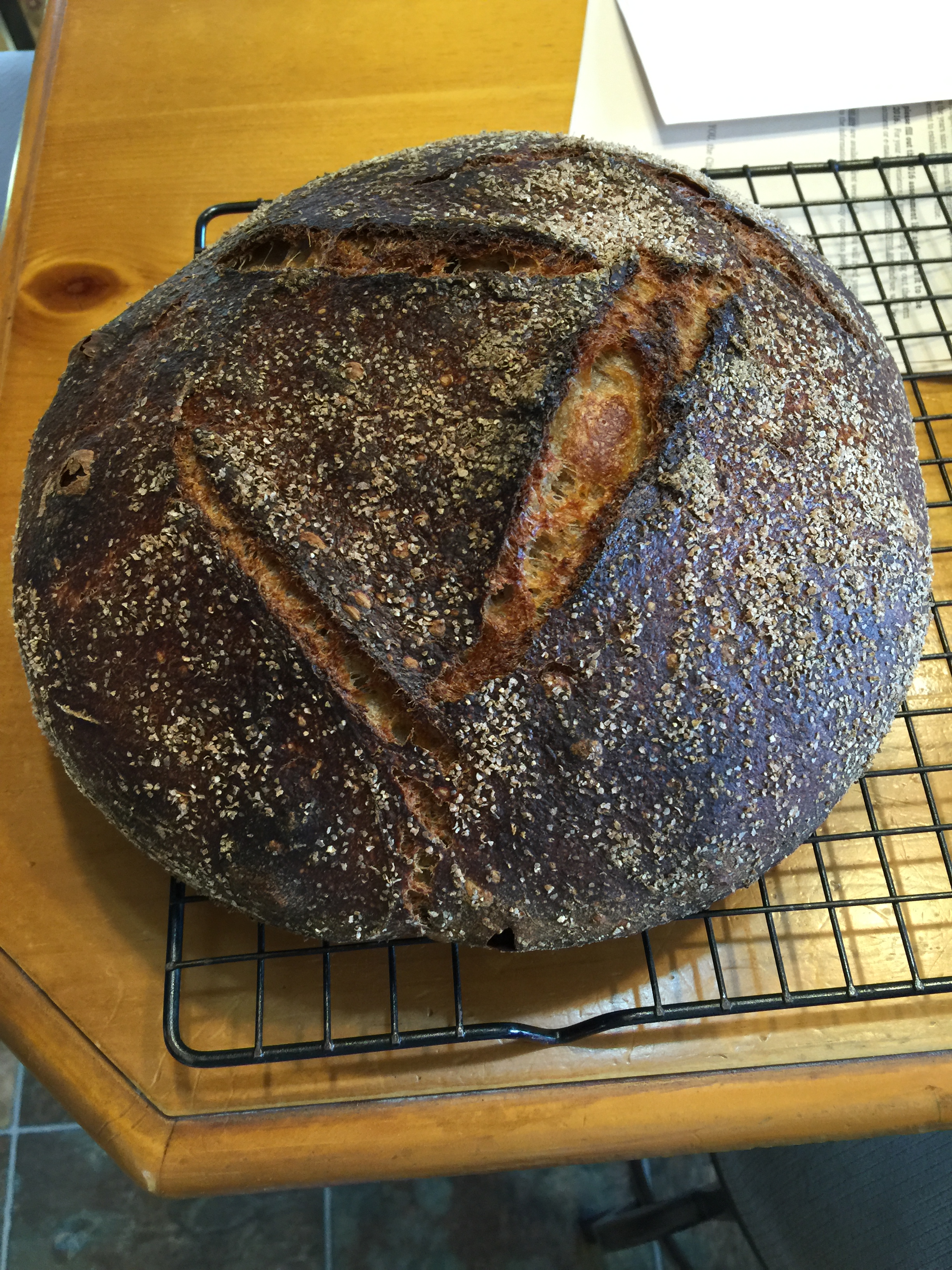
After baking, this is my bread…see the not-burned bran adhered to the top?

IMG_4616.JPG

Notice that there are no proofing basket marks on this bread. That is because it stuck to the basket and twisted 180 degrees on the way to my dutch oven. The marks are on the bottom! The second loaf twisted 90 degrees and the marks are on just one side of the top of the loaf. This is all because I did not form my wet dough properly.

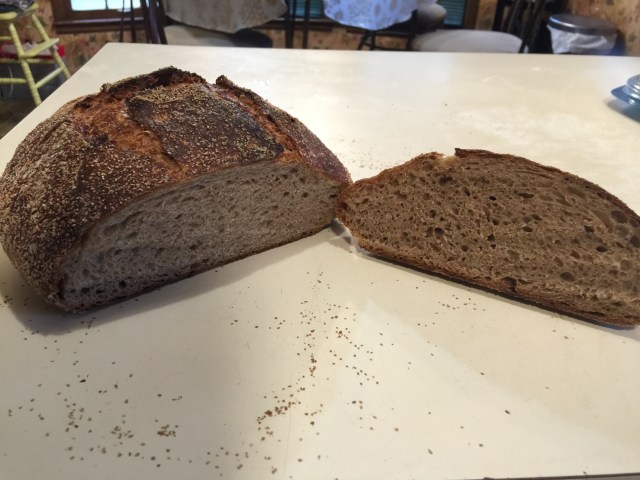
Here is the crumb of my latest creation, and the best one yet, despite my not quite completely understanding everything about baking a wet sourdough bread.

IMG_4618.JPG

The elongated shape of this bread makes it a bit hard to cut. I had to get my bench food slicer out and then I had to find a replacement fuse for it. I didn’t even know that it had a fuse, but cutting this bread actually blew my slicer fuse. It truly is hard to cut, even with a bread knife, especially when you get down to the cutting board, the bottom crust is rugged!

We have already eaten one whole loaf. It’s truly a good bread, either with butter or as the bread in a sandwich. I just don’t get my normal physical bread (carb overload) reactions when I eat this bread. I do get ‘bran’ reactions though, as this helps me cleanse the old pipes out.

This is, by far, the most ambitious do-it-yourself cooking project that  I have ever attempted, but as I learn more, I learn that its not as hard as I was lead to believe all these years. Once I found out that fermented bread is as different from processed bread as sauerkraut is to raw cabbage I knew I had to make the effort. So far I am not frustrated or disappointed. I will answer all questions, so feel free to ask in the comments or to make your own ‘ah ha’ moment comments if my story has reminded you of your story.

Happy Baking!

Posted in Health, Living | Tagged , | Leave a comment

Practically a Failure

Baked the two loafs of bread that came from the dough that I made last weekend. If you recall, I accidentally doubled the amount of salt in my recipe, hence I ended up doubling the recipe to catch up. After dividing the dough into four portions I froze two of them, baked two of them and called it a success.

Last weeks bread was tasty. This Friday I thawed the frozen dough for a day in the fridge, then on the counter until I could get home and work on it. When I got home I folded and shaped the dough into two globes, and put them into proofing baskets.

IMG_4570

I had never used baskets before but it certainly simplifies the experience. Previously I would let the dough rise in some very large crockery bowls that I own, they take up a great deal of room and are very good heat sinks. However, I didn’t have trouble rising the bread this way. These baskets went into  a spare bedroom with a space heater running. My thought was that if the bread were to rise in a decent amount of time that I needed the extra heat to help out.

Four hours later I went and the bread seemed to have risen, but I didn’t take a second picture to verify that, or even to look at my previous picture to see how much the bread had risen. I poked at the dough and it seemed to bounce back slowly. Now I know that it didn’t bounce back slowly enough.

I am still not certain what went wrong, but something went wrong. I but bran on the ‘bottom’ of the bread that I was looking at, dumped it out onto a bread peel and popped it into my 450 degree oven on a baking stone for 40 minutes. It did not brown like my last week’s effort. I did not get ‘ears’ on the loaf that indicate a good crust and crumb. When I cut the loaf it was damp, dense, and had gigantic bubbles at the top, near the crust. It had a very sour flavor, it tasted fine, but it could only be eaten if cut into very thin slices. It was edible but ugly.

So this bread came from the same dough batch that was a success last week. For the purposes of troubleshooting it means that this one was different in that it was one week in the freezer, then proofed in baskets for just four hours, whereas last week’s bread took about 8 hours to properly rise on the counter. I don’t know if more time would have helped, since I achieved a bread with gigantic air holes in it. That would indicate the gluten structure had not properly formed. Perhaps I should have folded the dough for the four hours, and then baked it after letting it rise overnight. That is probably what I did wrong. I think I baked this bread without a proper first rise period. Now that I think of it I separated this out and froze half before I folded the bread. That makes the most sense.

I think in future I will not try a bunch of new things on bread I intend to impress my friends with. That is probably a good policy for most things in life. Use the tried and true for company.

I did not take pictures of the finished loaves. The finished bread had pretty proofing basket rings on it. That was the best thing. It smelled good. Probably only I knew what it should look like inside, that it should have had uniform bubbles top to bottom, that it should be light and chewy. I did my best and nothing is a failure that you can learn from, but this felt like ‘not a victory’.

Posted in Health, Living | Leave a comment

Success, With Comments

After last week’s “trial loaf” that contained monoculture active dry yeast, though no sugar, and a modified recipe that was supposed to contain salt but did not, I have tried again and have it on reliable report that I have succeeded at making whole-wheat sourdough bread.

IMG_3771

This is loaf one of four that will be emerging from this batch of dough. Why four, you might well ask. Funny story.

The day before the day before bread-making day I fed my sourdough starter. This involves taking one or two tablespoons of the existing starter, adding to it 40 grams of whole wheat flour and 40 ml of water, discarding the rest of the old starter. The next morning I had an obviously live and vibrant starter culture to work with, it was bubbly and occupied very much more volume than when newly mixed. This was a far different result than one week earlier…

The day before bread making day I took one tablespoon of this starter and mixed that into 100 grams of wheat flour and 100 grams of warm water. The idea here is to be able to inoculate the dough with a large sample of very vigorous starter culture. I say culture because unlike adding active yeast, my yeast will be living in a symbiotic balance with a bacteria, much like what happens in my Kombucha tea. Each lives in it’s environment, with the yeast waste feeding the bacteria, prolonging the healthy environment for the yeast to live in. It does not suffocate on it’s own waste, so to speak. This is the same reaction that makes apple juice into cider. Yeast eats sugar, bacteria eats alcohol, making acid. Acid eventually builds up halting the entire process, but you are then left with a very different product than the ingredients, which were juice and time.

Also the night before I intended to bake I mixed together the rest of the flour and water that I would be using. This promotes the starches in the wheat to convert to sugars, much like you would do if you were making beer. Making beer is another fermentation process that cannot occur without fermentation. I am beginning to see how all of these techniques are intimately related.

The morning I made the bread I was very worried about the salt adding step. When making bread there are moments of furious activity embedded in hours of waiting for germs to eat. Adding the salt to the dough is right in the middle of a whirlwind of things to do. My story is that last time I missed the step because of that. This time, I read the recipe:

“Add about half of the leaven to the bowl with the wet dough; reserve the rest of the leaven as your starter going forward. (If you use commercial yeast, put aside half the leaven before adding it.) Mix the dough thoroughly and let rest for at least 20 and up to 45 minutes.
Meanwhile, in a cup, mix the salt in the remaining 50 grams of the warm tap water. After the dough mixture has rested, add the salty water and work it in thoroughly by hand.”

Excerpt From: Michael Pollan. “Cooked.” iBooks. https://itun.es/us/M1StG.l

A page earlier it explains what “the salt” means in the above excerpt…

“25 grams kosher or fine sea salt”

Excerpt From: Michael Pollan. “Cooked.” iBooks. https://itun.es/us/M1StG.l

Guess what I did instead of dissolving 25 grams of salt in 50 grams of water? I weighed out 50 grams of each water and salt. 50 grams of salt will not dissolve in 50 grams of water. You are left with undissolved salt in a slurry. I added it to my dough anyway, thinking it must be intended to dissolve in the water in the dough. As soon as I had mixed it in I thought maybe I should have went back to the book. A nagging suspicion came over me that if it were going to be a slurry of damp salt that my book would have mentioned that tiny detail.

I tasted the dough. Nasty! I wondered if I were to wait for the salt to finish dissolving in the dough would the saltiness even out. No! I thought to myself, that’s nuts. That kind of detail would be important and not left out of every single account of breadmaking I had ever read. I went back to the recipe and looked, but by this time I couldn’t remember how much I had weighed in, was it 25 like the book, was it 50 like the water? Dang! I put 25 grams of salt in my measuring cup and I was CERTAIN then that it was way less salt than I had put in before. I added 50 grams of water to be sure, and, of course it all dissolved right away. CRAP!

So, I then decided that I needed to double the dough recipe, hoping that I could even out the salinity. The only problem now was the fact that I had added enough leaven for one batch, not two. The ‘waiting for the yeast to eat’ step might take longer.

I finished cooking one of four loaves of bread last night at 1230 AM. I started making bread at 8AM, so about 16 hours end to end. You can’t rush it, but adding half the leaven more than tripled the time that this bread should have take to rise. Oh well, now I know that my bread recipe takes 25 grams of salt and 50 of water, and those values are committed to memory. Soldier on!


Posted in Health, Living | Tagged , | Leave a comment

ADHD and Diet

Reading the papers this morning I come across an article in the New York Times, Is It Really A.D.H.D. or Just Immaturity?” The article describes research in Taiwan that tries to distinguish between the incidence of ADHD suffered by children who enter school having barely made the age cutoff and those that enter school having just missed it the year before. The hypothesis of the study was that kids that are a year older are less likely to be diagnosed.

I am always looking for places to confirm my own biases, and I tend to think that the Western Diet leads to whatever ails us. I read on with interest. According to the NIH (US National Institutes of Health) ADHD is:

Attention-deficit/hyperactivity disorder (ADHD) is a brain disorder marked by an ongoing pattern of inattention and/or hyperactivity-impulsivity that interferes with functioning or development.

The thinking by Taiwanese researchers may have been that ADHD is something that children might grow out of. When I was a child there was no such thing as ADHD. There were fidgety kids in just about every class, but none of them ever just jumped up out of their seats and ran about disrupting things. I went to elementary school for seven years and never even heard of such a thing, this was in the 1960s.

Researchers in Taiwan looked at data from 378,881 children ages 4 to 17 and found that students born in August, the cut-off month for school entry in that country, were more likely to be given diagnoses of A.D.H.D. than students born in September. The children born in September would have missed the previous year’s cut-off date for school entry, and thus had nearly a full extra year to mature before entering school. The findings were published Thursday in The Journal of Pediatrics.

The difference was ever so slight. I re-state that NOBODY that I know of had ADHD when I was a grade-schooler. It leads me to confirm one of my biases, and that is that until a pill is developed there is sometimes no need for the disease. Never mind that the pill doesn’t cure the illness. Never mind that the pill leads to serious permanent side-effects that themselves lead to other pills. The Taiwanese in the conclusion of the study call for considering that the child may not have ADHD requiring a lifetime of medications to make them ‘normal,’ but that they may in fact be normal already and acting like the ‘little kid in class.’

In my opinion the upswing in ADHD diagnosis in the US is due to a couple of related factors, one of them that I have already alluded to, that there is now a pill to prescribe for it, but that there is an upswing in diagnosis in the US that is undeniable:

ADHD diagnoses skyrocket among U.S. kids

About 12 percent of children and teens in the United States had an ADHD (Attention Deficit/Hyperactivity Disorder) diagnosis in 2011, a number that’s shot up by 43 percent since 2003, according to a large national study based on parental reports of an ADHD diagnosis.

Several other childhood diagnoses have had pretty much the same trajectory since then: childhood obesity, childhood onset of type 2 diabetes, childhood incidence of NASH (nonalcoholic steatohepatitis or Fatty Liver Disease–a kind of cirrhosis), autism. Makes me think that kids that can’t sit still may be high on something. What could it be, hmmm, SUGAR maybe? What are the chances that we are giving our kids high doses of mind altering drugs to compensate for our giving them high quantities of another mind altering drug, sugar?

There is sugar in your child’s breakfast cereal, chocolate milk, fruit juice, yogurt, pancakes or waffles, oatmeal–and those are just the breakfast foods. When I was young you had to ADD sugar to your cereal in the morning. Add any more than a teaspoon of sugar to your Wheaties or Cheerios and Mom would start scolding. Now these cereals come with the sugar baked right in. Cheerios Honey Nut Medley Crunch: In 3/4 cup of this cereal there is 9 grams of sugar, or two teaspoons. Serve not even a cup of Sunny Delight orange juice and there is another 3 teaspoons of sugar (6.5 ounce serving). Add some yogurt and its another 2 teaspoons of sugar in a tube of GoGurt yogurt-candy. That is a total of seven teaspoons of sugar administered to the mind of a 60 pound boy or girl. Now ask them to sit still in the school bus or their school bench until their next dose at school lunch.

The idea that diet is a causal factor for every ailment that I have attributed to sugar in this blog and even in this article is not new. Throwing ADHD onto the pile of maladies that are suspected to come from eating fructose (50% of whats in table sugar) is not even a new hypothesis:

ADHD Is Associated With a “Western” Dietary Pattern in Adolescents

Objective: To examine the relationship between dietary patterns and ADHD in a population-based cohort of adolescents. Method: The Raine Study is a prospective study following 2,868 live births. At the 14-year follow-up, the authors collected detailed adolescent dietary data, allowing for the determination of major dietary patterns using factor analysis. ADHD diagnoses were recorded according to International Classification of Deiseases, 9th Revision coding conventions. Logistic regression was used to assess the relationship between scores for major dietary pattern and ADHD diagnoses. Results: Data were available for 1,799 adolescents, and a total of 115 adolescents had an ADHD diagnosis. Two major dietary patterns were identified: “Western” and “Healthy.” A higher score for the Western dietary pattern was associated with ADHD diagnosis (odds ratio = 2.21, 95% confidence interval = 1.18, 4.13) after adjusting for known confounding factors from pregnancy to 14 years. ADHD diagnosis was not associated with the “Healthy” dietary pattern. Conclusion: A Western-style diet may be associated with ADHD.

What is “Western”? Sugar in every bite, all of the food eaten is dead and hyper-processed, and there are 10,000 artificial ingredients. “Healthy” may mean nothing more than home-cooked or lots of single ingredient foods. One may get into how the researchers broke down what is healthy or not. They may even single out ‘fats’ as a dietary food of concern, like lots of other researchers do, but the conclusion is definitely that eating like kids do in the morning in the US gives them a greater than two to one chance of being diagnosed with ADHD, and it is getting worse.

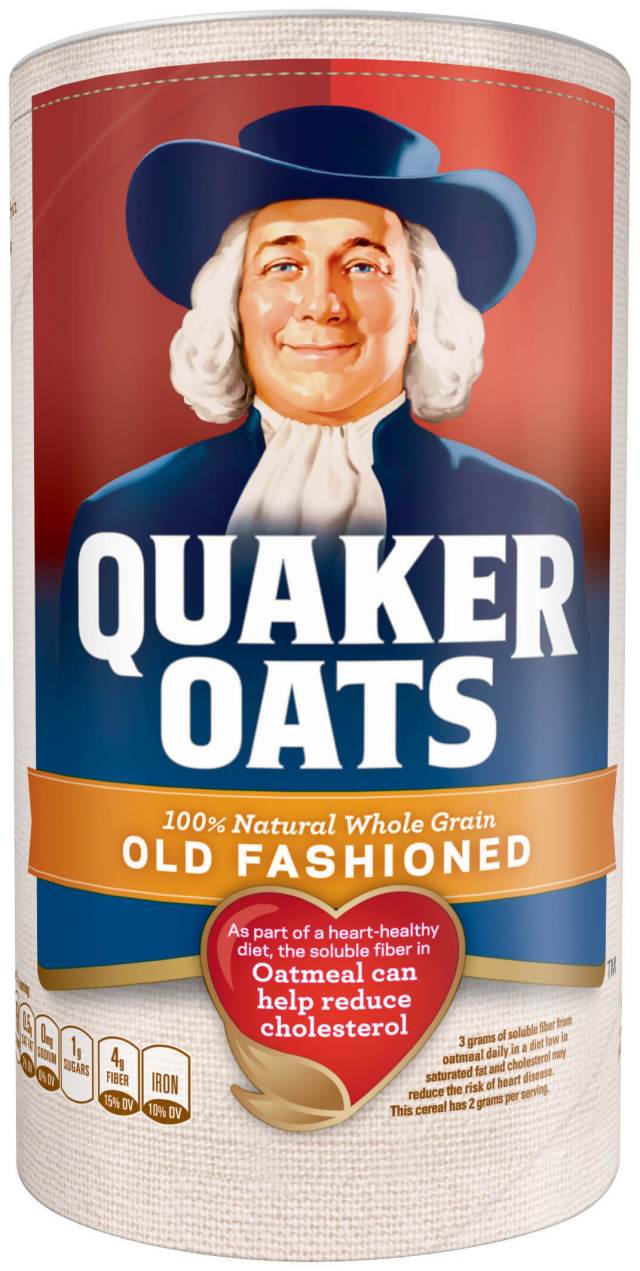
SOMEBODY SHOULD DO SOMETHING! You scream at your monitor. True, and it is you. In the US the government follows what the corporations are already doing. There will be limits on the amount of fructose added to children’s foods when we have all already quit eating them, so the corporations have already quit making them. The ball is in your court America. Quit feeding the kids processed foods. Make oatmeal the old fashioned way. Give the kids fruit not juice. Eat meat again, it’s health food. Ferment your own pickles, just takes three days, but only a few minutes to start. Make it yourself, make it real, or plan on giving your kids facial tics from a life on Ritalin or feeling guilty because they can’t set still and you refuse to medicate them. Medicate them to counteract the medicine that is in their breakfast cereal or feed them healthy food–bacon and eggs, home cooked oatmeal from the cardboard tube with the quaker on the label.

sqo_canisteree2e55418cb46e438643ff2300547e50.jpg

Posted in Health, Living | Tagged , , | Leave a comment

Here is the Headline…

The Longer You Work, the Greater Your Risk for Heart Disease

According to the underlying article, which is based on this study, “Working 75 hours or more doubled the risk for a cardiovascular problem — angina, coronary heart disease, hypertension, stroke or heart attack.”

Let’s imagine what the factor involved in working 75 hours per week might increase heart disease, high blood pressure, strokes or heart attack. In my estimation it would not be “working” that causes heart disease or high blood pressure. Perhaps the person that works that many hours per week also must rely on dining out, junk food, and eating on the run for most of their weekly meals. Just guessing but working 75 hours per week would not leave much time for home cooked eating.

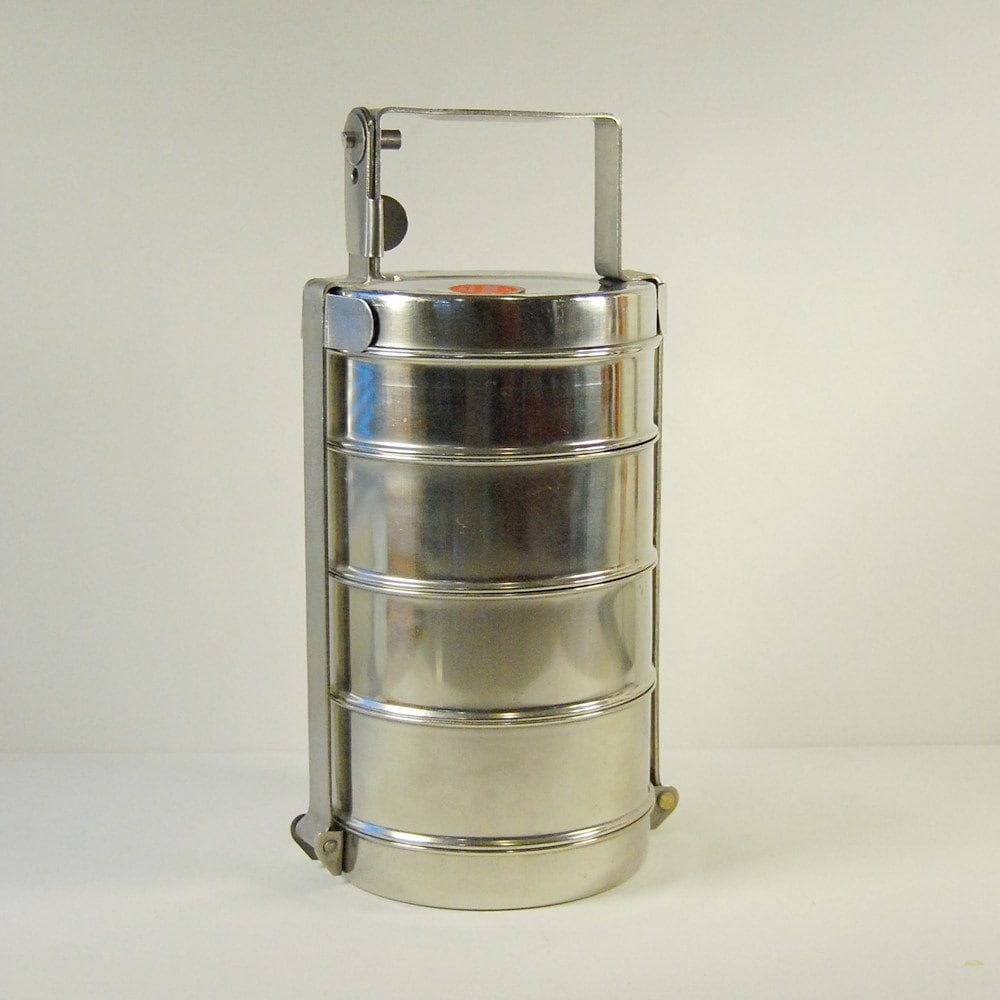
Unless you are in India. In India they have devised a system whereby women use their home kitchens to cook fresh natural lunch meals for customers located in occupations in the city. These Tiffin lunch containers are packed into thermal bags and a bicyclist collects them from the cooks, and when he has a bike-full he rolls them to the destination, collects the payments and delivers that back to the kitchens. I wonder if this same study would find the same issues with long working hours in Mumbai? Well, I don’t know but it would be worth checking into.

Posted in Health, Living | Tagged , , | Leave a comment

Nope

My starter culture of wild yeast and bacteria are not strong enough yet to make bread without Reinforcement. I had to add 2 teaspoon of active dry yeast to my leaven this morning, because my leaven tablespoon would not float–wasn’t even close.

My starter was not properly raised, I missed the detail where you don’t start it with All Purpose flour, and the detail where you throw half away each day. Those details are important details. Apparently when I add four ounces of flour to the 20 ounces that went before, it it’s not enough food to make a good strong culture, the acids are too dilute, the resulting mixture is not an ideal environment to create the symbiotic culture that I am trying to develop. My starter will not create a leaven in an overnight stay on the counter. I also missed picking up on the detail to not use a metal vessel for this step. Although I don’t think that Stainless Steel is reactive, it is a potential misstep to try and raise an acidic starter leaven in a metal bowl.

I will back my starter off now to a couple of ounces of starter and add four ounces of whole wheat flour and water. This will give me a 30% starter to food ratio. This will give me a strong start on my next loaf of bread.

So, all that being said, my existing loaves of bread still have no added sugars to them and they are rising briskly. I will be kneading and baking by the evening.

So I did end up baking my bread. The yeast I added was plenty vigorous enough to handle the work. I made two loaves of bread and only really made one mistake. I forgot to add in any salt. The recipe I was following had me add in the salt after first adding the leaven to the dough and waiting 45 minutes. When I figured out that I had forgot, my bread had already risen one time. I maybe could have added it in at that late moment, but I just decided that if my bread was rising fine, and it was, that I would just go ahead and forego salt. Salt is optional in fermented bread.

Here is my bread…


Both loaves are from the same exact dough. The disk is the first one to bake, the one with the black ears went in 45 minutes later. The only difference is in the way I handled them right before they went in the oven and the crusty one went in almost an hour later. I have not yet cut into the second one. Neither one has salt.

More later…

Posted in Health, Living | Tagged , | Leave a comment

Tonight I Begin

IMG_4547

Tonight I will start the process of making fermented bread tomorrow. My starter is growing on top of my refrigerator. I have five pounds of self-ground wheat to work with. I have a plan.

Tonight I will create my leavening.

“MAKE THE LEAVEN
The night before baking the bread, make a leaven. In a glass bowl, combine the whole-wheat and all-purpose flours with the water. Add 2 tablespoons of the starter and mix thoroughly. Cover with a towel and leave out overnight in a draft-free spot.”

Excerpt From: Michael Pollan. “Cooked.” iBooks. https://itun.es/us/M1StG.l

The idea here is to test the strength of the starter and at the same time create a very vigorous colony of wild yeast and bacteria, which will do the double duty of leavening my fermented bread. See, yeast alone can only eat sugars. But, bacteria and yeast in concert can eat starch, gluten and the sugars created by converting starches. The final product in the oven will be almost exhausted of these things, and they will have been converted into materials that are easier to digest. It is exactly like the idea behind fermenting cabbage or vegetables. Fermenting makes foods into super-foods. I want some bread super food.

There is another job for tonight, to pre-soak my flour.

“MAKE THE BREAD
The night before baking the bread, “soak” the whole-grain, all-purpose, and rye flours: In a large bowl, combine the whole-grain, all-purpose, and rye flours with 850 grams of the water, mixing with a spatula or by hand until there are no lumps or patches of dry flour remaining. (A recommended extra step: In the case of the whole-grain flour and the rye flour, pass them through a flour sifter to remove the larger bits of bran; reserve the larger bits in a small bowl for use later.) Cover the bowl with plastic wrap and leave out overnight in a draft-free spot. The reason for this step is to thoroughly moisten the whole-grain flours before the fermentation begins; this softens the bran (making for a more voluminous loaf) and begins the breakdown of the starches into sugars (deepening flavors and color).”

Excerpt From: Michael Pollan. “Cooked.” iBooks. https://itun.es/us/M1StG.l

The logic behind this step is to actually begin the process of sprouting the grains. Even though they are busted into a zillion pieces the chemical machinery is there. When soaked seeds sprout and the very first thing they do is activate the process that converts their starches into sugars for the new plant to live off of until a shoot breaks out into the sunlight, where the plant can make it’s own sugar. Doing this eight hours before I add yeast then gives my yeast something to dine on immediately as well. This works so well that you have to add salt to the mixture just to keep it from happening TOO fast. If it happens too fast then there is not enough gluten structures to trap the gas bubbles in the bread, it gets away, and then the loaf is heavy and dense. As Pollan notes in his aside, sifting the wheat will keep larger bits of wheat bran from cutting up the gluten as you knead and bake. I will sift before I wet. My first loaf will have the best possible chance.

This process works so well at eliminating starch and sugar in the bread that a known problem with sourdough bread is gray loaves after baking. There just are not enough proteins and sugars left in the product to undergo caramelization or the Maillard Effect during hi temperature baking. This is a symptom of bread that we can eat. Not enough sugar or starch to brown means not enough to cause a large insulin reaction to the bread. I simply cannot wait to test this out in my own body.

I am depriving myself of all carbs from yesterday until Saturday evening when I eat this bread. By doing so I will know by my body’s reaction to it whether or not there are sufficient carbs left in my fermented bread to make me gain weight. I am hoping that by eating bread with a meal that includes insoluble dietary fiber (green leafy veggies, for instance) that there will be no noticeable insulin effect.

Tune in Sunday!

Posted in Health, Living | Tagged , , | Leave a comment

A Journey of 1000 Miles Begins with…

…A Starter. I guess that should more correctly be, “A journey of 1000 loaves begins with a starter.” Three days ago I wetted flour, just regular King Arthur all purpose flour with an equal amount of water to begin my bread making and bread eating journey.

Each day since that beginning I have added more flour and water to the mixture, stirring it all in, checking for signs of life. I already detect bubbles, I wisely began my journey in a two gallon glass vessel, so that I can see beneath the surface of  my starter.

IMG_4548

Of course I will never fill this jar with starter, but I am glad I started it here. Sometimes when I am doing a new thing I wonder constantly if I am getting the desired results. Seeing my starter developing bubbles alleviates a tiny bit of that. By tiny I mean I am still probably overly concerned about all of the steps to come. I am amassing all of the information that I can find on the topic, which is surprisingly hard to come by.

To start with I would at least like to see a recipe for bread that does not call for sweets or yeast to be added. My ideal recipe will just have stone ground flour, which means that the germ was never milled separately from the rest of the flour. I have found this in the Air chapter of Pollan’s book “Cooked.” He also name drops the bakers and food writers that he got his recipe from. Searching the internet for ideas on how to make whole wheat bread that has no all purpose flour, added yeast or sugars in it is very hard, though. There is a good website devoted to the topic, a page on facebook, a few leads that I have managed to discover…

King Arthur flour is a good source on the internet, plus they sell wheat.

Mel’s Kitchen Cafe is a good site, but there is sugar, flour and yeast over there.

Peter Reinhart is an authority, and here is a link to his book on the topic.

Of Course, Michael Pollan’s book is where I am getting both inspiration and leads.

I now have everything I need to get going, except my starter. You cannot begin without it, and you cannot rush it in any way. There is no shortcut around starting the right way. Baking natural fermented bread requires the patience of a farmer. Essentially I am right now farming wild yeast. It cannot be tamed or fertilized into my time table but operates at its own speed for its own reasons. I must wait. As soon as this colony is established I will never have to take this step again. My journey will have begun and every additional step will be easier if I take the right first step.

Where I am headed…

“But here is the most curious fact: People whose diets contain adequate amounts of all these good nutrients from sources other than whole grains (from supplements, say, or other foods) aren’t nearly as healthy as people who simply eat lots of whole grains. According to a 2003 study by David Jacobs and Lyn Steffen,* epidemiologists at the University of Minnesota, the health benefits of whole grains cannot be completely explained in terms of the nutrients we know those grains contain: the dietary fiber, vitamin E, folic acid, phytic acid, iron, zinc, manganese, and magnesium. Either there are synergies at work among these nutrients, or there is some X-factor in whole grains that scientists have yet to identify. We are talking, after all, about a seed: a package that contains everything needed to create a new life. Such a recipe still exceeds science’s powers of comprehension and technology’s powers of creation.”

Excerpt From: Michael Pollan. “Cooked.” iBooks. https://itun.es/us/M1StG.l

You cannot beat natural, and even though fermented foods aren’t literally ‘natural’ they are unquestionably still firmly on the side of being within nature’s plan. When foods rot they do not go away, they become more valuable to the future. Our own future includes rot, and when we do, the cycle of life will have been completed. That’s the last step, and between here and there will be plenty of controlled rotting, delicious eating, and fun learning…

Posted in Health, Living | Tagged , , | Leave a comment