Creative Decay

Sourdoughbreadcrumb.jpg

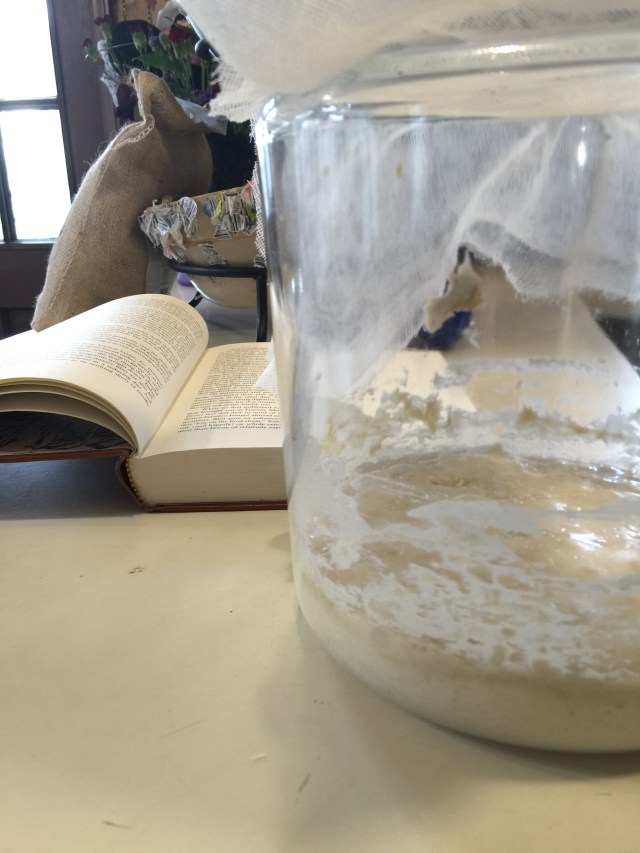
I have a kitchen scale and I weigh out four ounces of flour. I have a water filter and dispenser that removes chlorine from my tap water and from that I get four ounces of water. I mix the two together in a glass vessel. I put a cheesecloth over the top, fastened with a rubber band. Every day I add four more ounces of water and four more ounces of flour.

After just two days there are big bubbles forming in the mixture, they are easily seen through the glass sides of the container. By the five day point the sourdough starter will be ready for it’s continuous life as the source of yeast for my home made breads. This yeast will not be the same variety of yeast as the Fleischman’s yeast you get at the store. Typically bread recipes call for you to add sugar to your flour. The purpose of the sugar is to give that store yeast something to eat, so that your bread can rise with gasses trapped in the dough.

My bread will not have any sugar added. The yeast will be the kind that can eat glucose instead of fructose. When you add sugar you are encouraging a kind of yeast that does not eat what your flour is made of. The starch in wheat flour is glucose. When you do not add sugar but your bread rises anyway that means that the yeast is actually eating the carbohydrates in the bread. My bread will be lower in starch than a bread that is leavened with quick-acting yeast. Not only that, because my yeast is wild and eats glucose starch it will produce different waste products, meaning that it will create different vitamins, it will have a different flavor. It will be sour, aromatic, healthful unlike any bread you can get at the market. It will be less fattening, because it has less glucose left in it. Eating it will not give me the same insulin reaction that eating white bread or hamburger buns might.

What I will be making will be Fermented Bread. By just adding water and salt to my bread, and a pinch of my sourdough starter, my bread will be more like sauerkraut than your bread. The vitamins and minerals in my bread won’t be added back in because they will be created right there by the same microbes that create vitamins in the supplement factories. My vitamins though will not be processed and of unknown quantity and quality. By being fresh and natural my vitamins will be surrounded by natures vitamin helpers, immediately available to my own microbial hitchhikers.

I am really excited about this new leg of my food journey. Every time I have discovered how to do something for myself that I used to count on some distant food factory to make for me, it has been a revelation and a relief to find out how easy it really was. It has been a revelation to find out how much of the stuff in my foods are absolutely extraneous items, only added to make the food last forever, and have nothing to do with actually making food. Bread is a picture perfect example of this. In bread, the required ingredients are: Flour, water, salt. Read your ingredients on your store bought bread. Nothing else on the label is required to make bread. Instead all of those extra things are either to make it last for a week, make it possible to make a loaf in a fraction of the time, hide the flavor of the other ingredients, or to re-add back in the nutrients and vitamins that were stripped in the processing of the various raw ingredients.

I will be honest with you as I write about what it takes to really make my own bread. As I learn how to streamline my own processing of this staple food I will honestly report what I know in these pages. I will take pretty pictures along the way, and some of them will be very pretty indeed. Unfortunately I will not be able to adequately photograph the differences in the way my bread smells, or the way that my bread tastes. My words may fail me when I try to convey to you the new tastes and odors. I may not know the actual biological benefits of my bread, because I am not replacing processed bread with real bread. I had given up bread completely as a lost cause. I am happily re-inviting real bread back into my life, to give me something that commercial bread can not give me.

“And give us this day, our daily bread…”

Posted in Health, Living | Tagged , , | Leave a comment

Nothing is Black or White

I am in the midst of another transformation. From time to time as I slog along on my life’s journey I find that something I thought was ‘always’ bad, it not bad always. Some things in life, no–everything–is relative. All Bread Is Not Bad.

There, I said it. I am returning bread to my diet, conditionally. The condition is that I must make the bread myself (because you cannot buy bread this good), it must be leavened with naturally occurring yeast from around my kitchen area, and it must be from freshly ground hard red or white wheat.

I will explain all of those conditions, and why it is that if done this way bread is no longer considered by me to be processed food. My prohibition against consuming processed foods is still in full force. I am still in the “processed food is ALWAYS bad” camp.

We are watching Michael Pollan’s documentary on Netflix, “Cooked.” The episode that has changed my always negative opinion of bread was “Air.” In this episode the documentary takes us to Morocco, where they still produce bread from stone ground entire wheat. They also cover bread artisans in the US, where the bread produced is as different from mass-manufactured bread as margarine is from butter. It is a totally different food, even though sliced white bread is technically “bread.”

Let’s see if I can explain why the Moroccan bread is so different from what you buy in the store here. The biggest difference is that real bread is fermented. Real bread has three ingredients, four if you count “Time” as an ingredient. The ingredients are:Flour, water, and salt. Does that sound familiar, dear reader? What are the ingredients in sauerkraut? Cabbage, water, and salt! What are the ingredients in pickles? Cucumber, water and salt!

In a perfect world everything is simple and similar principles will apply to all similar tasks. So it is with breads. Store pickles are not as good for you as fermented ones, and its because of the fact that store pickles are not fermented, they are pickled instead. Store bread is not fermented, real bread is.

When I add the mother to my kombucha what I am doing is ensuring that only the probiotics that I want to dominate the end product have a chance. I inoculate the batch with remnants of the previous batch. What I end up with a week later is not sweet tea.

When I add some of my last batch of yogurt to warm milk I am making sure that the milk does not spoil, and it becomes a totally different kind of food. So it is with bread, when I add some starter to it, I am ensuring that the glucose in the bread is being eaten by a friendly organism, it is being modified and improved by the fermentation process. The microbes will change glucose into carbon dioxide and something that is not glucose. This bread will not be the cake that commercial bread will be. This bread will not require me to add vitamins and minerals, they will be in it naturally. Yeast does not produce minerals, so why do I say that my bread will contain naturally occurring vitamins and minerals? The yeast will make the vitamins, just like the bacteria make vitamin C in my sauerkraut. The minerals will come from the flour that I will be using.

When you buy flour at the store, lets say all-purpose flour, it is not wheat. You know that, right? Ground wheat cannot be sold in US stores because ground wheat spoils very quickly. Flour is not ground wheat, it is a part of ground wheat. The parts they don’t give you cause spoilage but they also contain all of the wholesomeness of the original. What they do give you is just the sugar. The starch in flour is pure glucose. Its not sweet because our mouths do not detect glucose as a flavor. When you eat whole ground wheat, which you cannot buy at any store, you are getting glucose, plus you are getting oil and protein. It is a balanced food. When you then ferment it, you are getting vitamins, minerals, carbohydrate, protein, and fats. Also a balanced food. If you eat home made bread produced using natural yeast, whole fresh-ground wheat, and the time to ferment you could live on it. If you eat store bought bread alone you would die a quick miserable death.

My bread list of ingredients do not include yeast either. If you are wondering where my yeast will be coming from here is a link to the factory that produces mine.

8999_08_05_2013__14_50_26_700.jpeg


Natural yeast is different from the fast acting yeast that you get in your local grocery, it isn’t fast acting. Good fermentation takes time and of course your industrial bakery does not have time to waste waiting for nature…time is money. What you lose by rushing the process is vitamins. What you gain by rushing the process is more glucose in the bread. Fast acting yeast is producing more gas on the added sugar it consumes, so that it rises quickly. Commercial bread is not bread. Bread is Wheat, Water, and Salt over Time. Extra ingredients don’t make better bread, they make quicker bread, cheaper bread. More ingredients make bread that makes my wife sick. Is it gluten? We will find out and I will let you know. I suspect that she can’t eat bread because of something that either makes it last for a week on the shelf or that makes it quickly produced. I can’t eat it because there is too much carbohydrate in it.

I am right now making my yeast starter for all of the bread I will ever make from now on. I put four ounces of flour in a glass vessel, then I put in four ounces of non-chlorinated water. I whisked it together. Tonight I will double it. I will continue to add flour and water for five days total and then I will use some of this bubbly biological “bread mother” to inoculate my first batch of home-ground whole wheat bread.

Here is some information on the grain mill that I will be using.

4327_07_10_2012__17_54_40_700.jpeg

Here is more information on milling your own flour.

Here is something funny I read while looking around for flour mill reviews…

Eating good takes time. I want to eat good.


Posted in Health, Living | Tagged , , | Leave a comment

NOT Health Food

When I was a little fella I can distinctly remember when I got to drink Coke. It was the late 60s, and Coke came in 16 ounce glass bottles. You opened a bottle with a bottle opener and you drank the contents because there was no way to save it by putting the cap back on. The two liter plastic bottle had not yet been developed, or the twelve ounce can, at least not for pop.

Unknown.jpeg

My mom and dad would keep an eight-pack in the house, they came in folding paper cartons. You returned the empty bottles to the store for later reuse by the soda company. When we got to get a pop for Mom or Dad the glasses in the house were all twelve ounce glasses. When you put ice in them then you couldn’t fit the entire bottle of pop into the glass. That is when I got to drink pop. I would pour the pop in, and it would fizz to the top, I would drink the fizz and put in more soda. I would take the filled glass to Dad, no liquid left in the bottle. Sometimes he would ask where was the rest, but he must have considered it my tip for delivery, because I did it just about every time.

The sweet drink for us kids was Kool Aid, and we would make a two liter pitcher of it with a cup of sugar added for sweetness. Mostly we drank water, mostly without ice. My Dad was allergic to milk so we kept it in the house for cooking with, not for drinking. The only milk I ever drank was in the one cup paper containers at school, and we drank it thru paper straws. There was practically no plastic in our lives back then, even the milk in the house was in a paper box.

These days kids are fat and nobody knows why. The WHO (World Health Organization) released a report, the ECHO report on what to do about childhood obesity.

ENDING CHILDHOOD OBESITY

The problem to be solved is this:

  1. In 2013, 42 million infants and young children were overweight or obese.

  2. 70 Million young children will be overweight or obese by 2025 if current trends continue.
  3. The rate of increase is 30% higher in low- and middle-income countries than that of developed countries.

Here is the proposed solution, which the consensus opinion can support:echo-recommendations.jpg

The consensus opinion, held by most dietitians though, will not end this epidemic. The number one item above, “promote intake of healthy foods” is the one that will prevent this effort from working. Mainly this is true because the public has no idea what a healthy food is. If you read the labels everything in the grocery is healthy in some way. Sugary breakfast cereals are healthy because of added vitamins and minerals.  Fruit juices are healthy because fruit. Breads build strong bodies 12 ways. Whatever.

Real food prepared at home is healthy. That is the entirety of the list of what your kids should be eating. Pouring cereal out of a box or adding hot water to the instant candied oatmeal is not healthy. Kids drinking 100% fruit juice instead of water is not healthy. All of the extra physical activity in the world will not counter act the damage that eating cereal and juice in the morning, pizza or chicken fingers and fries at lunch and spaghetti-0s at dinner will do to your kids. The Happy Meal, with it’s cakey bun, processed potato fries and Coke, even if its a diet coke, will slowly fatten up and sicken your kids, just like it is doing to you, concerned parents. If what the family is eating has made you fat and sick the only difference between you and the kids is the perhaps 20 or thirty years that you have been working on it.

Obese preschoolers are a symptom of a national disease. We are, for the most part, addicted to convenience. That convenience comes in a box, a bag, a bottle. It is sugar sweetened and highly processed. It is dead and cannot spoil. Once inside your kids it is going to spread that highly processed and chemical deadliness to the bacteria in your kids. The plastic it comes in will have put a few extra off-label chemicals into the food too. All of it will combine to create what you can see of the problem, the too-heavy toddler.

WHAT YOUR TODDLER SHOULD DRINK

The WHO stops short of making the recommendation that I make. I agree–eat healthy foods. In my opinion that list is short. Real food is healthy food. End of list. Juice isn’t healthy, but fruit is. Flour isn’t healthy but wheat is. Sugar isn’t healthy…period. Yogurt is healthy, but add sugar and now it isn’t. Breakfast cereal is unhealthy, but steel cut oatmeal is. Bacon is health food, and so is eggs, but don’t cook anything in processed oils, they are unhealthy. Keep it real and it’s healthy.

Posted in Health, Living | Tagged , , | Leave a comment

Seeing Red Dye

Safety is a relative thing. Standing on the ground is safe compared to jumping from a plane, and laying in bed can be safer than standing on the ground. Eating all natural real foods is safer than eating processed foods, mainly because of the chemicals that are added to processed foods to make them stay edible for months at a time, sometimes indefinitely.

Artificial colors are a necessary part of processed foods. Lots of the foods you expect to be a color would be a bland gray or brown without the uses of food colorings. Unfortunately, food colors are chemical concoctions. The FDA maintains that they are all safe when eaten in reasonable quantities.

When the FDA maintains that a food additive is safe, what that generally means is that it will not kill you. Food dyes cause hyperactivity and ADHD in children. Hyperactivity and ADHD are not fatal, so food dyes are ‘safe’.

Today in the news, over at Mother Jones, I Read that “Making Blue Skittles is About to get Way More Complicated.”

Mars Inc., the company behind many popular candies, chewing gum flavors, and food products, announced earlier this month that it will begin phasing out artificial food dyes.

Naturally, they are going to take their time doing it, the plan is to phase them out over the next five years. I predict that the FDA will take action to ban artificial food colors about the same time that all of the US food makers have voluntarily quit using them. This is the exact same strategy that they are using to ‘ban’ TransFats from the American diet. Currently they are not banned, even though there is no known safe level of trans fats in your diet. Food makers are down to ‘less than 1%’ in most of their foods now, and when they get us all converted over then the FDA will ban them. BPA plastic ingredient is not banned, but no plastic maker wants to use it, since it is banned in most of the other industrial nations. As soon as nobody here uses it any more then it will be safe to use this dangerous additive.

The decision came as a response to growing customer demand, said Mars Inc.’s president and CEO, Grant F. Reid, in a statement, estimating that it will take five years to phase out all artificial colors. Nestlé, General Mills, Kraft, and Kellogg‘s have also started eliminating artificial dyes from their products in response to demand for more natural ingredients.

If you think that your food is ‘safe’ then I am not here to worry you. If you think that the FDA is testing every additive as rigorously as it tests every new medical device then I am here to tell you that your faith is misplaced. The only protection you have against side effects of artificial ingredients is to not buy them. Eat real food, cook for yourself, add your own additives–like natural fats, natural colors, natural ingredients. As a side benefit you can also cook love into your meals, and you can care more about eating than profit. All the corporations care about is the profit.

The cartoon Kool Aid Man is not the most artificial thing contained in this package.

Posted in Health | Leave a comment

Seeing Red Dye

Safety is a relative thing. Standing on the ground is safe compared to jumping from a plane, and laying in bed can be safer than standing on the ground. Eating all natural real foods is safer than eating processed foods, mainly because of the chemicals that are added to processed foods to make them stay edible for months at a time, sometimes indefinitely.

Artificial colors are a necessary part of processed foods. Lots of the foods you expect to be a color would be a bland gray or brown without the uses of food colorings. Unfortunately, food colors are chemical concoctions. The FDA maintains that they are all safe when eaten in reasonable quantities.

When the FDA maintains that a food additive is safe, what that generally means is that it will not kill you. Food dyes cause hyperactivity and ADHD in children. Hyperactivity and ADHD are not fatal, so food dyes are ‘safe’.

In the news, over at Mother Jones, I Read that “Making Blue Skittles is About to get Way More Complicated.”

Mars Inc., the company behind many popular candies, chewing gum flavors, and food products, announced earlier this month that it will begin phasing out artificial food dyes.

Naturally, they are going to take their time doing it, the plan is to phase them out over the next five years. I predict that the FDA will take action to ban artificial food colors about the same time that all of the US food makers have voluntarily quit using them. This is the exact same strategy that they are using to ‘ban’ TransFats from the American diet. Currently they are not banned, even though there is no known safe level of trans fats in your diet. Food makers are down to ‘less than 1%’ in most of their foods now, and when they get us all converted over then the FDA will ban them. BPA plastic ingredient is not banned, but no plastic maker wants to use it, since it is banned in most of the other industrial nations. As soon as nobody here uses it any more then it will be safe to use this dangerous additive.

The decision came as a response to growing customer demand, said Mars Inc.’s president and CEO, Grant F. Reid, in a statement, estimating that it will take five years to phase out all artificial colors. Nestlé, General Mills, Kraft, and Kellogg‘s have also started eliminating artificial dyes from their products in response to demand for more natural ingredients.

If you think that your food is ‘safe’ then I am not here to worry you. I wont even debate you. If you think that the FDA is testing every additive as rigorously as it tests every new medical device then I am here to tell you that your faith is misplaced. The only protection you have against side effects of artificial ingredients is to not buy them. Eat real food, cook for yourself, add your own additives–like natural fats, natural colors, natural ingredients. As a side benefit you can also cook love into your meals, and you can care more about eating than profit. All the corporations care about is the profit. That doesn’t make them bad, it is how their game is played.

This is my first post in a few years. Much has changed in the nutrition landscape, and much has stayed exactly the same. I am older, wiser, and back on the horse..

Posted in Health, Living | Tagged , , | Leave a comment

What Happens To Cholesterol Levels When You Switch To Low Or Non Fat Dairy

From a favorite blog of mine. This doctor has done the testing to show what happens to cholesterol, with and without statins. I personally believe that the average American need only quit eating carbs to get their blood chemistry back into natural balance, no pharmaceuticals necessary. I believe this post says the same thing…

Posted in Health | Leave a comment

Nexium Connected to Dementia

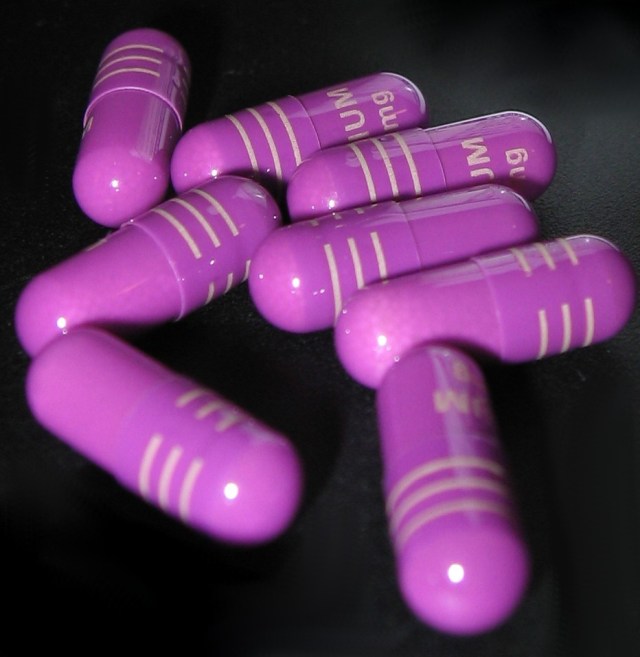
Nexium_(esomeprazole_magnesium)_pills.JPG

This is in the news this week…

A German study published in the medical journal JAMA Neurology found that seniors who regularly took proton-pump inhibitors like Nexium, Prilosec, and Prevacid were 44% more likely to end up with dementia. Proton-pump inhibitors, commonly used to decrease acid in the stomach, are used by more than 15 million people, according to NPR.

My quote is from Fortune.com’s report, but this same story is being passed along by all of the major news outlets. Here is the headline in Fortune “Some Popular Heartburn Drugs Have Been Linked to Dementia.” Other headlines are featuring the same potential connection.

A German research team has analyzed the health outcomes of 74000 patients who were first noticed to not have demential. The average age was 74, and after seven years had passed the same patients were checked to see how many now had been diagnosed with dementia, and of those, how many were also taking heartburn medication, specifically PPI (Proton Pump Inhibitors.) Nexium is only one brand of PPI and was not singled out in the study for condemnation, despite the fact that it is in my own headline. Here are the drugs generic names that were looked at in this study, which are now ‘linked’ to dementia…omeprazole, pantoprazole, lansoprazole, esomeprazole, or rabeprazole.

Now for a little bit of critical-thinking style analysis…

Nowhere in this news does anyone hint that any of these drugs CAUSE dementia. Nobody knows the actual cause of dementia. Dementia, in fact is a symptom of a disease, like fever, or headache. Sometimes, like pneumonia, this type of symptom is considered to be the disease and is used in shorthand form to describe the scary problem. I have also heard dementia referred to many times as “type 3 diabetes”. I have seen dementia linked recently to blood sugar problems, and to low fat diets. This is the first time I have seen it linked to heartburn.

I would, if I wanted to help the public and had my own news outlet, choose to rewrite my headlines describing this news to read “Heartburn Linked to Dementia.” In my own mind the thing that all of these heartburn drugs have in common is that people only take them when they have acid indigestion. Lots and lots of people have nightly heartburn. Somebody please study the number of patients that complain of indigestion that end up getting dementia. I don’t know how often it happens, but the chances that the artificial American diet, sugar-sweetened, fortified, lifeless and fake is the culprit in dementia.

This study has linked taking a drug to help with heartburn as pointing to a 44% greater chance to get dementia than people who were not prescribed this class of medicines. What are the chances that people who only took Tums for their heartburn also got dementia? What other differences could account for whether or not an individual gets dementia? Everyone that eats the typical American diet does not end up with Alzheimer’s. Why some do and some don’t is complex enough that there is no easy solution. Personally I blame food, specifically carbohydrates and processed food chemical additives and find them to be much more suspect than any drugs that have actually been through rigorous clinical drug trials. Nexium was tested far more rigorously for side effects than ANY food additive ever is.

I think that processed starches, artificial ingredients and sugars CAUSE heartburn, acid reflux, irritable bowel syndrome, high blood pressure, heart disease, obesity, non-alcoholic steatohepatitis (fatty liver disease), and a host of other diet related maladies. I think that if you dont eat processed foods you will never get heartburn and thus be one of the lucky seniors that does not need a PPI type drug–or a high blood pressure drug–or a statin drug–or possibly any drugs at all. Let food be thy drug, and drug be thy food.

Posted in Health, Living | Tagged , , | Leave a comment

Scientist or Science

Science is not a group that scientists join. It is not a club with rules of admission. Science is a way of figuring out the world. It is a method of investigation, a set of rules for determining what the evidence is suggesting. Scientific fact is always subject to modification. Scientists sometimes are immune to change and are extremely set in their opinions about what the science is telling them.

Today in the Washington Post I read that:

Scientists can’t agree whether salt is killing us. Here’s why.

Exactly what governments and other public health organizations ought to tell people about salt has been the focus of fierce debate in recent years. The U.S. government, through the Dietary Guidelines for Americans, as well as the American Heart Association, have long warned that most Americans are consuming far too much salt, and that excess consumption raises risks for high blood pressure, strokes and heart disease. However, research in recent years by some prominent scientists have raised doubts about those warnings.

The problem is not the science. It is mute on the topic–providing only evidence. The problem is that the scientists on either side of the science are only using the evidence that will confirm their conclusions about the issue. This, my friend, is not science, it is pseudoscience.

The problem, exactly the same, is in informing public debate and policy utilizing science concerning sugar, saturated fats, tobacco, and just about any other substance that may be ingested by one of us on a regular basis. We are constantly getting confusing mixed messages from “scientists” who are looking at primary research (the actual clinical data) and then drawing pseudoscientific conclusions from it. Then like-minded “scientists” will cite this research in supporting their latest analysis of the “existing data” and reaffirm the conclusions. They cherry-pick studies to include so as to pick up bandwagon support, the more studies on the wagon the more solid seems the research. The resulting echo chamber makes the devotees on the bandwagon feel secure in their validity. Meanwhile the opposing bandwagon is just as full of people on the other side.

Is there a right and wrong in the case of salt? Is there a dangerous level that applies to all people in all cases? Probably. Is there a level that is harmless to all people in all cases? Probably. In fact in every case where there is scientific debate on an issue, the reality lies somewhere along the spectrum. In fact YOUR REALITY will lie somewhere between those extremes and will be different than mine. There is not truly a “right” science in this case, and the honorable men and women arrayed in battle dress on either side of the issue are not always wrong, and their hearts are all in the right places. It has been said that science progresses one dead scientist at a time. This means that the people whose views are outdated will hold those views until the end. The new men and women just coming up will be schooled on both sides and invariably over time science gets to progress past the point where there is still debate about whether the earth is round or flat or obloid.

Just this morning I noticed that my friend Nina Teicholz is calling for help ensuring that the Nutrition Evidence Library may be missing crucial counterpoint evidence in it’s database of nutritional studies. The Library is supposed to be a way for scientists to find all of the evidence, on both sides of every dietary science issue (fat, sugar, salt, carbs, etc) so that when it comes time for the Govmet to issue advice to the public all of the conflicting reports can have their say on the outcome. Here is her request:

Please help with this effort to complete a list of studies missing from the US government’s Nutrition Evidence Library. This library is what the Dietary Guidelines expert committee draws upon for all its expert reviews–which become our Guidelines. And it seems that a great deal of crucial science is missing from that library. In fact, most of the science testing the diet-heart hypothesis appears not to be there. So if you have time, please help us flesh out what’s missing from this Library. Time Sensitive! I need this by Friday, when I’ll have the opportunity to present this to the USDA.

Teicholz is not a scientist, but she senses that any true scientist would want to know about contrary evidence to the opinions that they are used to espousing. A true scientist would not want to recklessly promote a false fact. Pardon her naivety, she is young. Even in primary studies, where evidence is being initially collected, as compared to secondary studies where primary studies are being compared to one another, the conclusion paragraphs are basically the opinions of the scientists that conducted the research. These conclusions are not facts. Later work, or decades of reality, can show a scientist’s conclusions were prima facia false. For instance, switching from a diet high in fats to a diet high in carbs will not end the ‘heart attack epidemic.’ Science that says it will could safely be thrown on the trash pile of history…but it won’t until all of those old scientists are deceased.

I applaud the researchers in the salt comparison study for pointing out the dichotomy in science research. They could easily just find/replace the word salt with sugar and reissue the report and it would be just as true. I applaud Nina for her work advertising and attempting to correct the Nutrition Evidence Library lapses. I even applaud the US Government for having a thing like the NEL that can be improved.

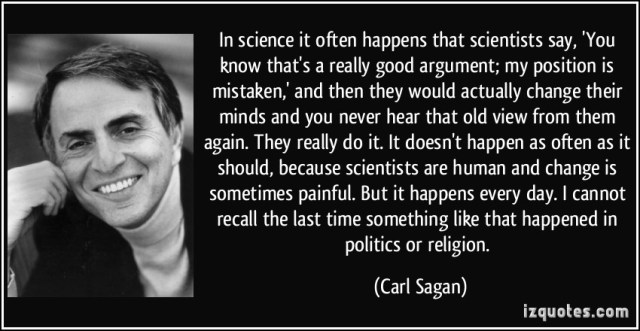
So for us, here living life, what should we believe? “Scientists Say” is now one of those phrases that will mean just another man’s opinion. This is always what it should have meant, but some people, usually NY Times headline writers, seem to think it means more than it generally does. It is probably safe to say that you can keep enjoying your daily ration of salt. If you eat real food, especially food that doesn’t have any health claims on the label, then you will be safe from just about every disputed nutrient in processed foods. Better yet, avoid processed foods and just eat real food.

quote-in-science-it-often-happens-that-scientists-say-you-know-that-s-a-really-good-argument-my-carl-sagan-286480.jpg

For more on the salt debate, read this lengthy article from the vaults of the Washington Post:

Posted in Health, Living | Tagged , | Leave a comment

Organic Definitions

I used the plural in the title on purpose. For the word “organic” there is more than one definition and keeping that in mind is important when you read the headlines. In the news this week we hear that “both organic milk and meat contain around 50% more beneficial omega-3 fatty acids than conventionally produced product.” This quote is from an article found at ClinicalNews.org, “New study finds clear differences between organic and non-organic milk and meat” where they write up a study performed at Newcastle University.

Newcastle University is located in England. This study analyzed previous studies that compared the composition of organic milk and meat to conventionally raised milk and meat and the observed effect on health. The studies they analyzed were conducted around the world, 196 papers on milk, 67 papers on meat.

The problem with the news is that organic is an English word, and it means something legally different in different countries. Organic products in the US must satisfy the FDA and USDA definitions of organic (which are not the same) and in England they must satisfy the requirements of British law. Each country may or may not have a legal standard for organic. To tell you that organic milk or meat here would be as beneficial as the same product in England would just not be true.

My guess is that in England organic means pasture raised. Conventionally raised in England must mean fed grain meal in confinement like we do over here. Let me go check…

Organic in England means no herbicides or fertilizers on cattle feed. That would mean that feeding corn and soy meal like they do in confinement operations here would be out of the question. They also must only give animals medicines by prescription of the veterinarian.

Here is the USDA definition of organic “After a drawn-out debate, the U.S. Agriculture Department has significantly narrowed the definition of organic livestock to animals that spend a third of the year grazing on pasture. The new rules also say that “organic” milk and meat must come from livestock grazing on pasture for at least four months of the year, and that 30 percent of their feed must come from grazing.”

The difference is vast between the two. In England organic means fed natural grasses, in the US it means fed in a pasture for one third of the year. That might mean fed in the barn in the winter, or it might not. It means what it means to the farm, and my guess is that the effects found in the Newcastle studies would not always apply in the US. The benefits of grass feeding animals that naturally eat grass are probably far more numerous than just the omega 3 essential fatty acids that are in the grass fed meats and dairy. Those benefits are from the grass not from the organic label.

Posted in Health, Living | Tagged , | Leave a comment

Debate, Deconstructed

In classical debate there are rules that must be followed. Just like in any competition the playing field must be strictly proscribed or else the game becomes too strung out for the audience to follow. In debate the playing field would be called the topic. If the debate is taken off topic it is up to both sides to agree that it should be brought back onto the playing field, where the cameras are already all set up, so that the audience can enjoy the contest as much as the opponents are.

We debaters forget at our peril that the purpose of debate is to convince the audience of the rightness of our arguments. Debate is rarely determined by one side or the other being suddenly convinced, mid argument, that they were wrong all along and becoming convinced by the argumentation of the opponent. For illustration let us take a recent incident concerning the upcoming announcement of food and diet policy by the US, and an argument that took place between opposing “sides” of this issue. I put sides in quotes because a debate may form along any fault line and sometimes the differences between sides seem vast to them, but in reality are quite close when compared to other differences in the world.

Every five years the government puts out US Dietary Guidelines for Americans. These guidelines are then used to develop school lunches and every eating institution will look to them to craft menus for the subsequent five years. It is a big deal and has had a major effect on the health of Americans since it was first created 35 years ago. Last year word began to leak out that the new standards would call for americans to eat less added sugar. This was a VERY big deal in my eyes, because if you know anything about how the political world in the US works having a government body say words that might cost any constituency vast sums of money is a very rare thing indeed. Perhaps, I thought, having a Liberal in the White House was finally beginning to pay dividends. Not only that, the same guidelines were no longer going to claim that lard and butter were bad for your health, but they were going to say that they are bad for the health of the planet instead. I jumped for joy and wrote about it for days. Alas, two of my allies, Nina Teicholz, author of “Big Fat Surprise” and the Center for Science in the Public Interest (CSPI), a Washington, DC-based advocacy nonprofit–an organization that has my dietary health in it’s mission statement began a months-long debate over whether or not the committee that would be deciding the Guidelines were using science as their primary sidelines.

The first shots agains the Guidelines were fired by Teicholz in a book-length article published in BMJ (British Medical Journal) on September 23, 2015.

The scientific report guiding the US dietary guidelines: is it scientific?

Here is the crux of the case made by Teicholz:

The 2015 report states that the committee abandoned established methods for most of its analyses. Since its inception, the guideline process has suffered from a lack of rigorous methods for reviewing the science on nutrition and disease, but a major effort was undertaken in 2010 to implement systematic reviews of studies to bring scientific rigor and transparency to the review process. The US Department of Agriculture set up the Nutrition Evidence Library (NEL) to help conduct systematic reviews using a standardized process for identifying, selecting, and evaluating relevant studies.3

However, in its 2015 report the committee stated that it did not use NEL reviews for more than 70% of the topics, including some of the most controversial issues in nutrition.4 Instead, it relied on systematic reviews by external professional associations, almost exclusively the American Heart Association (AHA) and the American College of Cardiology (ACC), or conducted an hoc examination of the scientific literature without well defined systematic criteria for how studies or outside review papers were identified, selected, or evaluated.

Note that her evidence states that the report produced by the DGAC (dietary guidelines advisory committee) will not use agreed upon scientific methodology to make the recommendations. This admission is worrying because the 2010 committee had set the policy for subsequent reviews to specifically use agreed upon methodology so as to keep politics and money out of the Guidelines. It was a worrying development, so much so that Teicholz wrote a massive article to draw attention to the potential problems.

Toward the middle of the article she gets into the suspicions of bias that may be altering the conclusions being formed by the Committee. Now the idea of this is not new, and the problem is not new, and it may well be occurring, but the pronouncement of this area of discussion in this article I think is what drew the attention of the CSPI. There are scientists on the Advisory Committee, and none of them want their work painted with the brush of “whitewash” before they are even born.

The CSPI organized a campaign to get the BMJ to retract Teicholz article. They rounded up almost 200 people to sign a letter to the editor that asked specifically for that. Thankfully BMJ did not do this, so we can now examine both sides of the debate.

In their letter, the CSPI listed 11 “Factual Errors” that called for a the article to be retracted, in the opinion of the letter writer, Bonnie Liebman, and 173 additional signatories. In my opinion having all of the extra people to sign the letter is probably a touch that made it more likely to get the attention of the publishers, but it does nothing to add to the credibility of the arguments that Liebman makes. Listing signatories is attempting to add credibility to an argument by general agreement, the Bandwagon Effect. Having a crowd cheering behind you does not in fact make your scientific arguments about “factual errors” any more or less accurate. Dramatic, but unpersuasive. It also doesn’t help that a score of the signatories are students, graduate students, or interested bystanders whose association with the letter adds zero weight to the bandwagon. Getting the letter retracted will also not change the true facts in the overall debate. Teicholz and Leibman are on the same side of the overall debate. Both want the Guidelines to improve the health of the nation and to represent the facts.

For the most part the science argument boils down to “Did the DGAC admit that they weren’t going to use strict science in 2015” and “Is there a study that shows that eating saturated fat makes you sick.” So, debaters, did the DGAC admit they abandoned the agreed to format for scientific review or not? The science is in on saturated fats, though. They do not make you sick. This year there is report after report exonerating butter, lard and coconut oils as healthy alternatives to vegetable oil. I know this because I have written about it at least two dozen times last year.

I am not going to go into it at all, but compared to eating sugar, saturated fats are health food. Low fat is more and more associated with Junk Food. Added sugars, because of this year’s dietary guidelines are on the way to being quantified on food labels, the first time ever.

It is a shame that the Guidelines are probably not going to take all of the stigma off of natural fats. Nina Teicholz, you are right to complain about it. The sustainability rationale that they were going to use is only because in the US we farm 70% of the arable land in corn and soy to feed confinement animals. If we rolled the agricultural clock back 50 years and suddenly raised those animals on the ranch again the problem of greenhouse gases from raising livestock would disappear. Then there would be no rationale at all for curbing fat or red meat consumption. CSPI that would not only benefit the meat producers, but the planet and the public health. Go to CSPI website and you will find calls for lots of these things. They are Concerned Scientists, after all.

For Teicholz part her initial article contains some words like “all” and “none” which are easy to call factual errors, by finding one case that is different. In the overall debate though, finding one scientific study that disproves a “none” argument does not make the case that the science is right. Eating saturated fats is not bad for you because there were interviews of people who claimed they ate it and some of them had heart disease. Saturated fat and red meat are foods that are healthy foods if the animals themselves are healthy. That is just how the food chain works.

Getting the Teicholz article retracted will not make up for the fact that there are a lot of interested parties that have already gotten the Guideline issuance enough attention for Congress to take a look at them. I guarantee you that from what little I know about the US Congress, that their review will not increase science’s chances of gaining more scientific results. Congress looking into it is going to make the standards more political, not less. Congress claims to be defending science, but half of those guys probably think the Earth is just 6000 years old. People like Teicholz want the standards to take the stigma off of fats because there should not be any. People like Liebman want people like Teicholz to sit down and shut up because getting Sugar on the crappy list is a worthy accomplishment all by itself so don’t subject the Guidelines to more political review. I actually agree with this. Getting the nation off fructose will save a lot of quality of life six or seven Guidelines from now.

In the end, debate does not matter on the periphery like this. Friends of mine are squabbling while we all watch. It makes it seem like there is no right answer. There is a right answer, dear reader, and you know what it is. In the case of you and yours, what to feed your children–eat real food. Do not eat processed foods, they contain artificial things, and artificial things lead to unhealthy futures. If it comes in a box or bag or bottle, put it back. If it doesn’t need a label then its probably a single ingredient food–health food. If there is a health claim on the label then there is a good chance that it is man made and it should probably be put back on the shelf. Eat right and the guidelines be damned!

Posted in Health | 1 Comment