Mother’s Day Edition

Happy Mother’s Day, America. Today my own mother woke up in the hospital, having suffered another cardiac scare. She is fine and she will be fine. We talked on the phone this morning and I told her that in a way, she is lucky. It is my opinion that her condition is one hundred percent diet-related, and that it is one hundred percent reversible.

I say this, and I believe that her doctors would agree, that if she would eat better foods she would lose weight, her blood chemistry would straighten out, she could get off of all of the pharmaceuticals they have her on, her heart health would improve, her pulmonary health would improve, her high blood pressure and diabetes would go away.

The only thing her doctors and I disagree about is what she should be eating. They tell her to not eat red meats or lard, not to eat sugar. I tell her only eat natural foods, including lard, which is a natural fat. I tell her to get her meats from somewhere that doesn’t feed the animals corn or soy for the last six months of their lives. A person like her that is suffering from years of insulin resistance needs to get off of the insulin-glucose merry-go-round. Her blood pressure could very well be a function of her sugar addiction, or it could be from having the typical American Omega 6 to Omega 3 essential oil ratio of 15 to 1. If she would eat Omega 3 chicken eggs, eat meat from animals that were provided their natural forage instead of genetically modified grains to fatten on, if she would cook with natural lard and natural butter, perhaps her blood pressure would go down without any regard for her ‘salt intake’.

Here is a video that is fifteen minutes long. In it a doctor gives the advice that I would give my mother. If you are currently trying to give advice to a loved one that is counter to the ‘conventional wisdom’ dispensed without regard for the consequences by the health and medical communities, try showing them this TED talk.

I plan to make for my Mom a one week menu of things I think she should eat the first week out of the hospital. My menu might make her doctor cringe. There won’t be any carbs  in it. The energy in it will consist of mostly natural animal fats. You could do it, too.

Mom, I am talking directly to you now. There is no reason for you to stay sick. What you eat makes you that way. If you would just follow the advice from the doctor in the video, instead of the one that talks to you after your heart attacks you would be much better off. Please listen. Please change.
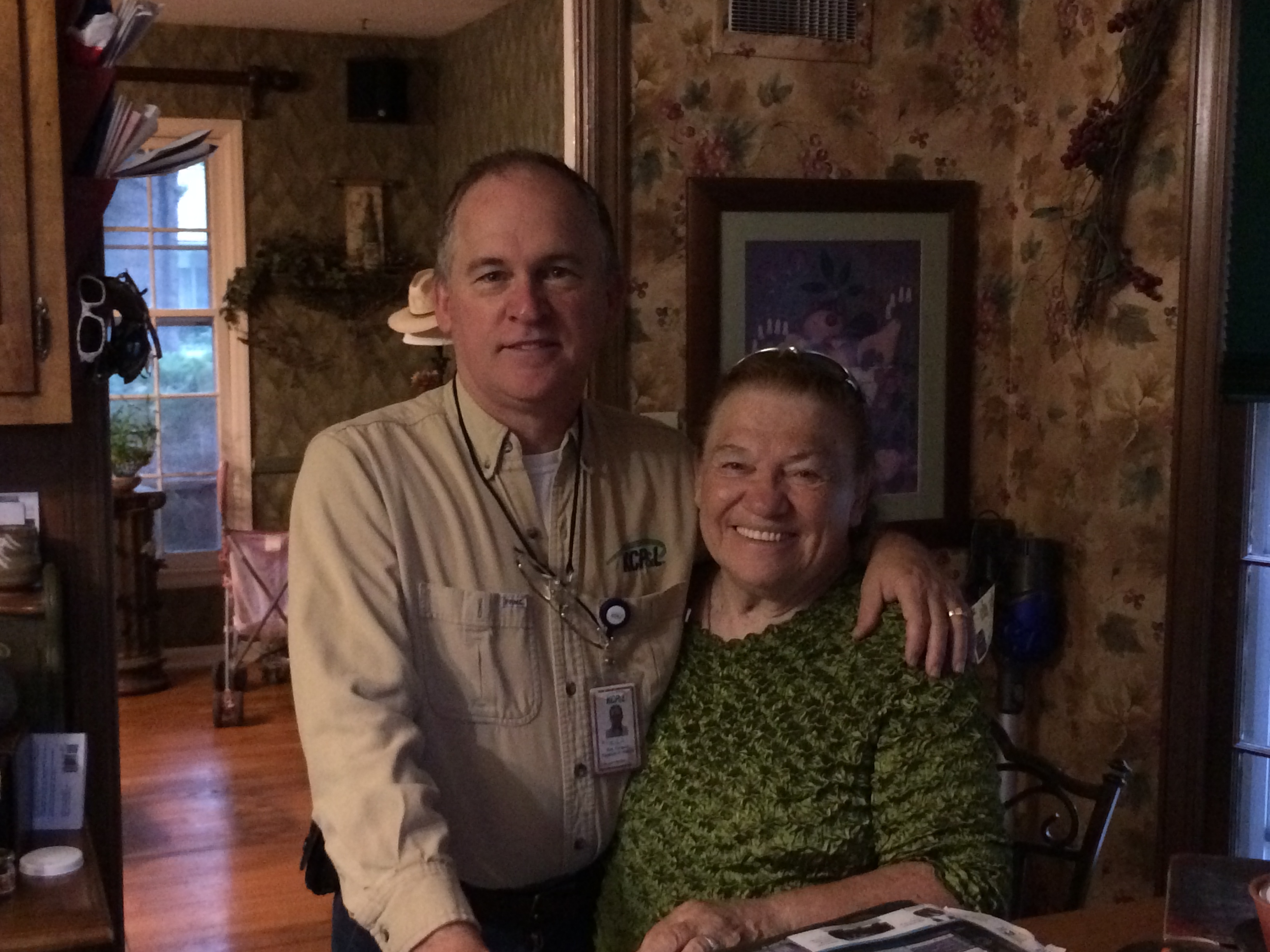
Me and Mom

Me and Mom

Posted in Health, Living | Tagged , , , , | Leave a comment

Roulade is What’s For Dinner

I prematurely called an end to my crazy-making work schedule, it’s still nuts over there. Crazy hours make for crazy eating and I have went crazy for the last few days. No breakfast, carbs in my drinks, eating at restaurants for one or two meals a day. We have decided to quit eating out for the next week, we will see if it works out. It is difficult to plan, buy and cook food for two when you only have three hours an evening to do it.

Yesterday, though we had a really good dinner that I would like to share with you. I have finally cooked enough dinner entrees that I can make adjustments to a recipe without fear, and that is what I did.

I bought a side of beef and went and picked it up the other day, and before I did I cleaned my deep freeze out. I have in my upstairs freezer now two flank steaks and four skirt steaks from the previous side of beef I bought. I brought it all upstairs so that we could use it up first, before the new beef.

Usually when I think of flank or skirt steak, I think of making fajitas, or something similar to that. Here is a great picture of a flank steak:

Raw Flank Steak

Flank steak, top and bottom

Here is a picture of a skirt steak:

Skirt Steak

Skirt Steak

This steak has long muscle fibers, like the brisket, but it is very thin. Because it is thin you can cook it very quickly like you would any other steak. Like the brisket, the important thing about serving it is how you cut it at dinner time. You can’t see it really in this picture, but the muscle fibers run from top to bottom, basically along the length of the piece. To cut it across the grain you would cut it into very long strips. Unlike brisket, this piece of meat is very tender after just a little bit of cooking, which makes it ideal for using in a roulade.

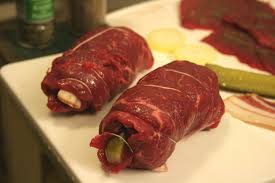
A roulade is what we had for dinner last night. To make a roulade you make a spicy or flavorful paste, spread it on one side of the meat just like you would butter bread. Then, starting at the pointy end, you roll the steak into a roll and either skewer it shut or tie it shut with butcher’s twine. To cook it you sear the outside of the roll and then roast it or braise it for a half an hour.

Unknown-1

Raw Roulades

Yesterday I made a paste of diced onion, dijon mustard, bacon bits (home made), paprika, salt and pepper to spread on the meat. I seared it and then braised it in fresh bone broth that I had just made the day before. This dish is so good! You will always cut the meat in the right direction if you cook it this way, as to cut across the roll will always cut across the grain, too. You can cut it with a fork at the table once you have cut serving size pieces up for your guests. I had one skirt steak and it was long enough that I had to cut it in two and make two roulades with it. It looked something like this when I had rolled them and tied them.

After they were braised for a half an hour I took them out of the braising liquid and reduced it down to almost gravy consistency, put a couple of table spoons of sour cream in it, and reduced it back down. After I cut the roulade I spooned this sauce over the meat just before I put it on the table. NUM!Unknown-2

Posted in Health, Living | Tagged , , , | 1 Comment

Stop Diabesity In Its Tracks!

Today’s post is going to be a re-blog of a valuable blog if you are concerned about the correlation of diet and health. It turns out that a person can get type two diabetes even if they are not overweight. Some people just can’t handle carbs as well as others, and it may not lead to putting on weight while it will still have the other blood chemistry changes that eventually lead to diabetes. This blog is worth exploring further.

Posted in Health | Leave a comment

Antibiotics and Panera Purity

Unknown

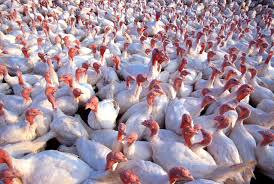
Antibiotics are not in the news this morning. The news is that twenty million birds living in the dystopian hellish confinement of the US Food System have died recently, succumbing to the latest variety of avian flu, H5N2. Food Scientists are at a loss as to how the virus is being spread from airtight confinement to airtight confinement. Poultry workers are entering and exiting the chambers in full ebola-proof clothing, and yet the virus still gets in. All of the antibiotics that these birds have been fed have not, can not prevent this virus from killing the animals within two days of them getting exposed.

Read this article in the New York Times this morning. So far there is nothing to fear for humans from this disease, it is only affecting chickens and turkeys. We only need to fear poultry prices rising. Perhaps this blitz of natural wrath will make big chicken producers rethink their devotion to this unbelievably cruel way that we raise our meat animals. If these 20 million birds were spread out over a much greater food production system, like individual farms that allowed these animals to live naturally, this disease would have a much harder time claiming so many victims in such a short time. Disease may do what thousands of dedicated animal rights activists never could.

The authorities are preparing for the panic that may ensue if someone catches one of these viruses and dies. Still, officials, say, most Americans are in little danger. The overall risks pale compared with those posed by well-known mortal threats that elicit no panic: car crashes, bee stings, bathroom falls and so on.

Chicken confinement operations could find themselves soon to be the victims of scare-science like nuclear power plants. If they begin to be places were biohazards are born then no one will want one in their back yard. It won’t matter at all that the likelihood of disaster is vanishingly rare. It won’t matter that the diseases born of this kind of unnatural lifestyle for these animals becoming deadly to us is less than one in a million. If it ever happens, then it CAN happen, and here in the US, that is all that matters. The news won’t be able to stop itself from amplifying the unreasonable fear. Just like the silly display they put on for the possibility of an upcoming blizzard, they will do all they can to get you to watch the news, so that they can increase their ratings. In the meantime, they are killing an industry, or helping to kill it at least. I see disaster on the immediate horizon for confinement food operations.

In related news, Panera Bread has posted a list of ingredients you will not find in their food offerings. The “No-No List” could be ten thousand ingredients long, if they were going to get rid of all artificial ingredients. They won’t. I can say they won’t because I see Lard on the list. Lard is not an artificial ingredient. It is a natural animal fat. However, if you are making something with a crust it is essential. If you don’t use lard you have to use an imitation animal fat, like partially hydrogenated vegetable oil, or a trans-fat, or some as-yet uninvented unnatural fat that will reproduce the effects of fats combining with oils in the bread making operation. Unnatural fats have unexpected consequences in the body. We have already, after 40 years of use, found that the trans fats in margarine and shortening were causing heart disease. Really. If Panera would put lard back in their foods I would feel better about the No-No List.

Posted in Health, Living | Tagged , , | Leave a comment

Gluten Free Dogma, And Others

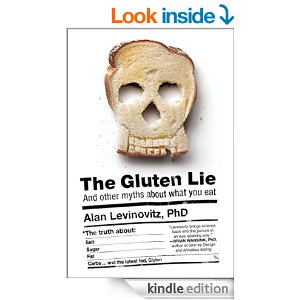
In his new book, “The Gluten Lie”, philosophy professor Alan Levinovitz analyzes why fad diets and crazes concerning food are so prevalent in history. This morning over at Salon.com I found a very thought-provoking review of it. I say thought provoking because one of the questions in the review conflates religion and religious language and the language of diet:

Food rituals, food taboos, dietary demons, dietary myths, magic diets, guilt, sin: why do we apply so much religious language to food?

Virtually ever religious tradition has had food taboos and sacred diets. I think part of the reason is that food is something that we have direct control over. It crosses the boundary in a very personal way: we take something outside of our body and put it into our body. Eating is very personal, and it’s easy to invest those kinds of things with religious and ritual significance.

51L5hpuzRoL._BO2,204,203,200_PIsitb-sticker-v3-big,TopRight,0,-55_SX278_SY278_PIkin4,BottomRight,1,22_AA300_SH20_OU01_

When talking about diet with people a great deal of the time you end up coming to a place where the conversation almost sounds like a religious argument. The dieter is operating on faith. It is especially prevalent when you talk to the vegetarian or the gluten-free dieter. As it happens there is now a great deal of science one can look to, to see what effect foods actually have on the human organism. In the case of celiac disease, it is possible to tell who is and who isn’t. Gluten based food marketing has reacted to the vanishingly small population of people who are required to medically avoid gluten by coming up with other ‘conditions’ that require a gluten-free diet. Gluten intolerance comes immediately to mind.

A person eats a food and has a bad reaction later that night or the next day. This person tries ‘gluten free’ and seems to not have that reaction. It’s all the proof that they need to then avoid gluten from now on. You can talk until you are blue in the face about all of the other chemicals that are in the same breads and crackers that they eat. You can point out that there are other known causes of dietary distress, but like all purists, the dieter avoids all contrary evidence.

Do you think there’s an incentive to setting yourself apart from the culture at-large? Uniqueness can carry its own social value.

I think a lot of people are distinguishing themselves by adopting ascetic diets. Religious people have done this since time immemorial. To show that they have some kind of strength to distance themselves from the material world, they adopt ascetic diets.

Lots of times the dieter wears the diet like a badge. You get to ask for a special meal on a plane, or at a large family gathering. You get to be different. You are like the religious ascetic denying the pleasures that surround you, and you have faith that your faith will be rewarded. It is incredibly religious in a secular society. It’s like these things are wired into the human brain. When I say, as I always do, that I am not on a diet…I guess I am saying that I am using diet practices, but not in a rigorous way, that I am not religious about it. I actually use those words.

Personally, I don’t recommend dieting. There are times where you have to eat outside of your normal food regimen. I had to for the last couple of weeks, for instance. It would have done me no good to not eat instead of eating fast food, restaurant food or processed food. It would have done me no good to feel like a dirty sinner when I did what I had to do, since there wasn’t a chance to do the right thing. Knowing, as I do, that eating processed foods and carbs is not life-threatening in the short term, and that eating sweets won’t make me instantly put on pounds, there is absolutely no scientific reason to not do as I must in the short term.

Eating as I do, trying to avoid carbohydrates in every meal, morning, noon and night, to get back on track all I have to do is eat breakfast of bacon and eggs one morning…that’s it. The second I set foot back on the path then my direction is once again set. When I go to a big family gathering I don’t need to ask for a special dietary restriction on the meal or for a special plate just for me. It’s just one meal out of many hundreds per year. I am not religious about it.

Posted in Health, Living, Reviews | Tagged , , | 2 Comments

Finally, a weekend

I made it through to the other side. Not too much worse for the wear. The long hours at work are over. Working every day of the week for weeks at a time are in the rear view mirror. There is still turmoil but it will get along without me for a couple of days. In the meantime I can get back to writing.

Working an insane schedule, sometimes sixteen hour days, is the absolute worst thing for eating healthy that I can imagine. We did a lot of dining out. I ate pizza, rice, potatoes, drank sugary sodas. Basically, for the last few weeks I have ate the Western Diet like I didn’t know any better. I haven’t even had my beloved bacon and eggs for the past three mornings.

I gained two pounds.

Temporary excursions off of the sensible dietary reservation are no big deal. They don’t cost you much in weight gained, because weight is gained as slowly as it is lost.

This week I am re-filling my freezer with beef grown on a pasture in Kansas. I will be smoking a side of bacon, the pork grown on a pasture in Kansas. I will be getting back into the things that I love doing, instead of the things that I have to do. Now I can begin to make my plans to roast a hog head. I can make a corned beef brisket. I am really looking forward to fermenting fresh vegetables that I will begin getting at the Liberty farmer’s market this spring and summer.

Posted in Living | Tagged , , | Leave a comment

It’s 4AM, even honeybees are sleeping

When I say I work long hours, I mean I work long hours. It’s four in the morning and I have time to write, so I have been writing all night. I write in a sports blog now, too, but just once a week. There are just not enough hours in a day to do everything that one would like to get done. Whatever gets done just has to be enough.

Earlier this week I read that there is a pesticide that is actually attractive to bees. If you haven’t heard, there is a current plague in the honeybee population, it causes about one third of the honeybee hives to go empty each year. It’s called ‘Colony Collapse Disorder’ and has been in the news for quite a few years now. The best documentary I have seen on CCD so far is “More Than Honey”.

Researchers have identified the fact that given a choice, honeybees and bumblebees will select crops that contain the class of pesticides containing neonicotinoids. That science word contains the root ‘nicotin’ which is related to nicotine, the one in cigarettes. Apparently the nicotine in this pesticide effects the same area of the bee brain that it does in the human brain.

This from Wikipedia:

As of 2013 neonicotinoids have been used In the U.S. on about 95 percent of corn and canola crops, the majority of cotton, sorghum, and sugar beets and about half of all soybeans. They have been used on the vast majority of fruit and vegetables, including apples, cherries, peaches, oranges, berries, leafy greens, tomatoes, and potatoes, to cereal grains, rice, nuts, and wine grapes. [13] Imidacloprid is possibly the most widely used insecticide, both within the neonicotinoids and in the worldwide market.

The online magazine Mother Jones has an article about the new research that shows that pollinators get hooked on these plants containing this pesticide class.

Because bees evidently seek out neonics, the authors argue, strategies to limit their exposure by planting pesticide-free nectar and pollen sources along roadsides and whatnot—a key element of President Obama’s “Federal Strategy to Promote the Health of Honey Bees and Other Pollinators”—might not by enough. “Instead,” they write, “long-term changes to policy that include reducing their use may be the only certain means of halting pollinator population decline.”

The EU has a two year moratorium on their uses. The US, of course, exercising the kind of regulatory restraint that we are known for, has decided to continue allowing their use, because their responsibility for the death of thirty percent or more of pollinators per year is not proven.

We must come to expect that our government is not going to regulate anything until all of the evidence is in. Recently they cautioned against an artificial stimulant discovered in 2013 to be adulterating a natural dietary supplement for weight loss. Back then they said there was ‘no evidence that it was a health risk’. Now that Canada has banned it, and now that most of the manufacturers and sellers have voluntarily curbed it’s use, the FDA shows its bravery and cautions us against its consumption.

Much the same thing is going on here. Our FDA is bravely holding out for all of the farmers that use this pesticide. They tell us that it is not known to be harmful to the people eating these crops. This pesticide is contained IN THE PLANT, and cannot be cleaned off. Eating it, though, is not harmful–studies show.

…the European Commission placed a moratorium on most neonic use back in 2013. But here in the United States, the chemicals remain ubiquitous. This spring, US farmers will likely plant 174 million acres of corn and soybeans—a combined swath of land about equal to the state of Texas. The majority of it will likely be with seeds that have been treated with neonics, which are then taken up by the crops and present in plant tissue, nectar, and pollen, ready to poison any creatures that munch (except humans—neonics aren’t  considered toxic to us).

Posted in Health, Living | Tagged , , | Leave a comment

Blogger Reported Missing, Antibiotic Free Chicken Found

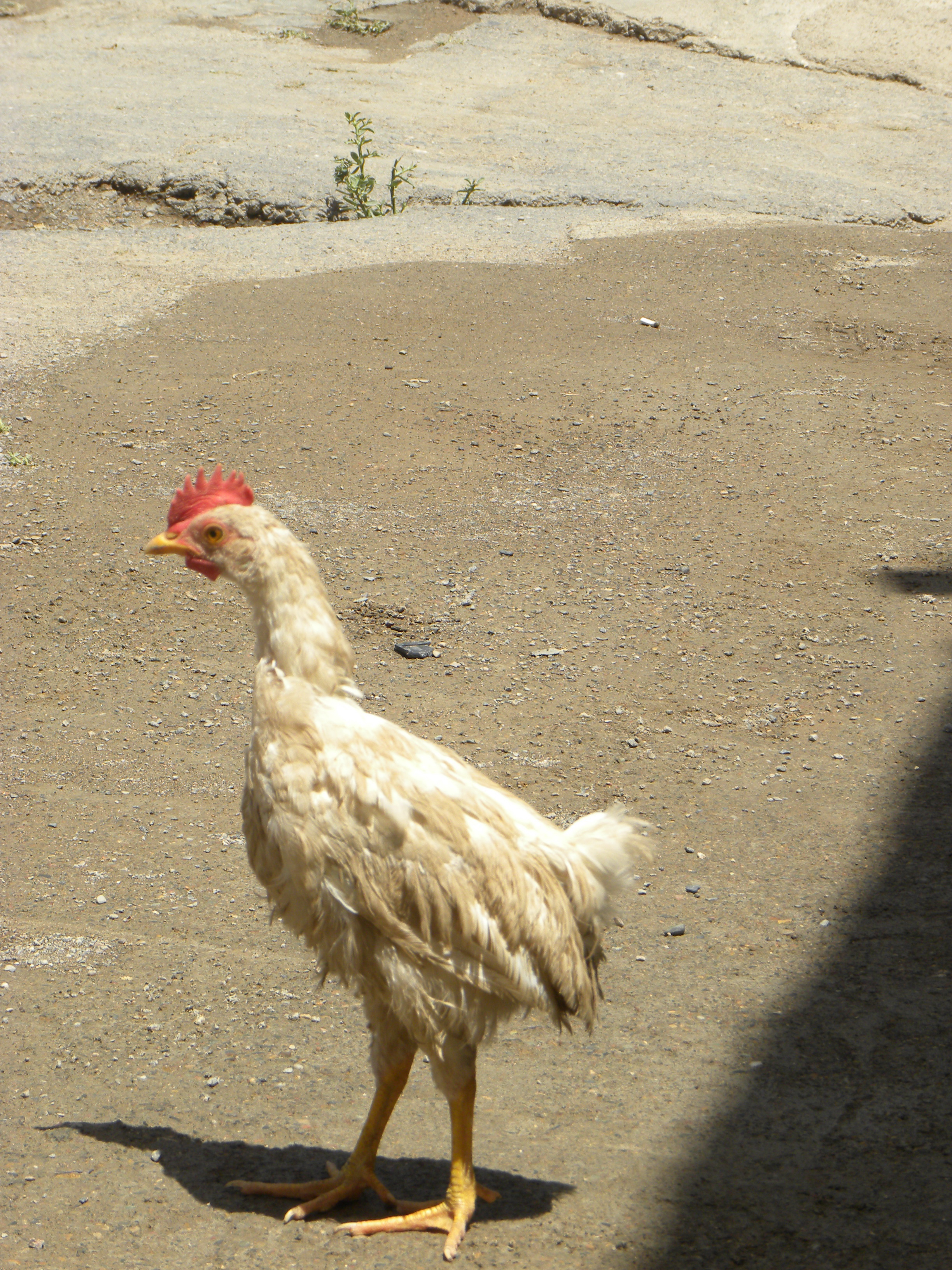
Antibiotic Free Chicken

Antibiotic Free Chicken?

Should you be wondering where “One Small Change” went, it is crazy hectic at work the last few days. It’s not a lot better at home. To make matters worse, I have run out of gigabytes of data on my data plan (I blog using my MacBook Pro and my iPhone hotspot) so I have to ration my work computer time severely. This leaves me only trying to blog from home, where I have a million other things that need done, instead of entertaining you, Dear Reader.

As luck would have it, at the same time that I have next to no time to write about things I read online, there is reams of good stuff to write about online. Grrrr.

There is the school that took an elementary schooler’s Oreo cookie snack away, that she had brought from home. Her mother, the freedom loving woman that she is, got the story on the nightly news in Aurora, Colorado. Here is a link.

I commend the mother for packing a lunch for her child, or children, as the case may be. Most of the school lunches these days are full of processed foods. They are ‘low fat’ and will be high in carbohydrates to make up for that fact. It is reported that kids don’t like the lunches at school. This is much the same as it ever was, but the difference is that now the lunches are produced in many school districts by vendors, for profit. Profit is a problem when it comes to feeding children. Nutrition is not inexpensive. Nutrition is not quick, and nutrition does not store well on the shelf. All of these disadvantages of nutritious food are reasons that our kids don’t get nutritious food at school.

Admittedly the inclusion of the four-cookie snack would probably allow this kid to eat desert first, and eat lunch if there is room after cookies. It is what I would have done. Taking the snack away was probably the right thing to do, but not giving it back was a little bit draconian. We will never know how this turned out, but the issue of nutrition is not really being debated, at least not in this story.

The biggest story in the last few days though, is this one:

Why Tyson antibiotic-free chicken is a bigger deal than GMO-free Chipotle

This really means that the ‘Market’ is winning. You or I didn’t even know that they were feeding antibiotics to our food animals a few years ago. The only reason it is done, feeding sub-therapeutic quantities of antibiotics to our food animals, is that for some mysterious reason they grow fat on less food when you do. The statistics vary, but it wouldn’t have to be a big effect for it to be worth doing for the food industry. In a world where profit is king, finding something cheap like antibiotics that can save you even ten percent of the total food bill looks like it has no downside at all.

But, it does have a down side. Antibiotics you feed to a food animal do not disappear when they are slaughtered. When you eat antibiotic laden meats, you too are getting a sub-therapeutic dose of antibiotics. The mysterious reason that the animal grew faster and fatter on less food would work it’s same magical spell on you. You would get fatter on less food. The microbes in your guts would be modified by eating meat that contains trace amounts of antibiotics. Recently the down side side effects of feeding antibiotics to our food animals have come to light. It is one thing when McDonalds says it will stop buying these kinds of meats, and it is an entirely different thing when a producer says they will quit making them.

Tyson Foods, which announced Tuesday that it will phase out antibiotics used in human medicine from its poultry supply by 2017, is quintessential Big Food. An estimated 1 in 5 chickens sold in the United States come from Tyson; with $11 billion in annual poultry sales, it supplies the chicken found in McDonald’s chicken nuggets, among other things. But Tyson’s announcement is a far more impactful one for the food industry at large, both because of its sheer size and the scientific support for such a move.

The big, profitable food producers stopping a practice makes it easier for smaller producers to compete economically. Now it’s not so hard for your local farmer to sell his chicken, because the lowest cost chicken is more expensive. It makes it easier to do the right thing. I will have one less reason to not eat industrial meat, but there are plenty of reasons left to me.

Posted in Health, Living | Tagged , , , | Leave a comment

How Can Busy People Grow Crops?

Great How To on gardening in a small plot with little time to spare…

Sophie Hudson's avatarThe Forget-me-Not Cultivation Blog

Good morning to you 🙂

Today’s post discusses organic food. What is it, and why it’s organic.  More especially with our lives getting increasingly busier could we grow organic crops ourselves?

A friend and colleague asked me the other day if I could point her in the right direction of places that sold organic fruit and veg to buy.  Other than the rather good selection in certain supermarkets (or a German origin), the only other places are either online and pay ridiculously high prices for the privilege of having them delivered to your door or skulk about various other supermarkets in the hope of finding a bunch of carrots or a bag of salad, after which you take them to the till to be horrified at the price.

I did offer one other alternative to my friend – to start growing her own.

Of course being a full time busy…

View original post 1,866 more words

Posted in Health | Leave a comment

Sugar Found to be Health Food, Studies Show!

Today I dredged up some four-year-old crap that CNN put out. Back in 2010 they reported that a “Nutrition Professor” from Kansas had eaten a reduced-calorie diet that was mostly snack and junk foods. According to him his blood chemistry readings improved and over ten weeks he lost 27 pounds.

The problem with a “news” report like this is that, given the professor is a nutrition professor, the story has the aura of science surrounding it. A real scientific study would not contain one subject, that subject would not perform his own measurements, and the conclusion would not be stated at the beginning of the testing. This professor went into this to prove that it doesn’t matter what you eat, just losing weight by restricting calories will improve your health markers.

I am not a dietary scientist, so I am not qualified to destroy the results of this work. Losing weight has health benefits, but a calorie is not just a calorie. Getting all of your calories, or the majority, as in this case, from sugar is unhealthful to the extreme. Many people get their news by reading the headlines and will undoubtedly miss the point of this ‘study’ that showed that losing weight is an isolated good. Those people will just see that eating twinkies is not unhealthy.

I searched around for somewhere that a more qualified person could analyze the results of this ‘study’ and I found this:

Harder. Better. Faster. Stronger.

In this blog post, the author goes by Raj, and I could not find other name information, perhaps he will see this post and provide more information in the comments.

An excerpt or two:

Hence clearly he [Haub] was on a daily deficit of much more than 800 calories. As a matter of fact, in order to lose 2.7 lbs per week he had to be on a calorie deficit of ~ 1,350 calories. Assuming the 2,600 calorie number is accurate, Haub should have eaten ~ 1250 calories per day for 10 weeks in order to lose the 27 lbs!

Point one, the data collection in this study is questionable.

His “bad cholesterol” or LDL dropped by 20% – His LDL dropped from 153 to 123 which isn’t much at all considering he lost a whopping 27 lbs. Also, judgement on this is reserved until the particle size of his LDLs have been measured. A high (processed) carb low calorie diet reduces your LDL but converts them into small dense particles which are lethal.

His “good cholesterol” or HDL increased by 20% – Once again this is not much at all. His HDL went from 37 to 46 which is not remarkable by any standards. I compared my blood work from the days of low-fat grain based eating to my blood work after starting to eat a low-carb, real food based diet (paleo/primal) per diet guidelines from Mark SissonRobb WolfRichard Nikoley and Martin Berkhan (IF). My HDL increased by a whopping 85% (39 to 72) for a weight gain of ~ 5 lbs!

He reduced the level of triglycerides, which are a form of fat, by 39 percent (120 to 75). – When you consume a surplus of calories (fat or carbs or protein), the body uses what it needs to fuel your activities and converts the rest to triglycerides (and subsequently stores it as fat). But when you are at a calorie deficit you are consuming lesser calories than is required by your body. This means that the body has no surplus calories to convert to triglycerides. As a matter of fact, your body taps into the body fat stores for energy resulting in fat loss.

So, once again, a 39% drop in triglycerides for a 27 lbs weight loss is shameful. I, once again, compared my blood work from the days of low-fat grain based eating to my blood work after starting to eat a low-carb, real food based diet (paleo/primal). My triglycerides dropped by a whopping 83% (170 to 29) for a weight gain of ~ 5 lbs!

There is more to every story than meets the eye. The CNN headline was ‘Eye Bait’ to get viewers to look at them. It worked on me, four years later. I knew that there was more to it than that headline, I read the story. After reading the story I knew there was more to it than was reported, I hit Google. I found what I wanted, thank you “Harder.Better.Faster.Stronger.”

Ninety percent of the population will not research a story they read on the internet, despite the fact that it is so easy. We have all seen over and over the Snopes debunked things passed around like the wave at a sports stadium. It’s so easy to find out they are fakes, but people keep reading, believing, passing. Most of them are harmless.

Bad science stories about diet and nutrition do hurt. Places like CNN should revise or take their stories down. People will read and reap the rewards of continued poor diet owing to this kind of ‘science’ story.

I went to Haubs’ Facebook page and he has a lot of stories that support sugar not really being to blame for health problems or obesity. It makes one wonder.

Posted in Health, Living | Tagged , , , , , , , | Leave a comment