You’re Not As Young As You Used To Be

You’re not as young as you once were is one of those stupid sayings that just states a fact. Every moment of your life this is true about where you are now compared to where you once were. As you get a lot more years in the ‘used to be’ category, though, things just have to change. We are in our fifties now, and we just can’t eat like we did when we were in our thirties. Foods that once had no effect now seem to be excessive or troublesome. Now, instead of chasing the kids around I am just chasing the wife around, and she’s not nearly as hard to catch up with as they were. Since my life isn’t consuming as much energy, I also don’t need to consume as much energy.

The National Institute of Health has a nice article about the things to think about as you consider how your foods should be changing as the years pile up. They list eating less, food in-tolerances, quenching thirst, dietary fiber, salt and fat content of foods, safe food handling and living on a fixed income as areas of concern for the over fifty diner to consider. If you are on the no-sugar, low starch detox with us still, then you have a lot of these bases already covered. Cutting back on added salt is really easy to do if you are cooking your own meals, but not as easy if you eat out much.

Women in menopause have even more to think about when it comes to food that they must watch out for. Some items are known to instigate hot flashes. Women whose hormones are changing can find things that have beneficial nutrients that add to their body’s ability to adjust to the changes. Dr Oz has an article dedicated to the special considerations that women in their fifties might check into.

In the article he advises that a person consume more fats that contain Omega 3, which is something that I would like to expand on. Since there are a lot of places you can purchase fish oil, which is a possible source of dietary omega 3, it is worth understanding what omega 3 is and where it comes from. Omega 3 is a dietary fat that must come from your food. Your body does not create it. Also, your dietary balance of fats must contain a ratio of omega 3 fat to omega 6 fats, which also come from your foods. A healthy diet has a balanced ratio of these two fats. An imbalance can cause problems, this from the NIH:

Excessive amounts of omega-6 polyunsaturated fatty acids (PUFA) and a very high omega-6/omega-3 ratio, as is found in today’s Western diets, promote the pathogenesis of many diseases, including cardiovascular disease, cancer, and inflammatory and autoimmune diseases, whereas increased levels of omega-3 PUFA (a low omega-6/omega-3 ratio) exert suppressive effects.

Just about every list you see of sources for this omega 3 fat is loaded up with fish. The reason that these fish contain that oil and not omega 6 is that they eat plants like algae and other water plants. There are chicken eggs that contain omega 3, and those chickens are free to eat grass and plants and are not fed grains. Corporate eggs have omega 6 oils because they are fed grains (and ground up dead chickens). Beef raised on grass contains omega 3 oils. Grain fed beef contains omega 6. See the pattern developing? We, here atop the food chain, must eat foods that contain an oil that comes from a source that we cannot eat–grass (or plants). If all of our meats and eggs were eating their natural diets then we would have a plethora of choices of foods to eat that contain this essential oil. Since our food are confined and force-fed foods that do not come natural to them, then we must look to the oceans for food sources that do contain it, because we have not figured out yet how to get salmon to live off of corn.

If you have a source of farm raised eggs, use it. If you have a source of grass fed beef, or foraging hogs, this is where you should get those things. They contain something that the feed lot beef and hog-prison pork just can’t. Omega 3 fats.

I wish I could get everyone who reads my words to quit buying your beef and pork at the grocery store. If we all did then the people who are raising cattle and pork the way they are, with the only consideration being how to cut one more nickle out of the cost of raising a hog for slaughter, would quit doing it. Perhaps they would go back to the old time tested ways that our bodies evolved to take advantage of. In the tens of thousands of years that men have been husbanding animals we have evolved to contribute to one another cheaply and easily. Cows eat grasses provided for free by nature, in such quantities that we must mow it and store it, and it will feed the herd all winter long. Instead, we feed them grains that would kill them unless we medicate them against the symptoms, robbing their meats of the essential nutrients that our bodies need from them, all to make them grow quicker so we can eat them sooner.  It seems like a colossal waste of energy to degrade the product just to sell it quicker.  Someday it won’t be like this.

Posted in Health | Tagged , , , , , , , , | 10 Comments

Music City Madness

Went to Nashville, and it turns out that for us this place is far off the sugar-free reservation. We ate what we wanted, and paid attention to the reasonable choices that were available to us. We had beans and rice at a Mexican restaurant, we had desert after our anniversary dinner. I ate potatoes of every kind, but mostly the french fried kind. We ate like we used to with two big exceptions. We never had a soda of any kind, and we ate no breads.

It is important when you are just changing your eating habits that you are not hard on yourself when you decide to have a sweet treat. It is no failure to decide that after your anniversary dinner you can have a sweet dish with candles, chocolate mousse, crunched up heath bars and a brownie. Then, when it’s too sweet to finish, you are free to think that some sweet deserts are only for the sweet-addicted. Our palate has now shifted to more asian semi-sweet deserts, or something lightly sweetened like a tiramisu.

Personally, I do not feel as though I have suffered a setback of any kind. Far from home and not able to cook for yourself is a serious limit on changing habits. We didn’t want to spend any time looking for special menu restaurants, we wanted to see the sights. It was easy to have water with every meal, and that was how I stayed on my plan. My one small thing is really no sweetened sodas, and I was true to that.

It was a little bit harder to walk past all of the honky-tonks and pass up all the great parties that were going on than it was to not drink a coke with every meal. Nashville is a great place to visit, and the choices that you make are all in the moment. As you walk on the street it would be an easy thing to decide to do something you wouldn’t normally do. Making that decision is not any kind of defeat, but it is something that you will feel. Having that desert will make you a little bit uncomfortable, physically. You might sweat a little bit. You might feel a little bit of inflammation. The nice thing is that as a non-sugar addict, you can take refuge in the knowledge that what you are feeling is fleeting. In just a day your chemistry will be back in balance, your gastric system is not reset to expect the flood of sugar at every meal.

If your life were lived on the road, say you drive for a living, it may be very difficult to live sugar and starch free. In that case you might have to find ways to eat that are a little bit more work. For a vacationer, since the change is short-lived, it is simpler to just stick to the reservation for the easy things like drinks, and to go ahead and eat the foods that are readily available. I made no deals with myself to allow the excesses. I just rested easy in the knowledge that what I was doing WAS part of the plan. Eating well every day gives me the cushion to eat what I have to when I have to. NO HARM NO FOUL.

I am glad to be back, I missed writing, too.

Posted in Uncategorized | Leave a comment

Science Progresses One Funeral at a Time

Professional people that compile the science of our lives are in the end just people like we are. As people they tend to maintain their biases and prejudices. They like their work and they grow attached to the things they have created. Nobody likes to be wrong.

When writing about scientific progress, one of the greatest physicists, Max Planck wrote in 1950, “An important scientific innovation rarely makes its way by gradually winning over and converting its opponents. What does happen is that its opponents gradually die out, and that the growing generation is familiarized with the ideas from the beginning.” If you consider the history that you know, this sentence rings with truth. The FACT that you know the Earth to be round and that it orbits the sun is due in large part to two things. A brave scientist spread the idea, and the powerful detractors of that idea eventually died off. The new people in the world, having no existing bias against the truth were free to embrace that and move on.

We live in such a time with regards to dietary science. In the late 1950’s there grew up a body of work suggesting that diets that contained fats and cholesterols would lead to a body loaded with fat and cholesterol. Heart attack and stroke were blamed on the ‘fact’ that if you ate fat you got fat. In your veins the fat would plate out, on your hips the fat would build up. I was born in this time period, when the scientific world was just getting warmed up to this notion. To me it always seemed too simple.

Years later I was watching the movie “Lorenzo’s Oil“, a true story, and the protagonist, Augusto Odone, was a diplomat in the US when his son was struck ill by a disease that was causing him to become paralyzed. Odone researched the illness himself when western medicine would not. His doctors had him cut all oils out of Lorenzo’s diet, to keep his body from manufacturing too much of a certain type of cholesterol. Odone found out that actually Lorenzo needed to eat more oil in his diet, his body was CREATING oils that it needed, and denying oil actually made this process worse. I write all of this because it pointed out to me that science is the accumulation of knowledge, and answers are suggested by facts and study. The idea of cutting fats from the diet to control body fat sounds simple. That conclusion seems natural. Its just wrong.

In my world there was increasing activity at the grocery store to capitalize on the low fat science. Low fat milk took a product that has been safely consumed for as many years as the cow has been domesticated and removed some fat, replacing it with sugar. Just about every product where fat is removed, the fat is replaced with sugar. For decades now we Americans are consumed with the idea that eating less fat would reduce our body fat, not realizing that we are eating more sugar in the process. It comes as no surprise to me that by now two out of three of us is overweight, and that the epidemic has spread to our children in grade school. Knowing that a serving of low fat chocolate milk contains the same amount of sugar as three Snickers bars should be an eye opener. Here is a case study by two British twins, one living in the US and one the UK. Any healthy food, like yogurt, can be turned into poison if you put enough sugar in it, like GoGurt.

Yet, despite the facts and dangers caused by our previous science, there are scientists willing to argue that the ‘new’ ideas about fats and carbohydrates are coming from incomplete data or flawed science. This will continue until these scientists are all dead, if history is any guide. They will continue to support the ideas that they are credited with. They will continue to skew arguments and data toward low fat and low cholesterol. History will wait them out. In time it won’t matter if their beliefs are theirs or due to where their funding comes from.

We need not wait for the science to come in. Right now we can stop eating anything in a box. We can stop eating anything that has a health claim on it’s label. We can prove to ourselves by losing weight while eating lard and butter that the idea that eating fat makes fat is to easy to be true. Your diet is yours. Your habits are yours.

Posted in Uncategorized | 2 Comments

Just Deserts

What is life without a sweet treat at the end of a dinner gathering? I, for one would not relish the idea of living life confined to savory dishes. It would be unnatural, too, since we live in a world where we are encouraged by the plant to eat the sweets she provides, if only to carry the seeds within to new locations thus spreading the species.

The good news is that even if you are cutting artificial sweeteners and processed starches and sugars out of your life, there is no reason to cross the treat at the end of the day off of your menu. Plus, unless you tell them, your guests will never guess that what they are eating is ‘less than’ a dessert they would purchase that is fully loaded with sugars at their favorite dinner time eatery down the street. We smart eaters can easily find things that both reward us by being delectable and that reward us by being good for us and just plain good.

Last night here at the Cafe De Carmack we had just such a treat. Frozen fresh fruit, natural ingredients, and power tools combined to bring us this no-cook bit of heavenly flavor. “Chunky Monkey Ice Cream” contains no monkey, and no cream, but for the ability to make one think that they are having ice cream with enormous icebergs of nutty chocolate there is nothing else quite like it.

20140516-090114.jpg

The site, Raw Guru, that it came from is worth bookmarking as well. We have mined this treasure trove of great ‘paleo’ recipes for things like this many times. It is especially good at finding and publishing no sugar desserts. We have had some terrific fruit based, easy to prepare foods that will go a long way to satisfy your cravings for sugar. I, like you, am not on a quest to live a monk-like sequestration from the joys of food. I am on a quest to recreate life before refined sugar became the end of thinking when one considered how to make a food sweet. It turns out to not be hard to do, but we have to BREAK THE HABIT of grabbing for the syrup or sugar bowls when we are thinking about sweetening our lives up. We have to create new habits, and a new source of inspiration, if we want to reach our goal of living life differently, healthily, without fear of increased risk of disease and debilitation.

It has been incredibly fun to share our journey these past weeks. I seriously enjoy the comments that I have gotten, because writing is a craft that usually gets no feedback to let you know that you are meeting the intellectual needs of the anonymous and diverse readership that is out there. If you want to leave comments, there is a comment box at the bottom of every post. I can’t tell you right where it is, due to not having access to just your brand of computer or browser to see, but I assure you it is there. If you think of it, leave links to sites you have found that share recipes and advice for the newly health-conscious diners like we are. Do drop me a note, close the feedback loop and it will be appreciated by all of our readers, it may even inspire the next blog post!

Posted in Uncategorized | Leave a comment

It’s Not a Diet, It’s a Change

One of my favorite food people in the media is Mark Bittman, and he has a new book out, where he helps people learn how to cook without having to resort to processed foods. The basic gist of his way of eating is to eat fruits and vegetables morning and noon, and have a meat entree (if you want) at dinner time. He calls the idea VB6 or ‘Vegetarian Before 6’. This idea is really the gist of what I am trying to do with my diet changes and with my life. Eat moderately, eat vegetables and fruits, and don’t sweat anything, but especially don’t sweat weight. I am not trying to lose pounds, I AM TRYING TO LOSE HABITS.

In an interview with Salon magazine at Salon.com, Bittman describes the difference between a diet and a change of habit this way…

What I’ve been saying is that dieting is about deprivation. And this, at least in the beginning, is more about delayed gratification. You’re unlikely to see so-called results in a week, and the other thing is that if you want to see results you will be have to be pretty strict. But one needs to be non-dogmatic or one is going to freak out and say, “This isn’t working for me,” and give up.

It’s hard to convince people to be moderate. We hear, “You can only eat this way and if you go off, you’re bad.” With this, if you go off it, don’t worry. But live mostly that way forever. That doesn’t mean that if you’re dying for a slice of pizza you don’t have it; it means that’s not your everyday.

If you agree with me that what you need to do is change what you are eating so that you can get off the blood pressure and cholesterol medicine train, then you owe it to yourself to get these two Bittman books. The first is the VB6 philosophy book.  Super Quick read, and very informative.

Image


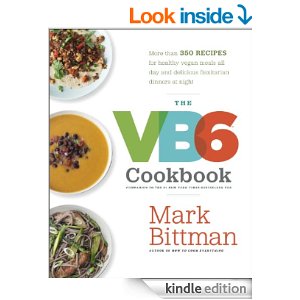
After you are done with that one, read it’s companion book, that describes for you how to make the VB6 concept happen as easily as possible, in your busy life. The VB6 cookbook tells you how to cook these foods. If you have never read a Bittman cookbook it’s not like any other one. He gives you a basic idea of how it’s done, guidelines, and then suggests some variations on it to make the dishes your own personal favorite. This gives you the idea that in order to cook good meals you don’t need to read your recipes like the bible, where any deviation is a sin, but you can mix and match ingredients. It is encouraged. He lets you play with your food! This twelve dollar book is a great introduction to the Bittman method of cooking.

Image

When you are done with those two books, you should then get the encyclopedia of cooking that has been around for quite a while, it is called, humbly, “How to Cook Everything”. When I say encyclopedic, I am hardly kidding. This book comes in at 1056 pages, and has instructions on how to make the most basic ingredients like Mayo and Ketchup, all the way to the fanciest of dishes. Each recipe comes with the list of Bittman trademark variations.

Image

There is also a “How to Cook Everything” app for your iPad, that has all of the bells and whistles. It is easily the best recipe app on the market. 


Posted in Health, Uncategorized | 1 Comment

Safe for Children

At some point during my lifetime, the government quit watching over the ingredients that go into foods. I am sure that they quit doing a great deal of the great social things that the 1930s got started, but lately the loss of oversight in food manufacturing is having the biggest effect on our health and future. The children that are eating today’s food are suffering from life with parents too busy to make food from scratch, and packaged foods that contain ingredients that have never been checked for safety by a neutral third party (the US Government).

P4261189-1024x768[1]

In 1958 there were around 700 added ingredients in manufactured foods. Legislation that year, the Food Additive Amendment, cut the approved number down to 188. However, new ingredients could go in that were not on the list, and by 1980 the number had grown to around 2000. In 2011 the Pew Charitable Trusts tallied the number again and it is over 5000. There is no comprehensive list of ingredients allowed to be added any more.  The process of approving them has been ‘streamlined’ so that regulation need not get in the way of progress (or profit). This has left us with a system whereby ingredients may be approved as safe by the manufacturer, through a process dreamed up by the manufacturer, and added to your diet without even an email to the FDA that it has been done.

Well, at least we don’t have to worry about whether they are safe to eat over the long term or whether they are safe to be consumed by growing young bodies. The industry must get the FDA to approve their new ingredients as Generally Recognized As Safe (GRAS). All that must be done in this case is to notify the FDA that a food safety assessment has been performed on a new ingredient. No approval or veto of this notification by the government is allowed for. If the FDA makes a company withdraw it’s notice, it can just ‘retest’ and resubmit the notification.

Can this cause problems?

Red Dye in foods was withdrawn from foods in the 1970s because it was found to cause tumors in lab animals. It came back recently and is now in your foods again due to the byzantine and ineffectual process of regulating additives described above. It is known to cause hyperactivity in some children (I know at least one) and may be the reason so many children are on hyperactivity drugs. Why would you cut out the cause of the hyperactivity when you can sell a pill to mask the symptom? There are numerous reports of this problem, here, and here, for instance, but don’t be surprised if you have been too busy to notice the warnings. Like all news it is all ‘balanced’ with reports of ‘scientists’ that don’t think there is a real problem. This from the Forbes article:

Not surprisingly, the Grocers Manufacturing Association, whose members includeCoca-Cola, Nestle and General Mills, questions the validity of these studies and claims made by groups such as the CSPI. While the FDA does not reject the proposition that the remaining approved artificial colors may carry adverse health effects, its representatives generally agree, stating that further evidence is needed before another ban is enacted. FDA scientists have theorized that bad reactions to artificial colorings in certain individuals may be similar to a food allergy, in that they only affect a small group of people and need be avoided by those select individuals only, as opposed to the entire public.

Yes, by all means, continue to study, even though there is no government group that is actually doing such a study, sequester and all. The best advice in the article is in that last sentence there…”need to be avoided by those select individuals only”. They are talking about dyes in foods. However, this advice applies to all 5000 ingredients. Noone is watching out for YOU. They will not be banned if they cause thousands of people mysterious problems, it is up to YOU to figure out which ingredient doesn’t work for YOU, we can’t penalize the rest of US and condemn the rest of US to slightly more expensive or slightly less long-lasting foods to help just the people who have a problem with an ingredient.  Here is the bottom line. You may not have a problem with red dye or yellow dye, or even 4990 of the 5000 ingredients. You probably have a problem with one.

SO, the solution is not to wait for the government to pick up the job and perform the basic function of government and protect us all from the profit motive. The solution is to take matters into your own hands. Make your own foods from basic ingredients. There are no additives in eggs yet, no additives in oatmeal. Make your own cereal mixes, put them in quart jars, let your kids pour that into a bowl. Put whole milk on it or almond milk that you made, and once again no additives. Send fruits with them for lunch, and nuts, and maybe even make your own granola. None of this is hard, but it takes some planning. There need not be any added ingredients in foods you make for yourself. Maybe MS is from one of the 5000. Want to figure it out for yourself, or would you just like to go with me the easy route and make all your own foods?

Posted in Health | Tagged , , , , | 4 Comments

Tre’s Kitchen- Post Mother’s Day Meal (Crawfish & Crab)

Here is a perfectly good no sugar, all natural meal you can serve a crowd and everyone gets what they want. You don’t have to eat the potatoes, and they don’t know just how healthy they are eating. Feeds about eight people if you add more shrimp.

Posted in Uncategorized | Leave a comment

Monday, Monday, Can’t Trust That Day

Just kidding. Monday was an uneventful day, meaning that the event we had scheduled ended up with no attendees. Last week was well attended but this week, just us two organizers were there. We practiced our string instruments instead. Next week’s meeting will be promoted more thoroughly by us, and we welcome all interested readers to help us support one another in getting the sugar and starches out of our diets.

I think it may throw some people when they read me reporting that giving up sugars is easy. By that I mean that it has to be easy or it doesn’t work. The idea behind our movement is to do the easy parts and get them firmly into your daily habits, then bring in another part, which is then easy, having done the previous part.

If I told you to give up all sugars and starches, from day one, and never go back ever on pain of failure, that would seem hard, looking into the unknowable future. So I am not telling you that. I am not telling you that to do that would be easy. I didn’t do that, myself. If you think that giving up all sugars (which means added by you and added by the evil food corporations for you), that might also be too hard for you. You should keep paring back the change until it is something that you can undertake while thinking, “Ok, that will be pretty easy.” Let’s say all you are comfortable with is giving up canned and bottled soft drinks. Notice I did not say sugary drinks, because I personally refuse to believe that replacing sugar with artificial sugar is a forward move. I recall when real fats like lard and butter were replaced in our ‘good foods’ category by transfats and margarines, and now the science is in. I figure that the science just isn’t in on the new manufactured sweeteners. For myself I am not waiting for that science, no canned or bottled drinks for me at all! So back to my point, let’s say you agree that just doing that part wont be too hard for you, and you give up the sodas. After a month, you see that it was in fact really easy to do that part, so you give up boxed foods, frozen and dried. When you have done that a month you give up potatoes and pasta.  See where this leads, but the time you are three months in you are pretty much where I am, and your sugar and starch consumption is just about down to nothing, you have done what you thought was too hard to do on day one.

Another thing to consider is the occasional setback. We all have them. I gave up smoking years and years ago, but I have a cigar with friends out by the pool from time to time. It is a social thing and I CAN be a social smoker. I gave up drinking and it has not been long enough yet to allow me to be a social drinker. Maybe some day I can have a beer with my buddies, but right now that is like playing with matches in a pool of gasoline. I know my limits. You know your limits, too. When you are trying to change your life, it helps to not beat yourself to a pulp if you sneak a candy bar. You can’t hide it from yourself, even if you can hide it from the rest of the world, so when you violate your own boundaries, you pay the penalty to yourself. The smart course of action is to recommit to the plan, and don’t repeat the violation. The dumb thing to do is to quit the plan because you had a lapse of commitment. There is nothing wrong with the plan or with you, you just haven’t been in the plan long enough for it to have changed your normal way of thinking. Give it more time, the slips will be fewer and farther between, and you will succeed. You have the rest of your life to get it right.

In my honest opinion, there is no such thing as easy weight loss. So I am not losing weight. I don’t think of what I am doing as being on a diet, because I am not denying myself anything that I really want. I really wanted some granddaughter birthday cake. No problem, I am not on a diet. What I am doing is losing habits, and I am losing them the way that I learned them, gradually, a habit at a time. It’s just that easy.

Posted in Uncategorized | Tagged , , , , , | 1 Comment

And Now, For the News

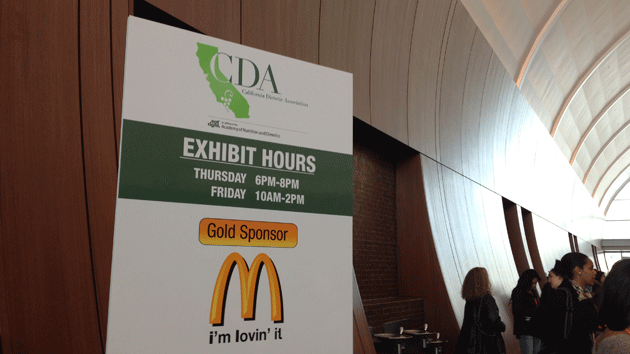
Ok, just finished my longest blog post ever, and am reading one of my favorite online magazines and this is on the front page. Of course I have to comment! It seems that this California Dietetic Association annual conference was sponsored by the big names in nutritional foods: McDonalds, Walmart, the Corn Refiners Association. Perhaps these names seem out of place, but no!

Image

Here is a sample of one of the breakout sessions, where there was a great deal of ‘Truthy’ information to put out…

I attended “Sweeteners in Schools: Keeping Science First in a Controversial Discussion.” Sponsored by the Corn Refiners Association, whose members produce and sell high-fructose corn syrup, it included a panel composed of three of the trade group’s representatives. The panelists bemoaned some schools’ decision to remove chocolate milk from their cafeteria menus. Later, one panelist said that she’d been dismayed to learn that some schools had banned sugary treats from classroom Valentine’s Day parties, which “could be a teachable moment for kids about moderation.” The moderator nodded in agreement, and added, “The bottom line is that all sugars contain the same calories, so you can’t say that there is one ingredient causing the obesity crisis.” The claim was presented as fact, despite mounting scientific evidence that high-fructose corn syrup prompts more weight gain than other sugars.

As you know from reading my blog previously, a chocolate milk serving contains as much sugar as THREE SNICKERS BARS. The decision to not offer it to children as a lunchtime choice is a very necessary defensive maneuver. Would these same panelists like to see Snickers Bars offered right next to the school lunch, that the kids could take as many as they want to fill up on?

So, if you are still reading this, go to the article. Apparently, you can learn all you need to know about food by listening exclusively to the people that make it. No conflict of interest is going to affect the tone of the panel discussions, right? 

Andy Bellatti, a dietitian and member of AND, recalls his shock the first time he attended the organization’s national conference, in 2012. “I could get continuing education credits for literally sitting in a room and listening to Frito-Lay tell me that Sun Chips are a good way to meet my fiber needs,” he says. “I thought, ‘No wonder Americans are overweight and diabetic. The gatekeepers for our information about food are getting their information from junk-food companies.'”

Of course, all of the dieticians are not made members of the corporate food mafia and tried to do something about it…

They worried that if word got out that dietitians’ professional organization had been bought out by food corporations, the profession would lose credibility. So Bellatti and several other members founded Dietitians for Professional Integrity, consisting of academy members who want to change the sponsorship policies. They lobbied the leadership, but nothing changed—except for the rules about photography at the annual conference. The following year, when Bellatti took out his camera in the exhibition hall, he was told that photographs were prohibited.

See, change! Now you can’t take any pictures at the conference, and outside journalists are discouraged from attending, lest we all get the wrong idea about where the dietetic associations true interests lie. The real science is out there, but you may not get it from your dietitian. You may have to find it from places where the corporate money doesn’t have such a negative effect, like the NIH, or the CDC, where they have to deal with the consequences (health wise) of the pis poor choices we are being convinced to make.

Watch ‘Weight of the Nation’. It will change your life. Then, of course, change your life.

Posted in Uncategorized | Tagged , , , , , | 1 Comment

Habit, Thou Art The Enemy

If you asked me on March 31 what I thought would be the biggest stumbling block to giving up sugar, I would not have told you the right thing, because I would not have guessed back then what it was. My thought was that to change my eating habits would involve mostly willpower, and the strength to resist the sweets that were available. I have posted on just about every occasion that I was tempted like that, look through the archives. Sometimes I made it, sometimes I succumbed, and it turns out that these events aren’t that frequent, or that important in the overall life change.

Actually, the biggest deterrent to consistently eating healthy day in and day out is my limited imagination. Cooking used to be, “what’s for dinner” meaning what meat do we thaw out. You know, meats and fats aren’t the problem, so we haven’t had to change the process at all as far as the main entree goes. No, the problem is that now we have to think “What goes with that, that we want to eat.” In the past we could just cook potatoes in one of their many forms, fried, mashed, boiled, baked, broiled…that was the go-to ‘I’m too lazy to give it more thought’ side dish. Meat, potatoes, and cottage cheese–if you ate with us, you had that very meal, probably 75% of the time.

Perhaps in your house it is “let’s see whats in the freezer” where there might be some Tater Tots, maybe some frozen fries. Maybe you would go to the pantry and break out the Kraft Macaroni and Cheese. Maybe you would make a Hamburger Helper. Opening a can of green beans or corn, put some butter in it (or -gack- margarine) and a little salt. Dinner. If you have to give it much thought, well, why give it much thought! The kids will eat this, it’s filling, and before we cared about sugar and starches, at least it’s not fast food.

So, now that kind of thinking is out the door. We have to think about side dishes that don’t hurt us with easy starch or sugar, because we really don’t need them at all. It turns out that side dishes can be just as quick the new way as the old way, but we just need new arrows in our quiver, new go-to’s that come immediately to mind.  I am here to help. Today’s post will be all about the fast, healthy side dish, things that go with anything, are filling, and take just minutes to get ready–if you are ready with the supplies in your cupboard. No pastas, no sweets, no breads, no starches in this list.  Here we go.

The first and best of the bunch vegetable for side dishes is cabbage. There are several kinds of cabbage you can get for this job, napa, bok choy, green, red…it doesnt matter at all, you should get whatever is least expensive the day you are at the market. Any of the following cabbage dishes will be WONDERFUL with whatever cabbage you have. You just have to have a head or bunch of cabbage in your fridge so that you can make it quickly.

One thing to try very soon is buttery dressed cabbage. The best way to make it is to cut the cabbage into ribbons.  How much to make? Realize that it will look like a whole bunch of cabbage until it wilts, then it wont look like enough. A little bit goes a long way, but for each couple of diners you probably need to make a quarter of a head of green cabbage. Put your biggest pot on the stove and get the water boiling, put a tablespoon of salt and sugar in the water, boil the cabbage for about two minutes. If you over cook it it’s ruined, so just two minutes then strain it out and cool it off in the sink. Two tablespoons of butter in a skillet, a teaspoon of caraway seeds, and about a half cup of seasoned croutons, pulverized, and brown that until you can smell the caraway warming up. Mix in the cabbage.  This is your side dish.  Here is the recipe.

IG1B15_Sauteed-Cabbage_s4x3.jpg.rend.sni12col.landscape[1]

Cabbage also works really well if you put some salt and olive oil on big slices of it and broil them in the oven until they begin to burn on top.  That burned part adds a lot of flavor, and you can spice them any way you like.  Super quick and super good to have in your plans. Also you can try chopping cabbage up and frying it with some garlic and other spices, use a flavorful oil like bacon grease or lard, olive oil works too, and you won’t need to throw any meat into this side dish.  Literally ten minutes, tops.

Fresh green beans are also a terrific go to if you are short on ideas. Try just melting some butter or ghee in a skillet, and cleaning up some whole green beans (stems off) and toss them in.  Move them around every so often, when they start to leave brown stuff in the bottom of the pan, deglaze the pan with some chicken stock, put some sesame oil in there and some sesame seeds. You will not have leftovers of this side dish. Here is one way to do this…

greenbeans1[1]

You can essentially do the same thing with asparagus, but it works best if you blanch these in boiling water like you did the cabbage, because the tips will burn before the stems are fully cooked if you aren’t very careful.  Just don’t overboil because they are not very easy to fry if they are falling apart mushy.

asparagus[1]

You might look up some other vegetables that we are just now beginning to experiment with. Fennel is very good, looks like a cross between a green onion and a celery. Root vegetables are really good, like parsnips, and turnips. You have to get past those nasty names, but the vegetables themselves have been around for thousands of years for a good reason. Probably the only reason you haven’t eaten them more often is that Del Monte doesn’t put them in a can.

Salads have got to be mentioned here. If the dressings that you put on yours come out of a bottle, they are about half the quality of what you could, in seconds, produce for yourself. Who knows how to make Buttermilk Ranch dressing at home? I will tell you…it’s essentially two ingredients…Mayonnaise and buttermilk. Equal parts of mayo and buttermilk, season with salt and pepper. Every time I see a bottle of ‘buttermilk ranch’ dressing it makes me laugh. There is no way to make it without the buttermilk. Why not call it ‘Mayo Ranch’.  Just sayin’. How about Russian dressing? It’s Mayo and Ketchup. Equal parts. No added ingredients to make it last a million years in your fridge. No bottle to throw away half used months from now.

Maybe in another post I will show you how to make your own mayonnaise at home.  Come back later on and see.

Posted in Uncategorized | Leave a comment