Upset Weekend

Unknown

This weekend I was a solo diner. Eating alone presents it’s own challenges. It’s tough to cook for one, and eating alone is not comforting it’s only filling. I finally invited my son over to share in the eating, so that it would be worth the cooking. Overall I ended up not doing too bad a job at eating good, but I didn’t try too hard in the end.

From this Thursday I was a bachelor. The first night I had dinner at the airport, bar food. The first night I boiled a beef tongue that I had cured, so that I would have prepared meat for later meals. That was the high point of my eating weekend, as the change in schedule of being alone to cook and eat was more than my meal planner could handle.

I made a corned beef hash with potatoes, beef tongue and eggs. It was a good start. I ate a hamburger salad one night, using home made ranch dressing. Then, when my son came to spend the rest of the weekend with me, I made reuben sandwiches with potato chips and the next night was processed battered shrimp and processed potato tater tots. Oh yeah, root beer. Oh yeah, ice cream.

I would love to blame my son for being a bad influence, but the reality is that I was having comfort food. I wanted to just eat without thinking and having something I could fry quickly, and eat quickly, well…it was comforting. I could have grilled steaks instead of buying the shrimp. I could have roasted a pork roast I had thawed. Instead I heated up some tallow, threw in a pound of artificially flavored battered shrimp, followed by some enhanced potato bites and called it dinner. Each bite was a guilty pleasure.

Back on the wagon.

Posted in Health, Living | Tagged , | Leave a comment

Why Eating Fat Does Not Make YOU Fat

Eating natural fats in your diet will not lead to fat on your body. Your body doesn’t run on glucose, though it can. Some organs of your body do not consume glucose at all. You must eat some dietary fat to survive. You do not need to eat carbohydrate to survive. You could go the entire rest of your life without eating a bite of processed sugar and you would be healthier for it. You could eat five times more butter, lard or tallow than you currently eat and feel no ill effects from it.

Don’t believe me? Read this….

Fat: The New Health Paradigm

This is an article for investors, looking for new growth opportunities for their money.

Healthy living and changing lifestyles have proved powerful investment themes in recent years spanning a wide range of both companies and indus- tries in their reach. Research from the Credit Suisse Research Institute has sought to both enhance the debate and provide our clients with guidance in their investment process.

This study follows on from our 2013 report “Sugar: Consumption at a Crossroads” in examining another key component of nutrition and dietary make-up. We analyze in depth the ecosystem of “fat”, looking at the five types of fats, the main fat-rich foods and who produces them, the medical research on fat and the perception of doctors, consumers and health officials.

Here is the conclusion, in a nutshell, bolding is not in the original, but was added by me for emphasis:

We believe that we are at a turning point. Our own analysis and the most recent medical research support these new trends. Medical research has shown that eating cholesterol has basically no influence on the level of cholesterol in the blood or on potential heart diseases. Neither has the link between saturated fat intake and cardiovascular risk ever been proven. On the other hand, a high intake of omega-6 polyunsaturated fats (vegetable oils) has not been proven as beneficial for our health and trans-fats have been shown to have negative health effects. The higher intake of vegetable oils and the increase in carbohydrate consumption in the last 30-40 years are the two leading factors behind the high rates of obesity and metabolic syndrome in the U.S. Saturated and monoun- saturated fats are not.

Glucose is not the predominant fuel the body uses.

When adding up the composite fuel requirements, it is clear that glucose is not the predominant fuel the body uses. At rest (and even during moderate exercise) fat may account for at least 50-60% of fuel burned by tissue and much of the remainder is protein. This also means that according to current dietary guidelines (which imply more than 50% carbohydrates consumption) our liver must turn carbohydrates into fat to give our tissues the fuel they require.

Eating carbohydrate leads to fat production. Your body must have fat to survive and if you do not eat it, your body will create and store it.

Who still thinks that eating saturated fats is going to lead to heart disease? Well, lots of people do, it’s conventional wisdom…and it is wrong.

One of the biggest myths in nutrition is that saturated fat intake above a certain level—say 10% based on most dietary guidelines—significantly increases your risk of heart attack. This conclusion that has held for almost half a century is inconsistent with the wealth of epidemiological data or scientific evidence in the form of clinical randomized trials. Plenty of research funding has been earmarked to study and back this hypothesis, yet we cannot find a single research paper written in the last ten years that supports this conclusion. On the contrary, we can find at least 20 studies that dismiss this hypothesis.

A high level of saturated fats in plasma blood—not a good thing—is driven by the amount of carbohydrates we eat, not by the amount of saturated fat we eat. [bold in original]

There is no study that has ever implicated dietary fat as a reason that people gain weight. It has only ever been thought it might lead to blocked heart arteries. Nobody, ever, in a position of scientific authority, has ever implied that you will get fat by eating full fat versions of food.

Posted in Health, Living | Tagged , , , | Leave a comment

It’s Not the Weather

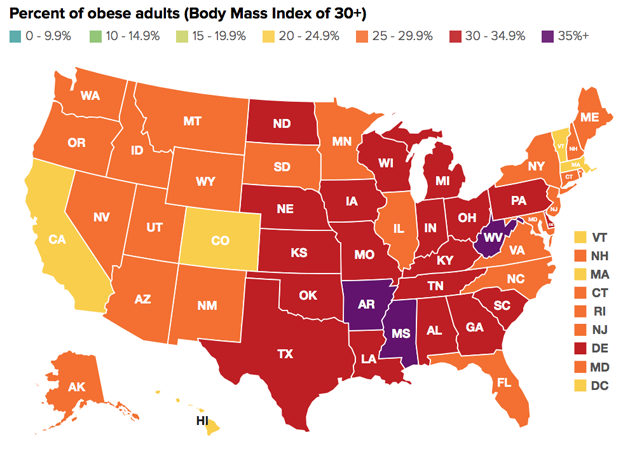
Here is an article that shows several medical statistics, State by State.

According to the article, the Midwest of the US and the South of the US are the fattest, sickest parts of the nation. If you read the comment section, it outlines the reason why this is so…because nobody seems to know why people get fat.

They blame the weather, it’s hot and humid, which, it is believed makes people stay indoors. This is the idea that not working really hard makes people fat. Why it would give them high blood pressure and diabetes is not discussed in the comment section, but they wrongly believe that weight and exercise are directly proportional. They are not. Some of the fattest people on the planet also have the most physically demanding jobs.

They blame eating fatty foods, even though you can’t get fat by eating fat.

Nobody, in all of the comments that I read blames carbohydrates. A few blame junk foods and processed foods, but because of the fats that they contain more than the sweets. People want to blame the obese for eating too much, but why, suddenly would 40% of the people in one state be eating more than they ever did? Answer:they aren’t eating more than before! The food they are eating is full of sweets and starches more than ever before. It’s not the people, its a combination of lousy advice and food that is getting worse and worse for them.

obesity

Posted in Health, Living | Tagged , | Leave a comment

What They Are Doing Is Not Evil

Danger-of-Food-Additives-Graphic-300x246

If something looks easy to cheat on it doesn’t mean that cheating is occurring. Lets say the IRS next year completely disbanded its army of auditors. That would not immediately lead to massive tax fraud. Some of us pay our taxes because we love to, not because we are forced to by threats of financial ruination and prison time if we get caught. Some of us do not sin, even though we have no God to believe in, either. But then, corporations have no morals, and their only goal is to make a profit. For them, lying, cheating and stealing have no chance of leading them either to prison or to Hell.

…in 1997, a change in the rules made getting something on the GRAS [Generally Regarded As Safe] list even easier, turning the stringent food-additive process into a vestigial organ of the regulatory system. The FDA said that instead of GRAS petitions— a filing process where agency scientists had to look at safety data and make a decision— there were now GRAS notifications, a system by which a company would assess the safety of its own ingredients, often by assembling a panel of experts. The company would then notify the FDA of its decision, unless, of course, it decided not to. The system, remember, is still voluntary. The GRAS process became so attractive to ingredient companies that everyone pretty much stopped using the petition process Congress had set up. Since 2000, there have been formal FDA “food additive

Warner, Melanie (2013-02-26). Pandora’s Lunchbox: How Processed Food Took Over the American Meal (p. 107). Scribner. Kindle Edition.

A food science company develops a new revolutionary new food chemical. They need it to be safe so they can start marketing it for human consumption. They put together a panel of experts to review it’s safety. That panel green-lights it’s safety and they inform the FDA that the new product is safe. To me, this seems like a system like an audit-free IRS.

In deciding their own fate, companies are supposed to adhere to guidelines laid out in what’s known as the FDA’s Redbook, but there are no legal ramifications for not following these nonbinding guidelines. What’s more, the standards for what sorts of qualifications an “expert” must have were never spelled out beyond the expectation that it should be someone “qualified by scientific training and experience to evaluate [an ingredient’s] safety.”

Warner, Melanie (2013-02-26). Pandora’s Lunchbox: How Processed Food Took Over the American Meal (pp. 107-108). Scribner. Kindle Edition.

So here we have a voluntary process of testing safety, where the safety is reviewed by a ‘panel’ of experts who ‘should’ be trained in science and have experience. These experts will be paid and evaluated by the company who they are themselves evaluating.

Tom Neltner, the chemical engineer who’s leading Pew’s food-additive project…counted eleven instances out of 410 of an expert “panel” of one and knows of a single person who has served on 185 different panels. “That person may have done a wonderful job and he may have been picked because he’s the most responsible, but it raises a lot of questions,” said Neltner. The FDA has the ability to respond to and effectively derail such paltry evaluations, but when it does, companies are first given the opportunity to withdraw their notification. Neltner identified thirty-one such withdrawals since 2001. What’s allowed to happen next is even more remarkable. Companies can either drop the ingredient (unlikely), do additional investigations in order to resubmit to the FDA, or simply go the abracadabra, ghost-additive route— declare the item safe and start selling it. Pew has found numerous instances of this.

Warner, Melanie (2013-02-26). Pandora’s Lunchbox: How Processed Food Took Over the American Meal (pp. 108-109). Scribner. Kindle Edition.

IF the FDA balks at your panel of experts’ review, you can withdraw your “notification letter” and drop your ingredient, or investigate your ingredient some more, or JUST DECLARE THE INGREDIENT SAFE. If all of your competitors are doing it, Generic Food Science Corp, you would be guilty of Corporate Malfeasance against your stockholders to not do likewise. It is your corporate duty to take full advantage of any advantage your rivals are taking. It is not evil. What these companies are doing is PERFECTLY LEGAL.

Like I said earlier, just because it would be very easy to accidentally put on the market a food additive that is in fact very dangerous to some people, that does not mean that it has ever happened. Well, maybe trans fats were approved in error. Now that I think of it, Aspartame artificial sweetener is also currently approved but is dangerous… I know people personally who have issues with various artificial colors added to foods. I could go on, and on, and on, and on… There are currently things added to our foods that would not be approved if they were drugs. Our FDA is not protecting us.

The good news is that none of the foods that they are putting all of these untested ingredients in is required for life. You can go days, weeks, moths, years without ever eating a processed food. I do it (eat processed) for fun, but I never do it for convenience any more. Saving time is not worth it. If I am on the road I will have to eat something processed because I am not preparing my own food on the road. I will, from time to time, binge out on snacks, sweets or drinks. By and large, though, I only eat foods that I know where they are from, and I know how they are prepared, because I did it myself.

Maybe you think my life is something you don’t have the time or money to recreate in your own life. Well, you can’t really use time as an excuse, because I work loads of hours and so does the wife. As far as money goes, people that eat like me end up eating less pounds of food, because there is so much energy in the fats that we eat. You, if you are eating processed carbohydrates, are eating far  more often than I am, because your carbs make you feel hungry as soon as the sugars in them are out of your blood. I eat at breakfast, lunch, and dinner, and I don’t eat all that much.

Nobody in your government is currently watching what goes into your processed food. Eat manufactured food at your own risk.

Posted in Health, Living | Tagged , , , , | Leave a comment

Ain’t She Pretty?

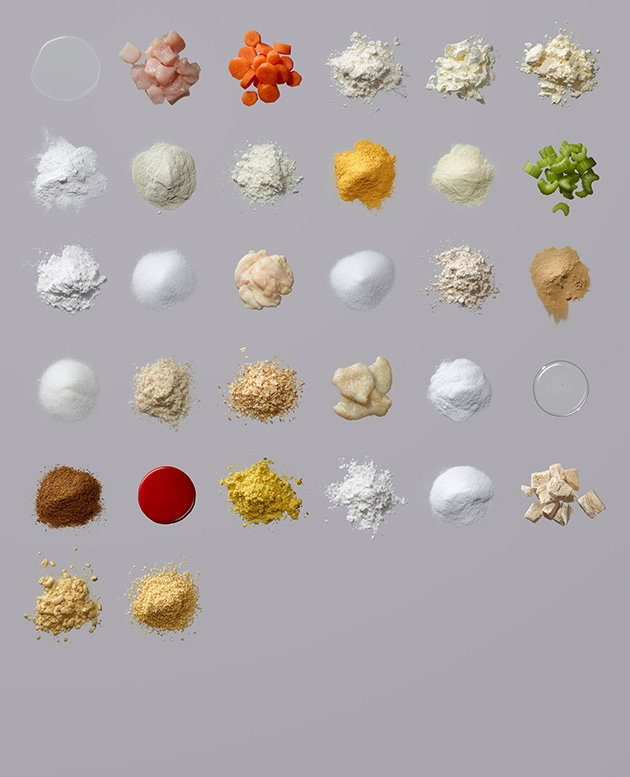
Beauty is in the eye of the beholder. It is possible to look at a pile of paint tints, varying colors, arrange them in such a pattern that they become more than just colors. They can take on the ability to become more than their component parts in your mind.
INGREDIENTS_FOOD_02_Campbells-Soup

Because of the bulky texture of some of the piles you can see that I am trying to pull a fast one. These are not tints, but all of the ingredients required to produce Campbell’s Chunky Chicken Soup. There are a couple of real ones in there. The photo above is from a new book about to be released which shows the ingredients in this way for 25 different foods, “Ingredients: A Visual Exploration Of 75 Additives & 25 Food Products” by Dwight Eschliman and Steve Ettlinger. There is an article in Mother Jones about it this morning.

When I look at this photo though, I do not see a beautiful sight. What I see is how much trouble that the food industry goes through to make food last almost forever from the long trip from the factory to your table. In the name of profit they are working as hard as is humanly possible to create new ingredients that solve age-old food problems. Ingredients to make it creamier. Ingredients to make it flow. Ingredients to make the product uniform.

Calling dough conditioners “chemicals” isn’t entirely accurate, because they start with a fat, such as soybean oil, beef tallow, or palm oil. After that, you need a heavy-duty floodlight to guide your way down the industrial rabbit hole. Here’s a quick glimpse: To create sodium stearoyl lactylate, the fat is first sheared into its component fatty acids in a process known as thermal cracking, something commonly employed in petroleum refining. The resulting stearic acid or palmitic acid is then combined with heat, lactic acid, and sodium. That gives you the sodium stearoyl part. To get lactylate, cornstarch is treated with enzymes to yield dextrose, which is then fermented to produce lactic acid. Monoglycerides and diglycerides come from applying an alcohol and an acid to glycerin, a derivative of soybean or palm oil. Further processing of these compounds with tartaric acid, a naturally occurring chemical found in wine though derived synthetically, yields DATEM. Sodium stearoyl lactylate and mono- and diglycerides are not exclusive to bread.

Warner, Melanie (2013-02-26). Pandora’s Lunchbox: How Processed Food Took Over the American Meal (pp. 102-103). Scribner. Kindle Edition.

Each and every ingredient is the equivalent of a pharmaceutical. In the case of a new drug, not a new class of drugs, but a newly formulated drug, the approval process is well known. The drug maker puts together an animal trial, then a human trial. Side effects are carefully monitored, cataloged, and listed on the package and during the TV commercial. We all laugh at the horrible things that MAY go wrong as they list them for a sleep aid or some other drug on TV, as they are required to do.

In the case of the food industry, though, it’s not so cut and dried. The FDA does not require such rigorous testing.

The FDA is the government agency responsible for overseeing the safety of all our food except fresh meat (that falls to the USDA). It’s a monumental responsibility, and the agency often seeks to convey the impression that the large number of materials going into our food supply are under close watch. “All food additives are carefully regulated by federal authorities and various international organizations to ensure that foods are safe to eat and are accurately labeled,” the FDA states on its Web site. Yet the truth is nowhere near as reassuring. The food industry’s blistering pace of innovation and the force of its lobbying efforts have always overwhelmed those charged with reigning it in.

Warner, Melanie (2013-02-26). Pandora’s Lunchbox: How Processed Food Took Over the American Meal (pp. 104-105). Scribner. Kindle Edition.

Lately there has been plenty of news regarding the rigor with which the FDA executes its mandate to make sure labels are accurate. Mayonnaise must contain eggs, even if you call it “Mayo” on your label.  The FDA is also charged with ‘regulating’ food additives with regard to ‘safe to eat’. How are they doing in that department lately? The FDA finally agrees with the rest of the modern planetary governments that trans fats are dangerous, and cause heart damage. They have agreed to protect our safety, by requiring that they be completely gone from foods three years hence.

There are 10,000 modern food additives. Most of them fall under the category of ‘natural flavors’. All of them have been tested for safety by their makers who inform the government that they are safe to eat. Unless there is a problem that crops up later, as in the case of trans fats, for instance, the food additive is assumed to not cause problems. If we aren’t keeling over by the millions, then it must really be ok. If you think I am exaggerating, look at aspartame. Banned in food, approved at industry pleading, now about to be banned again, as food makers abandon it due to bad public opinion of it. The public is leading the regulation. We are not going to get bad artificial ingredients banned in this way, one ingredient at a time, over the years and years it takes to get industry to move due to public opinion.

And nowhere on any site will you find mention of what [Pew Charitable Trusts] has estimated are roughly a thousand ghost additives out there on the market. These are ingredients companies have simply declared safe on their own without so much as an e-mail to the FDA. Pew says that the actual number of these additives is unlikely to be less than five hundred but could be several times larger than one thousand.

Warner, Melanie (2013-02-26). Pandora’s Lunchbox: How Processed Food Took Over the American Meal (p. 106). Scribner. Kindle Edition.

I hope you don’t mind me bolding that last bit. It is entirely possible that the number of ingredients in modern US industrial foods whose safety has been determined by the ingredient maker, whose main aim is to make a profit for the company not produce safe ingredients, is several times larger than 1000.

When I look at pretty piles of powders and liquids I do not see beauty. I see a perfectly good explanation why children’s allergies are exploding. I see a possible reason why elementary school kids are blowing up like Thanksgiving day float balloons with obesity. I see an alternative theory for autism that does not involve avoiding vaccines. I see a reason that the state of microbes in the guts of the Western diet is a disaster.

Your government is not on your side in this fight.  You must look after your own family. Here is some advice from Mother Jones…

We could go on, but the authors would rather you buy their book, which publishes on September 29. Apart from being full of fascinating facts, it may just ease your mind a little bit. We tend to think of food additives as evil, but most of them are fairly benign, and necessary. Unless you plan to make everything from scratch, that is. And we all know that ain’t gonna happen.

Most of them are necessary, unless you make your own from scratch. That is what I recommend, quit eating processed foods. The ingredients are potentially unsafe for you and yours. It doesn’t matter how pretty they are, you aren’t going to put them on like makeup, you are going to take them into your body.

Posted in Health, Living | Tagged , , , | Leave a comment

Love the Lights

On the way to work today I had to wait for every single light to turn green. The first couple of red lights passed nearly unnoticed. The next couple of red lights sparked some impatient indignation. “It’s Saturday at 6:30 AM, I am the only one here, what am I waiting for!” The next couple I began to reflect on my own reaction to the waits. Why am I stressed about sitting here, I wondered. I would be setting in this very seat, I would be doing nothing else but waiting to arrive at work any way. Why am I in a hurry to get where I am going? I am going to work, it will be there when I get there, and I will get there when I arrive. Arriving sooner comes with no reward, arriving later than sooner carries no penalty. Why do I want to get there sooner, then.

What is it about the pressure of time, what is it about the temporary setback that makes us feel like we are degraded? When you are trying to lose weight, does it really matter if you lose a pound a week or two pounds a month? When you get to your target weight there will be no earth shattering changes in your life. If you get there slow, but the changes you made to get there are the kind you can do from now on, isn’t that a much better outcome than getting there twice as fast? If you diet in a manner that you cannot sustain, which results in you regaining all of the weight lost and resuming the upward trend of all the years past, isn’t that worse than not dieting?

Losing weight must be accomplished in the exact reverse process from that which you gained it. If you speed up the process then you will be living in a manner that cannot be kept up, your results will be fleeting. If you are patient, if you look at daily setbacks as moments to reflect on your life instead of looking at them as pauses, reversals, or reasons to stop trying, then you will be using the stop lights on your journey to the little you that is trapped inside of the bigger you.

You gained every pound of the weight you now carry one ounce at a time eating carbohydrates instead of fats. It did not show up in a month. It was not all there in a year. It took years of eating carbs to gain it, it will take years of not eating carbs to shed it. Your pace will be gradual, but sustainable.

The good news is that you don’t even have to quit eating carbs completely. Sure, at the beginning, for at least a couple of weeks you have to quit eating carbs completely, but once your body chemistry has flipped over to getting energy from fat instead of from the carbs you eat every day then you can begin to eat the occasional dessert, have the rare sweetened drink, eat rice at the Chinese restaurant, or eat the chips at the Mexican restaurant. When you are living on dietary fats you will find that the gradual loss will continue–even if you eat a candy bar. Your progress to smaller is gradual and constant, as long as you live mostly on meats and fats. Green leafy vegetables are great for adding bulk in the bathroom, they contain almost no carbs, so they are perfect to eat, human.

If you want to quit eating carbohydrates and processed foods the first habit you have to break is in your grocery store. Don’t go down every aisle, stay on the outside walls of the market. You will want to buy lots of green leafy veggies, real meats with fat in them (70-30 hamburger for instance), cheeses, eggs, real unflavored full fat yogurt, cottage cheese, and true butter (not margarine). When you buy fats to cook with make them real ones, like butter, lard, tallow, coconut oil, or olive oil.

While fruits are healthy to eat from time to time, for the first few weeks of eating no carbs you won’t want any of them. If you do eat fruits make it green apples and green bananas. You will hate them they are not sweet at all–that’s the point.

Don’t dread the stoplights on your journey. They are places where you can contemplate the journey, they are part of the trip. Time is not an enemy, time is not a reason to stress out about your progress. You will get there when you get there, plan on staying.

Posted in Health, Living | Tagged , , , | Leave a comment

Aren’t You Ashamed of Yourself?

Addiction. Food, liquor, heroin, cocaine, sugar are all addictive substances. If you indulge your cravings you may become addicted. Sex, gambling, eating, crime are all addictive behaviors. If you indulge your cravings you may become addicted. What do they have in common with one another? You. You are the variable in the addiction equation. Sex is sex for everyone–all of the machinery is the same, the software is different. What is going on in the addict’s head is different than for a person not yet addicted.

There is a simple test to see if you are, in fact addicted to a substance or behavior. Are you ashamed of doing it? If you steal off into a room late at night to eat until you make yourself sick, hiding from those you love, you are addicted. If you rush to quit the program you are looking at on your computer when you hear the garage door open, you are addicted. If you promise yourself that you won’t do it again, right after you just finished doing it, you are addicted.

There have been some really good movies in the past that cover very well the cycle of addiction. Lately the movies have gotten better at showing the cycle of shame that accompanies it. Here is a partial list of my favorite shame films…they cover both substance and behavior problems.

In the genre of substance addictions there are some really great shows. “The Days of Wine and Roses” is a movie from 1962 that covers the slide and redemption of a man who, with his young wife, leads the life cycle of the alcoholic. I say alcoholic even though I do not think that such a thing really exists. In my opinion the ‘alcoholic’ is a person whose addiction cycle includes alcohol. Alcoholism is no more a disease than gambling addiction, but the behavior is addictive when it becomes compulsive. Watch Jack Lemmon descend from social drinking to compulsive drinking. The compulsion and shame of it lead him to loathe himself, which leads him to the solace he finds when medicating himself with more of his chosen medicine.

In my next choice for great movies about substance abuse we have Jennifer Anniston who is self medicating with pain killers. In the movie “Cake” she has chronic, mysterious pain that she can’t get a doctor to prescribe enough pain killer to cure. She takes matters into her own hands and procures them for herself. Her misery drives everyone away from her, and the movie is about her figuring out how her problem is herself, she begins to cure her pain by living instead of avoiding. I need to watch this one again, as I will probably watch all of these again. You might think she has a disease, and that somehow taking these pills has altered her brain, but you would be wrong. There is nothing special about this woman, nothing about her that is any different than the Lemmon character in Wine and Roses. She is wired exactly like the people in the behavior addiction movies. This movie shows you what the source of her mystery pain is–no review will tell you, but once she acknowledges it I knew that she would no longer have to take pills to feel better. Great movie.

Joseph Gordon-Levitt plays a porn addict in the movie “Don Jon”. There is plenty to see as he hides his compulsive behaviors from his new beautiful girlfriend, played by Scarlett Johansson. In this one I can see where he finds the need for the mental relief provided by masturbating ten times per day. Not finding joy in his life, his religion, his boys, or any of the real people in his life, Don Jon shows how a normal behavior, like masturbation, can descend into something to be ashamed of–something to hide. Hiding and shame are the dividers between the normal life and the addict life. This movie tries to show how the triggers available in our day to day lives make these behaviors harder to avoid, which is true to an extent. The reason that some people become compulsive is not because of the triggers that we are all subjected to week in and week out.

A much better movie about sex addiction is found in the Mark Ruffalo and Gwyneth Paltrow movie “Thanks for Sharing”, which is about the benefit that a talented cast of characters find in an AA type program for sex addicts. It’s really great in showing the hiding, sneaking, and shame that these people find when they indulge in their compulsive behavior. It doesn’t go deeply enough into any one story to show you why someone would put themselves through this kind of torture. Is sex really that good to destroy your life over? You know, and I know that the answer is no. The hit of brain chemicals that you get from the act is so fleeting, and the shame and self loathing so long-lasting that it is hard to feel any sympathy for the addict. Why can’t they just say no? Where does the compulsion come from? The problem is in the way that the brain can re-wire itself if the emotions are strong enough. Watch this movie to see how you can begin to emerge from the fog of compulsion and self loathing…

If you have made it this far, here is a list of movies and trailer links, for more great films about all kinds of addiction. Feel the shame, wonder at the lying and self-deception, marvel at the broken promises and lives, but know that none of the real people that these stories are based upon are any different than yourselves. They are not weaker or more evil than you, your spouse, your neighbors. Any person can be a victim of compulsion, some compulsions are productive or creative…work, art, sports. Lives have been wrecked by being over productive, just like over medicated lives are wrecked. Love the addict in you, the addict in your life, because the healing starts with self-loving to kill the self-loathing. Don’t be part of the problem.

Clean and Sober

These following are movies I found looking for the links to the other movies. I am excited to watch them now, here are the links.

Owning Mahowny

Thirteen

The Lost Weekend

Posted in Health, Living, Reviews | Tagged , , | Leave a comment

EPA Forced to Do Right Thing

Honey_Bee_on_Willow_Catkin_(5419305106)

The news every morning is full of things we could all care about a great deal. Oklahoma is set to execute a death sentence on an innocent man. Donald Trump is on his way to being the Republican nominee for President. The EPA has been ordered to rescind it’s approval of a popular pesticide that kills honeybees.

Let’s talk about bees and pesticides for a moment. To fill yourself in rapidly on the plight that the European Honeybee finds itself in, watch the documentary “More Than Honey”. You can find it here…if you rent it from YouTube its 3.99 and you won’t enjoy spending 3.99 any more than this. The honeybee is susceptible to the threats from modern poisons, and modern handling by for-profit beekeepers.

These vital insects are all carted to California every year to pollinate nut trees, mostly almonds. While they are there they are sprayed with herbicide, fungicide and come in contact with modern insecticide. In Europe suspect insecticides have been put on moratorium while the effects on bees are studied. Here in the US the story is different. Having approved these insecticides for use using studies conducted by manufacturers, the EPA has been sued by Beekeepers.

US beekeepers were less enthusiastic—a group of national beekeeping organizations, along with the National Honey Bee Advisory Board, quickly sued the EPA to withdraw its registration of sulfoxaflor, claiming that the EPA itself had found sulfoxaflor to be “highly toxic to honey bees, and other insect pollinators.”

Read the following paragraph twice.

And in the case of sulfoxaflor, the agency didn’t try very hard to get… information. In January 2013, because of major gaps in research on the new chemical’s effect on bees, the EPA decided to grant sulfoxaflor “conditional registration” and ordered Dow to provide more research. And then a few months later, the agency granted sulfoxaflor unconditional  registration—even though “the record reveals that Dow never completed the requested additional studies,” the court opinion states.

Granted conditional registration at first, with the condition being we need more industry-provided research, and then the approval finally given without any of the conditions being met. It’s as if the EPA in 2013 had forgotten what the “P” in its name stood for. This problem, of for-profit industry being considered first, is a problem with every arm of the Federal Government. This one pesticide is now un-registered, presumably until they have convinced the government, through industry financed ‘independent’ research that the pesticide is safe to beehives.

There are other competing brands of pesticide that are utilizing the same technology. None of them have been unregistered and declared unsafe. Just this one has. All of them are banned in Europe. Why is Europe so much better at protecting it’s people and environment than our own? Well, the conversation could now get political, and it will not.

The FDA suffers from the same issues as the EPA. It maintains its approval of BPA containing plastics to be used as food and water containers until every manufacturer has voluntarily withdrawn them, due to horrible public acceptance of them. The FDA approves a dietary supplement implicated in heart damage even after Canada bans it, until finally all of the pharmacies in the nation decide it’s too risky to sell it any more. Aspartame sweetener has been approved, banned, and re-approved and is likely to be re-banned, since soda makers have once again begun to move away from it now that the public will no longer eat it.

Your regulators react to your lead, America. Most times we can’t seem to get anything to change. No matter how many times you vote, or for who, things can’t get done in Congress. We can’t do anything about innocent people being executed in other states. We can’t make the EPA and FDA suddenly start putting the environment and safety first in their priority list. We can do something about the foods we eat, and because of this collective power, we can change the things the FDA and EPA can hurt us with.

We can protect honeybees if we quit eating processed food. Most of it has either corn or soy in it. The bulk of these new pesticides are used to increase the yield in corn and soy production by a minuscule amount. The effect of this on bees is around 30% of hives die every winter. If you quitting eating processed foods because of these pesticides (as one reason of many) it will lower the need for corn and soy. If you also quit eating industrially raised and processed meats (as one reason of many) that are fed corn and soy instead of grasses, then you will lower the demand for corn and soy so much that industry may well quit using these pesticides.

I guess what I am saying is–1. Quite eating processed foods and 2. Quit eating confinement raised and industrially slaughtered meats. The benefits to your health will be instantaneous, and the benefits to the bees will come YEARS before they would ever come by relying on the FDA or the Federal Courts to defend them from the profit motive.

Posted in Health, Living | Tagged , , , | Leave a comment

ReBlog

Todays post is a rerun of one from February…I really liked it as I was looking for a certain article for a friend. Please read and enjoy.

IT’S A MATTER OF LIFE AND DEATH!

Posted in Health, Living | Tagged , , | Leave a comment

Swimming Upstream

It’s hard going against the flow. It’s hard advocating for science instead of superstition. Conventional wisdom’s main strength is from the constant repeating that it gets in conversation, the media and your head.

Low calorie, low fat, exercise. To lose weight you have to… Fill in the blank. The first thing that comes to mind to finish that sentence is one of the statements before it. None of those things is guaranteed to make you lose weight. You might, for a time, but can you ‘cut calories’ forever? There are people who work VERY hard to earn a living that are fat and out of shape. Ever looked at an NFL lineman?

Excellent examples of how carefully animals (and so presumably humans, too) regulate their fat accumulation are hibernating rodents— ground squirrels, for example, which double their weight and body fat in just a few weeks of late summer. Dissecting these squirrels at their peak weight, as one researcher described it to me, is like “opening a can of Crisco oil— enormous gobs of fat, all over the place.”

Taubes, Gary (2010-12-28). Why We Get Fat: And What to Do About It (Kindle Locations 1371-1374). Knopf Doubleday Publishing Group. Kindle Edition.

Animals metabolism is controlled not by how much they eat. Squirrels put on weight before the winter on purpose. They find and store food for the lean months, but they put on weight too. Perhaps, you might say, they put on all of this weight because they eat so much when the acorns are falling. It’s just a matter of calories in being greater than calories out…

But these squirrels will accumulate this fat regardless of how much they eat… They can be housed in a laboratory and kept to a strict diet from springtime, when they awake from hibernation, through late summer, and they’ll get just as fat as squirrels allowed to eat to their hearts’ content. They’ll burn the fat through the winter and lose it at the same rate, whether they remain awake in a warm laboratory with food available or go into full hibernation, eating not a bite, and surviving solely off their fat supplies.

Taubes, Gary (2010-12-28). Why We Get Fat: And What to Do About It (Kindle Locations 1374-1378). Knopf Doubleday Publishing Group. Kindle Edition.

Read that again if you have to. It doesn’t matter if they are on a diet, they will gain that weight in the autumn. It’s not because they are eating more. They will lose the weight over the winter, even if they are fed every day all winter long. Something else is controlling the weight of a squirrel and it has nothing to do with calories in versus calories out. People are the same way. There is no way that you get fat if you ‘eat too much’, because if that were the case there would never be people that ‘never gain weight no matter how much they eat’. If it were a simple matter of physics, then you would have to be very careful that you never ate more than you worked. How would you be sure you were eating exactly the right amount every day? The good news is that it’s not that simple, and you don’t have to watch it that close.

The fact is, there’s very little that researchers can do to keep these animals from gaining and losing fat on schedule. Manipulating the food available, short of virtually starving them to death, is not effective. The amount of fat on these rodents at any particular time of the year is regulated entirely by biological factors, not by the food supply itself or the amount of energy required to get that food. And this makes perfect sense. If an animal that requires enormous gobs of fat for its winter fuel were to require excessive amounts of food to accumulate that fat, then one bad summer would have long ago wiped out the entire species.

Taubes, Gary (2010-12-28). Why We Get Fat: And What to Do About It (Kindle Locations 1379-1383). Knopf Doubleday Publishing Group. Kindle Edition.

There are other examples where it’s obvious that calories have little to do with putting on fat. Babies are putting on fat the whole time they breast feed. Children eat and eat but don’t get fat, they get bigger. I should say they don’t HAVE to get fat, but many do. I argue in these pages all the time that its not because of calories, it’s because of carbs. Counting calories is not effective at losing weight, but counting carbs is. It is for me.

I will continue to swim into the current of mainstream opinion, because these things I am reading and quoting make so much sense to me. I have never seen it fail, for anyone that cares enough to quit carbs for a month. Quitting carbs for a month is all it takes to make your body switch from a carb-based chemistry to a fat based chemistry. Once that change is complete you can eat the occasional dessert, have the occasional pastry or sandwich and feel no increase in cravings for them. Eat a little too much or a little too frequently and you will sense your renewed need for all things starchy or sweet. Addiction to carbs is a real thing. Quitting will make you feel and act like an addict. Addictive behavior is a real thing where carbs are concerned.

Posted in Health, Living | Tagged , , | 3 Comments