Addiction as a Positive

Unknown

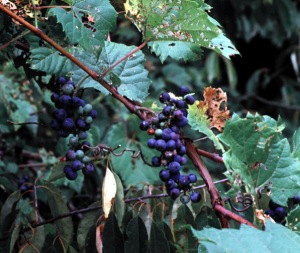
I was thinking about mulberries just now. I distinctly remember the first mulberry I ever ate. I was about thirteen, it was the beginning of summer and a group of middle school boys were riding bikes on paths through some woods near the neighborhood. It was sweaty work and we stopped to catch our breath under a mulberry tree. The branches were heavy with berries, and some were low enough that we could try them. The very dark ones were sweet, the lighter ones bitter. We cleaned the lower branches of dark berries, climbed the tree and cooperated to get every berry that could be reached.

Decades later I moved into a house and there was a mulberry tree on the property. I did not recognize the tree or it’s leaves. Only in the early summer when the green fruit began to appear did I recognize that it was a berry tree. It had been decades since I had seen a mulberry, but I knew that there would be a sweet treat for us every morning as the berries blackened.

Such is the power of sugar. There are millions of things that have happened to me between that climb in the berry tree of my youth and now that I could not recall with the clarity of what those berries looked and tasted like, from a single day forty years ago! One look at a green pre-mulberry and I instantly was transported back across decades to memory of taste and satisfaction. This is a sure sign of the ability of the brain to ensure the survival of the species–any good food source is instantly locked into permanent memory.

Addiction begins with such knowledge. Addiction to sugar happens to be a feature of the human mind, one that will ensure that a source of sugar will not soon be forgotten. This feature is a relic of a time when sugar was not available in every bite of food we would eat. Back in our prehistory we would only get sugar from fruit and only fruit for a single season out of four. If you forgot and had to relearn what was sweet every year, that would be a serious disadvantage compared to the other beasts that do remember. Fortunately we are constructed such that an important thing like where to find sugar is never forgotten.

Obtaining that first mulberry was by chance. Every subsequent trip to the tree over the years was prompted by desire. The effect on the mind of the sugar in the berry was taken advantage of by the tree, so that I and all other sugar desiring animals would spread its seeds through our desire. Every time I eat sugar the want of it means more to me than the actual act of eating. Once the food is in my mouth I scarcely think about taste after the first taste. A tray of pastry on a table calls out to me every moment that I do not eat from it, but once I do–in an instant the desire is gone when the food is. The pastry never tastes as good as I imagined it would. The desire is the most important thing, the thing that has to be satisfied.

So desire is really the big wheel in all our goal-directed activities. And addiction is no exception. The critical role of desire in the brain has been the focus of research in Berridge’s lab for well over a decade. Berridge was the first to argue that addiction is about wanting, not liking— desire, not pleasure— while the rest of the field has been catching up slowly. The low profile of pleasure in addiction explains why Natalie kept shooting heroin, Brian kept smoking meth, and Johnny kept drinking, long after the enjoyment dimmed to an ember of its former glory. And why smokers are rarely heard to celebrate the pleasure they get from smoking— at least after the first cigarette of the day. Even the satisfaction afforded by relief doesn’t remain in attention for long. But the drive to get that relief, to acquire it, especially when it’s been out of reach for a while, takes on colossal proportions. Not that pleasure isn’t important. There’s a reason why all species of fruit have evolved to produce sugar: so that mammals will eat them and spread their seeds. Pleasure is great for triggering desire— I want more! But once that connection is made in Act 1, Scene 1, the audience turns its attention almost exclusively to desire.

Lewis, Marc (2015-07-14). The Biology of Desire: Why Addiction Is Not a Disease (Kindle Locations 2704-2713). PublicAffairs. Kindle Edition.

51qBBQwO4XL._SX327_BO1,204,203,200_

Posted in Health, Living | Tagged , , , | Leave a comment

Sugar is an Addictive Substance

From researchers, in their article written for the New York Times about their study of the addictive qualities of sugar:

Sugar is addictive. And we don’t mean addictive in that way that people talk about delicious foods. We mean addictive, literally, in the same way as drugs. And the food industry is doing everything it can to keep us hooked….Sugar stimulates brain pathways just as an opioid would, and sugar has been found to be habit-forming in people. Cravings induced by sugar are comparable to those induced by addictive drugs like cocaine and nicotine. And although other food components may also be pleasurable, sugar may be uniquely addictive in the food world.

Science is studying the addictive cycle of sugar and here is a sample paper on the findings:

Overall, this research has revealed that sugar and sweet reward can not only substitute to addictive drugs, like cocaine, but can even be more rewarding and attractive. At the neurobiological level, the neural substrates of sugar and sweet reward appear to be more robust than those of cocaine (i.e., more resistant to functional failures), possibly reflecting past selective evolutionary pressures for seeking and taking foods high in sugar and calories.

Three out of four packaged foods contain hidden sugars. Here is the government again:

Of the 85,451 uniquely formulated foods purchased during 2005 through 2009, 75% contain sweeteners (68% with caloric sweetener only, 1% with noncaloric sweetener only, 6% with both caloric and noncaloric sweeteners). Caloric sweetener are in >95% of cakes/cookies/pies, granola/protein/energy bars, ready-to-eat cereals, sweet snacks, and sugar-sweetened beverages. Noncaloric sweetener are in >33% of yogurts and sport/energy drinks, 42% of waters (plain or flavored), and most dietetic sweetened beverages.

Fructose is deadly, it is more dangerous than most other addictive substances. It’s chronic use leads to 1. Heart disease, 2. high blood pressure, 3. Type 2 diabetes, 4. Fatty Liver Disease (NASH), 5. insulin resistance, 6. obesity. Don’t believe me, this is from Open Heart at bmj.com:

Evidence from epidemiological studies and experimental trials in animals and humans suggests that added sugars, particularly fructose, may increase blood pressure and blood pressure variability, increase heart rate and myocardial oxygen demand, and contribute to inflammation, insulin resistance and broader metabolic dysfunction.

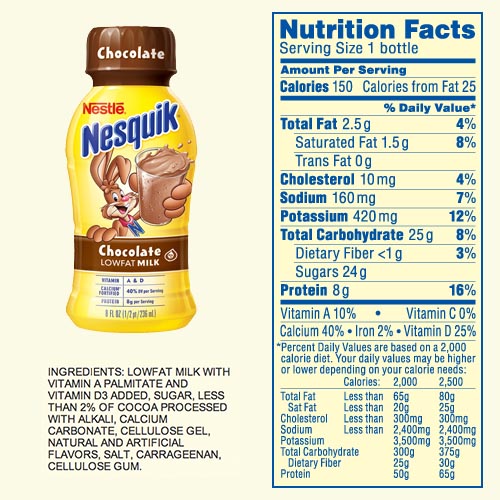
Finally, the government is going to recommend that sugar content be quantified on food labels. You know how when you look at a food label you see most of the nutrients described as a percentage of the daily allowance? Here is an example:

Nesquik-Nutritionals

Notice the column “% Daily Value” and how every line item has a number in it except for one ingredient? Sugar is 24 grams (6 teaspoons) per serving, but there is no % value for it. That value is known. The World Health Organization has recommended that the average man should have no more than ten grams of sugar per day. That means that the % RDA for sugar on this one food item, chocolate milk, would be 240% of the RDA for sugar for a grown man. Unfortunately, the average man will not just eat this one product containing sugar on the typical day, though. He will eat 75% of the packaged foods that cross his lips containing more sugar. All of the soda that he eats will be sweetened. If he has healthy fruit on top of the pile of sugar that is hidden, it will not be healthy, it will be more fuel on the fire. On average, he will go on to eat 88 grams of sugar. If it’s not a man we are talking about, but a toddler, preschooler or grade schooler, it will lead to agitated behaviour, learning disabilities, and ritalin to fight the effects of all of this sweet addictive poison that is hidden in the diet.

The food industry is not happy, here is what their minions say in response to the suggestion that we be warned when we are being snuck sugar in three out of four bites of our foods:

The proposal brought immediate criticism from manufacturers of foods and beverages, which claimed that the labels would confuse customers and that dietary limits on added sugars were not scientifically justified.

In a compromise move the FDA, in it’s waffling wisdom, will say that the RDA for sugar should be 50 grams. That is five times the WHO recommendation, but it is a whopping 56% reduction to the amount the average US resident gets. Event the American Heart Association thinks it should be a lower recommendation.

  • The AHA suggests an added-sugar limit of no more than 100 calories per day (about 6 teaspoons or 24 grams of sugar) for most women and no more than 150 calories per day (about 9 teaspoons or 36 grams of sugar) for most men.

The average American consumes 22 teaspoons of added sugar a day, which amounts to an extra 350 calories. 22 Teaspoons is 88 grams of sugar a day on average. There are people that get a lot more than that per day, and there are people like me that avoid the stuff like the dangerous drug it is, and get close to zero on the average day.

So the FDA is recommending you cut your sugar consumption in half, and they are going to help you out by making food makers tell you how many chocolate milks you can drink to get that much. Food makers will be dragged kicking and screaming into a new healthy future. Of course, the future is not now….this recommendation will be debated and is coming later.

Way back when, the tobacco industry used to claim that their products were healthy, then they argued that they weren’t unhealthy. For a long time they never lost a product liability lawsuit. Then one day all of the states got together and sued the tobacco industry for damages because of all of the extra money that cigarettes caused them to spend on medicare for citizens. Well, the damage caused by sugar absolutely dwarfs the damage caused by cigarettes. At no time in the nation’s history has one product caused two thirds of the populace to be sick. Well, two out of three of us are overweight. The lawsuit against sugar will totally dwarf the rewards paid out by big tobacco. Mark my words, sugar, keep fighting the future, you are only adding victims to the roles of people you will pay for your behavior.

In the meantime, while this all gets sorted out, YOU should treat sugar like the poison it is. Quit eating processed foods, treat them all like they contain sugar, you will only be wrong one time in four. If you have to have sugar, get it from eating real fruit, in season. Get your energy from eating real meat, real cheese, real butter, real eggs. If you want fiber, eat green leafy vegetables. If you have to have a dressing on your salad, take some real mayonnaise, some real buttermilk and mix them together in equal proportions. Add some salt and pepper and there you have ranch dressing.

Don’t wait for the government, the law, the industry to behave like the stewards of health that they should. You could be dead before that happens, your kids could be just as hooked on sugar as you are by then. Kick now, there has never been a better time.

Posted in Health | 1 Comment

I Wish It Were That Easy

In this morning’s New York Times I read a terrific article “Americans Are Finally Eating Less”, describing a downward trend in recent years in our consumption of less calories than in years past. The article is good news on several fronts. The data on soda drinking is heartening, overall it has dropped by 25% since the end of the 90s. According to the report the obesity rate has stopped increasing, and may be decreasing for toddlers.

While good news is good news, my problem with the article is that it chains lower calories in the diet to losing weight. It doesn’t work that way. We here in the US are not fat and getting fatter because we eat more calories than we expend. A calorie doesn’t weigh anything. Talk of burning calories puts the wrong idea in your head, because no matter how much physical work you do in a day, the weight you lose that day is independent of that work.

If you get on a scale and weigh yourself before and after a five pound meal you will find that you weigh five pounds more. That is weight gain. At the very same time the next day, before the next meal, if you weigh yourself again you will weigh the same amount as the day before. That is because you must calculate all of your inputs and outputs to exactly balance the weight equation. You will have passed solid waste, evaporated and passed liquid, and exhaled carbon dioxide. A normal person’s weight will fluctuate two or three pounds each day, over the course of the day. Personally, I always weigh about two pounds less after sleep than I did before I went to bed. Where did that weight go? I exhaled it.

Every second you live, every cell in your body consumes energy, but energy has no weight. That energy comes from fat stores in a healthy person, and it comes from excess blood sugar in a person that is insulin resistant. As a healthy person, my blood sugar does not stay elevated all of the time and when it is depleted my liver calls for more to be released out of fat stores, but not in the form of glucose, in the form of ketones. Ketone bodies are the energy provided for your cells to meet their momentary energy needs if you do not have sugar floating around in your bloodstream.

If all I care about in my diet are ‘calories’ then I don’t realize that some foods have a huge effect on my blood sugar and insulin levels. Only one kind of food (of the three kinds:fat, protein and carbohydrate) can be turned easily into body fat. Eating carbohydrate, the starches and sugars are immediately turned into blood sugars, either fructose or sucrose. As these sugars increase your body almost has an allergic reaction, instantly secreting insulin to keep the sugar level below the danger level, to return it to the tight band that is the normal blood sugar range.

Where does the sugar go when it leaves your blood? Fructose is converted by your liver immediately into liver fat. It is the only organ that can deal with fructose. Table sugar is made up of half fructose and half glucose. The glucose goes straight into your blood. Insulin commands muscle and organ to bring glucose out of your system, but those roads can only handle so much traffic, and glucose that does not go immediately to use is turned into fat stores, where it is changed into fatty acids. Three fatty acids are tied together in a fat cell, where they are too big to get through the cell wall, and must be broken down, when needed into ketones for use by the cells. Fat stores are not turned back into glucose.

The process that I just described only happens with carbohydrates. If you eat nothing but meat you never get high blood sugar, an insulin reaction, and nothing is put into your fat stores. None of it happens.

People never gain weight rapidly without an underlying medical condition to have caused it. People gain weight gradually, taking a long time to get obese, except sometimes gaining a lot of weight is perfectly normal. Think of the infant taking nourishment from it’s mother. Every breast fed baby is a plump collection of fats and rolls all over their little body. It’s normal, its a desired effect of eating real food, they are immediately propelled to their natural weight for that diet, at that time in life. As soon as they are weaned all of that cute fat disappears over time and if they are still eating real food, their weight drops to the normal weight for their new age. It has very little to do with the calories that they eat versus the calories that they ‘burn’.

If it were just a matter of eating less, or eating less calories, then there would not be an obesity epidemic. Everyone could just cut calories a little bit and the weight would come off as gradually as it went on. Unfortunately for us, the constant drumbeat of advice that we are “eating too much” is counterproductive. It is counterproductive because eating less doesn’t seem to fix anything. It doesn’t fix anything because we are still eating what turns into body fat in the first place, carbohydrates. The news that we are drinking a lot less soda is certainly good news. That good news is not so good when you see that just as many people are obese as last year, the weight curve is not headed in the right direction, and I argue that it is not headed in the right direction because we are still telling obese people that they must eat less calories to lose weight, that the solution is in how much.

The solution is in what we eat instead.

Eat no processed food.

Drink no sweetened drink.

Get your calories mostly from fat and protein.

Outside of beverages, there are few clear trends. Experts who have examined the data say the reductions do not mean that Americans are flocking to farmer’s markets and abandoning fast food. Consumption of fruits and vegetables remains low; consumption of desserts remains high. Instead, people appear to be eating a little less of everything. Although consumption in nearly every category has been “cut some,” said Mr. Popkin, “the food part of our diet is horrendous and remains horrendous.”

The food part of our diet is horrendous and remains horrendous. Not because there is too much of it.

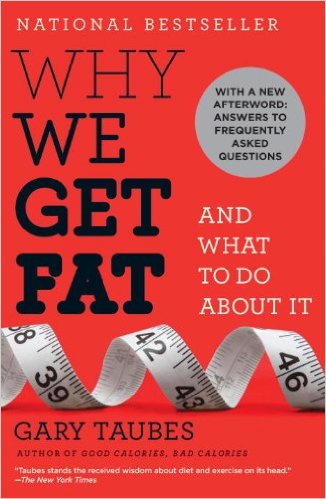
Why We Get Fat: And What to Do About It

51FImT5NhLL._SX324_BO1,204,203,200_

Get this book.

Posted in Health, Living | Tagged , , | 1 Comment

A Fella’s Gotta Eat

Unknown

When I am not on a mission, I am like an unguided missile. Without proper planning it is just about impossible to eat sensibly in the United States. I know that you know what I mean. If you decide in the evening that there is not enough time between events to cook a meal, the chances that you will be eating wholesome local food instead is very slim.

We went to one of the nicer shopping districts in Kansas City the other day, and we picked one of the nicer restaurants down there to eat at. I bought a sandwich and had a Coke. What was in the bread besides flour? Well, it was awfully pretty bread, so there were undoubtedly dough conditioners and other artificial ingredients. There were french fries that may have been just potato, but they were very crunchy, so there were extra ingredients in there as well. I don’t have to say a word about the Coke. All it had going for it was ‘real’ sugar. That means that it only had the normal amount of fructose in it, not the ‘high’ variety that has so many people excited.

When you eat right two out of three meals a day there is some leeway. Eating like I just described one meal, maybe every other day, is not going to make you fat or unhealthy. That is unless you happen to be one of the millions of people that has a reaction to one of the dozens of artificial ingredients I ate. My own reaction to may day of indulging in bread, sugar and frankenfoods was that I sweated all night which alternated with freezing. I couldn’t get to sleep until around midnight, I lay there totally alert. Occasionally I would pull the sheets up to see if it would make me sweat again. I tossed and turned.

The next day I craved sugar. Sugar is an addictive substance, and you will be looking longingly at sweetened things for a couple of days after a binge day. I did. The very next morning a vendor at work brought in sweet pastries. I resisted them, I am happy to say. I did eat the last half of the sandwich from the restaurant at lunch. Waste not, want not.

Posted in Health, Living | Tagged , | 2 Comments

Abandoned Ship

Vissersboot

Vissersboot

This craft has been drifting without a rudder for the last five days. I can’t believe it, but I have not went five days without writing in the last year. In my defense I have worked a ton of hours in the last TWO days. That accounts for the overall length of the dry spell. The three days before that were just a general dis-interest in the idea of creating anything.

This last week I was the consumer of art instead of the creator of it. We went to a concert on Wednesday night, got to bed at midnight. We went to a concert on Thursday night, got to bed at midnight. We went to a ukulele jam on Friday, got to bed by 11:30. Then Saturday and Sunday I had to work overnight, 16 hours both days. That is my excuse for not being creative. Art must not be forced!

So, to recap–eat real food, not processed food.

Posted in Living | Tagged , | Leave a comment

SMH

I am Shaking My Head over the health news in the New York Times this morning. Here is the headline:

2 Studies Back Guidelines for Wider Use of Statins

I can’t assume that you know what statins are, and why their use might be expanded to more people than currently take them now. Statins are a drug that people at risk for coronary artery disease are prescribed to lower the cholesterol levels in their blood. Remember that the advice until just this year on cholesterol included not eating foods high in cholesterol. Cholesterol in your blood does not come from eating cholesterol laden foods, though. That is why they have removed the cautions about eating things like eggs and shellfish. You don’t get high cholesterol in your blood by eating it.

Statins lower blood cholesterol by preventing your liver from creating it. People with high cholesterol in their blood are making more of it than their body needs to operate, and the statin drug interferes with the liver’s ability to make cholesterol.

study published last year estimated that 56 million American adults, or almost half those age 40 to 75, would be advised to take statins under the new guidelines, compared with 43.2 million, or 37.5 percent, under the old ones. In actuality, about one in four adults of that age now take statins, according to the Centers for Disease Control and Prevention.

Re-read that paragraph with me: 43.2 million, or 37.5 percent of all adults age 40 to 75 are currently advised to take statins to correct their liver’s creation of cholesterol. With the new guidelines it will go to 50%. Every other person you know between 40 and 75 will be advised to take a drug that has serious side effects, to correct a symptom of poor diet, to cause a chemical to go down in your blood, with the effects of this lowering on your health being hotly debated in science.

We all know, if we have been following this blog for any length of time, that two out of three Americans are overweight, and one third are obese. These people are all, one hundred percent of them, going to be advised to take statin drugs by the time they are 75. They are overweight because they eat too much carbohydrate, and their blood cholesterol numbers are out of whack because their liver creates cholesterol out of the foods that they eat. They don’t make cholesterol out of eating cholesterol, they make it out of eating sugar, starch and grains.

Science is not even certain that lowering cholesterol is beneficial in improving cardiovascular health. It has become an article of faith among doctors that if there is heart disease they prescribe statins. The effect that these drugs have on the progress of the disease is not certain, despite what they would have you believe.

(“ Most drugs have multiple actions,” notes the University of Washington biostatistician Richard Kronmal. Saying that statins reduce heart-disease risk by lowering cholesterol, he adds, is like “saying that aspirin reduces heart-disease risk by reducing headaches.”)

In the late 1970s, the World Health Organization launched a research project known as MONICA, for “MONItoring CArdiovascular disease,” that was similar in concept to Keys’s Seven Countries Study but considerably larger. The study tracked heart disease and risk factors in thirty-eight populations in twenty-one countries— a total population of roughly six million people, which unlike previous studies included both men and women. Hugh Tunstall-Pedoe, the MONICA spokesman, has described the project as “far and away the biggest international collaborative study of cardiovascular disease ever carried out” and noted that, “whatever the results, nobody else has better data.” By the late 1990s, MONICA had recorded 150,000 heart attacks and analyzed 180,000 risk-factor records. Its conclusion: heart-disease mortality was declining worldwide, but that decline was independent of cholesterol levels, blood pressure, or even smoking habits.

Taubes, Gary (2007-09-25). Good Calories, Bad Calories (Kindle Locations 1890-1896). Knopf Doubleday Publishing Group. Kindle Edition.

Science is likewise uncertain that lowering cholesterol is a cause of other problems. When studies have looked at mortality in relation to cholesterol levels, not just heart attack versus cholesterol, the results were alarming. Here is Taubes again:

…This was compounded by what may have been the single most striking result in the history of the cholesterol controversy, although it passed without comment by the authorities: those Framingham residents whose cholesterol declined over the first fourteen years of observation were more likely to die prematurely than those whose cholesterol remained the same or increased. They died of cardiovascular disease more frequently as well. The Framingham investigators rejected the possibility that the drop in cholesterol itself was diet-related— the result of individuals’ following AHA recommendations and eating low-fat diets. Instead, they described it as a “spontaneous fall,” and insisted that it must be caused by other diseases that eventually led to death, but they offered no evidence to support that claim.

Taubes, Gary (2007-09-25). Good Calories, Bad Calories (Kindle Locations 1921-1926). Knopf Doubleday Publishing Group. Kindle Edition.

We are on one long drug trial. Half of us are going to be recommended to take a class of drugs that prevent one of our organs from performing a perfectly normal function. What your liver will do about the chemicals that it encounters that it is being prevented from turning into cholestrol is anyone’s guess. If it can’t make cholesterol, then there will be a raw material of cholesterol in your blood that your body is not handling. Statins cause cramping and muscle damage. Perhaps this is a reason why.

What you should do, if you want to prevent your liver from creating too much cholesterol, is quit putting foods in your mouth that lead to cholesterol. We know what they are not–eggs, shellfish, foods high in their own cholesterol. We know how to get better cholesterol ratios too, lower your weight by eating less carbohydrates.

“In the 1980s,” says Judith Hallfrisch, who worked with Reiser at the USDA, “people didn’t even believe that elevated triglycerides were a risk factor for cardiovascular disease. So they didn’t care that much about the increase in triglycerides. Everything was cholesterol.” (Although sugar also seemed to raise cholesterol levels, particularly LDL, as would be expected for any nutrient that increased triglyceride synthesis in the liver. In 1992, John Bantle reported that LDL cholesterol in diabetic patients was elevated more than 10 percent on a high-fructose diet after a month, which is comparable to what can be achieved by saturated fats.)

Taubes, Gary (2007-09-25). Good Calories, Bad Calories (Kindle Locations 4230-4234). Knopf Doubleday Publishing Group. Kindle Edition.

Body chemistry science is complex and evolving. The ability to measure things like the different kinds of cholesterol are evolving. It is only recently that they realized that there is a low density cholesterol and high density cholesterol. One is good for you and one is implicated in health problems. What you eat actually leads to divergent LDL and HDL readings. It is proven that eating real food leads to better results. Better results will lead you to not have to take statins in the first place. You can control whether you are in the half of people that doctors will target as statin drug test subjects.

Posted in Health, Living | Tagged , , | 1 Comment

The Market God

There are people that would tell you that the market will make the best decision. These people would have you think that people will always make decisions base on a calculus involving worth, benefits and price. Here is an example:

11012065_829165337165278_2335228775580332686_n

The implication of this ‘argument’ is that we feed our children Coke instead of bottled water because Coke is half as expensive per bottle as water or that we feed them a Happy Meal burger instead of salad also because of the price difference.

Water in a 24 ounce plastic bottle costs two dollars. Coke in the same size container costs approximately half as much, but water from the faucet costs $1.50 per thousand gallons. That would equal 5333 24 ounce bottles for 1.50–a much better deal! Water at a drinking fountain is free of charge. Fill your thermos up at the drinking fountain. It’s free. Fill it up at home, its practically free.

Plastic bottles are known to leach chemicals into the water that they contain. Bottled water contains chemicals that act like the sex hormone estrogen. Plastics leach other chemicals, too that are known to lead to high blood pressure. From Mother Jones:

The chemicals, di-isononyl (DINP) and di-isodecyl (DIDP), were long seen as safer alternatives to their precursor, a phthalate called DEHP, which was associated with hypertension. Even though their use has been on the rise over the past decade, they were never fully tested—until now.

In one study, researchers from the NYU Langone Medical Center analyzed urine samples of over 1,300 adolescents between the ages of 8 and 19 and found that the levels of DINP and DIDP corresponded to levels in blood pressure. In a separate study, the same team studied 356 teens and found a similar correlation between the chemical levels and insulin resistance—a condition that can lead to diabetes.

There are people in this world that will not let their children be vaccinated because there is a controversial link to a negative side-effect that has been reported in underground media on the internet. They would risk catching dangerous communicable diseases instead of taking any risk. Bottled water though, for them, is safer than tap water.

There are federal standards requiring tap water purity. The tests are rigorous and the standards are high. Any time there is a problem with the quality of your water you will be getting a notice from your local water department. I can count on one hand the number of notices that I have gotten in a 55 year lifetime.

Every plastic bottle of water has chemicals that have dissolved out of the plastic. Every single one is adulterated with chemicals that act like hormones once inside your body. They cause high blood pressure, insulin resistance, diabetes and weight gain–in you and your kids. Not to mention that bottled water is 500 times more expensive than tap water. At least a Coke has sugar in it as an excuse why it is more expensive.

We would give the kids a bottle of water instead of a Coke because the water is healthier than the Coke–except that it is not. Some people would spend more for the health claim that water has. Water is healthier, yes, but plastic bottled water is not. People just don’t know that it’s not.

Kids are getting fat. Everyone is getting fat. Two out of three people in the US are overweight. Kids aren’t getting fat because of the price of things, they are getting fat because just about everything they eat has sugar in it, or contains another carbohydrate. It doesn’t help that things you assume to be healthy, like water, are not healthy because of the container. It doesn’t help that the government strictly regulates water quality in the pipes to your home, but doesn’t care at all about the quality of the water in plastic bottles. You just figure they would not let them sell it if it wasn’t safe.

There is your first mistake. You should not assume that everything on the store shelf is safe, that every health claim you see is the end of the story. If you don’t buy anything in plastic, no processed foods, if all you drink is water out of the tap from your home or work, you will be doing yourself a great service. You will be protecting your children and family. Don’t look at the fat people around you and assume that they are that way because fattening foods cost less than the non-fattening alternatives. Help them by spreading the news that carbohydrates make you fat and that tap water is better than any other water.

The problem with the drinks pictured above is the plastic that they are in, and the sugar that they contain. The problem with the hamburger is the bun, not the price. The problem with the whole idea is that we are making ourselves fat by choice, when it is really happening because we don’t know why we get fat.

Why We Get Fat:And What To Do About It, by Gary Taubes

Posted in Health, Living | Tagged , , , | Leave a comment

Fat Stigma

If your children are overweight they are likely to be bullied at school because of it. Apparently, as reported in the New York Times on July 7, a first-ever cross nation study has been conducted and it found that kids who are fat are bullied because of it. What is the world coming to.

The article goes on to elaborate. Because it is still legal to discriminate against fat people based on their weight, the study authors presume that it leads to an atmosphere where children feel like it is ok to treat the obese badly. For my whole life kids that are overweight have been picked on. This is not news, or new. Kids don’t become fat because they are choosing to overeat, or because they are lazy.

This push to make discrimination based on weight illegal is part of a pattern that I am seeing across the nation these days. There is an effort afoot to make being fat and/or obese acceptable, because so many of us are fat/obese. Two out of three people in the US are now overweight. One out of three people are obese.

Don’t get me wrong, I am not calling out the people who are overweight. I am not blaming them for their condition. I am not blaming the victim. People in the US are victims, but they are victims of very bad advice.

As obesity rates have risen, she said, so much emphasis has been placed on taking personal responsibility for body weight and changing behaviors “that there is a perception that these youth are somehow to blame for their weight and in some way deserve this treatment.”

Somehow the youth are responsible for their condition. There it is, in a nutshell. There are 17% of kids in GRADE SCHOOL that are obese. That fact alone proves that the problem is not one of willpower. Kids don’t choose their own food, we feed them ‘healthy’ foods. Kids eat candy-like food in the morning, be it cereal, yogurt, chocolate milk–every one of them with a health claim on the label. Kids eat cake covered food at lunch be it chicken nuggets or school lunch pizza–healthy foods selected for them by their school system. Kids eat bread encased meat and processed food potatoes washed down with a big glass of syrup for dinner. They don’t choose any of this, and they are getting fat just like their parents are.

Eating low-fat doesn’t help either. The advice to eat less fat equals eat more sugar. There are only three kinds of food–fat, protein and carbohydrate. If you cut the fat down then mathematically one or both of the other two must increase, the total must be 100%. We have been told for generations to eat more carbohydrates, and it is killing us.

Now we are being told to quit putting a stigma on the obese among us. I say “AMEN”  to that advice. The obese don’t need shame, they need excellent advice. The advice to eat less fat has been horrible advice, leading to an entire industry that is shelling out dietary poison with huge font health claims on every label.

Read this paragraph from the Times:

While some health experts acknowledge that individual genetic and metabolic differences mean that some people are more prone to gaining weight than others, the most widely disseminated public health message is that anyone can achieve a desirable weight by eating less and exercising regularly.

Some experts acknowledge that genetic differences might be responsible for some people gaining more weight than others. LOL. Two out of three people are overweight. Our genetics have not changed. What did? The advice that these health ‘experts’ dole out is what has changed. The most widely disseminated advice is that anyone can achieve a desirable weight by eating less and exercising regularly. Have you ever heard that advice before? It is the ONLY advice they give out. It is where we get the idea that the fat are that way because they lack the willpower to be thin. Fat people choose to not lose weight, according to health experts. Even fat grade schoolers are just hard-headed overeaters.

What they don’t tell you, what is now known, is that you are not getting fat because of how much you eat, or how much you don’t work out. You are getting fat because of WHAT you eat. Eating fructose, which is the sugar in fruit and fruit juice, and is 50% of the sweetener in table sugar, can only be metabolized by your liver and turned immediately into fat. That fat cannot be converted into energy by your body if there is insulin in your blood. There will be insulin in your blood as long as your blood sugar is elevated and your blood sugar will be elevated if you ate carbohydrates. You slowly gain weight because you eat carbohydrates. Telling you to not eat fats is making you fat. Your low fat yogurt is making you fat. It’s not your fault, you are just believing their advice.

We don’t need new laws. We don’t need stronger laws. We don’t need taxes on sugar, it’s only one kind of carbohydrate. We need to quit eating processed foods. Eight out of ten of them on store shelves have hidden sugar and carbohydrates as the main ingredient. We need to start eating real meats, real vegetables, whole milk and eggs. You can’t eat too much of foods like those…you get full before you can overeat.

It’s not normal to be fat, even if we all are. Fat comes at a very steep price. We can’t ask everyone to accept as normal something that we all know is unhealthy. If we all smoked it would be a very bad idea for the tobacco industry to try and get us all to just get over the fact that it causes emphysema and lung cancer. The stigma against tobacco was well deserved and got the desired results. But people that smoked were going against the grain, they all wanted to quit. They got our support to quit.

For fat people right now, they are not getting our support to quit doing what it is that is making them fat. They are still getting the same old bad advice, “Eat less and exercise more”. It hasn’t ever worked, and it won’t because it is bad advice. Advising me to just accept the fact that its beyond their ability to lose weight in grade school, to just accept that kids these days are obese is insane advise. Bad Job New York Times.

Posted in Health, Living | Tagged , , , | Leave a comment

Hunter, Gatherer

Read a great piece yesterday, and watch the accompanying video from Mark Bittman of the New York Times about wild foods that grow in the green spaces and the cracks between sidewalk sections all over the US. This knowledge about what is edible, when they show up, what are the best parts of our plants in our neighborhoods, is actually available from your agriculture university extensions. He goes around with some professors from Berkeley, but I could probably find similar help from the University of Missouri.

Ancient peoples that lived in Missouri must have known all of this, and the knowledge would be handed from mother to daughter from generation to generation. We don’t know this because we brought foods with us from our mothers and fathers, transplanting the potato and corn to live on, and ignoring to a great extent the cornucopia that are available all around us in every season except winter.

There are tons of advantages to eating wild plants. First and foremost in my mind is that they are hardy. That hardiness is passed on to you. Their resistance to disease and pest is passed on to you. They are also as fresh as any food you have ever eaten, because you will eat them practically the moment that you pick them. Nothing is lost from them because they must be picked too early, like commercial fruits. Nothing is lost from them because they were picked too long ago.

If you must eat fruits and vegetables in order to feel like you are eating healthy, you owe it to yourself to find out what grows all around you that you can use. Bittman provides us with this handy guide, click this link and print the guide that comes up. Use it to find things you try every year to kill, that you can eat instead.

Here the accompanying video produced by Bittman and the NYT:

http://graphics8.nytimes.com/bcvideo/1.0/iframe/embed.html?videoId=100000003778858&playerType=embed

It is possible to find out which plants are best in your locality. I found a great article here at CenterForDeepEcology.Org where they show pictures and describe a short list of plants to start with. This one grows over my privacy fence, for instance:

Wild Grape:

Edible parts: Grapes and leaves. The ripe grape can be eaten but tastes better after the first frost. Juicing the grapes or making wine is most common. The leaves are also edible. A nutritional Mediterranean dish called “dolmades”, made from grape leaves are stuffed with rice, meat and spices. The leaves can be blanched and frozen for use throughout the winter months.

Here is another great link, but the pictures are not as pretty. The list does not repeat very many plants, either and includes great Missouri fruits like paw paw. I intend to go on excursions this year to find some of these things for myself.

This all has piqued my interest in learning about living off of the land…my land. There is bounty all around us, and there is information all around us concerning how to to take advantage of it. I recommend that you read up and look up. I will, and I will be posting more in the months to follow.

Posted in Health, Living | Tagged , , , | 1 Comment

Cardiac Health Advice

Recently my mother had a cardiac event that put her in the hospital a couple of times and has led her to pay more attention to her diet. Her hospital gave her typical heart-healthy advice–eat no salt, eat low fat, take this medicine. I gave her the advice that she should quit eating carbohydrates and start eating good healthy local meats and dairy. Of course, she is following her doctor’s advice.

This morning in the New York Times there is an Op-ED that is calling for different dietary guidelines, specifically in relation to dietary fat and carbohydrate recommendations.

Recent research has established the futility of focusing on low-fat foods. Confirming many other observations, large randomized trials in 2006 and 2013 showed that a low-fat diet had no significant benefits for heart disease, stroke, diabetes or cancer risks, while a high-fat, Mediterranean-style diet rich in nuts or extra-virgin olive oil — exceeding 40 percent of calories in total fat — significantly reduced cardiovascular disease, diabetes and long-term weight gain. Other studies have shown that high-fat diets are similar to, or better than, low-fat diets for short-term weight loss, and that types of foods, rather than fat content, relate to long-term weight gain.

I have many friends and colleagues that will not hear the advice that they should eat meat and fats instead of grains. When I tell people that what you eat is way more important to your weight and health than how much you eat I am met with blank stares. Nobody wants to argue about it, but everybody else says fat is bad for you, is the impression I get from them. I hear people saying that low-carb is an unsustainable way to live, but in fact, low-fat is a very new way to live. Low carb eating used to be the norm, before we started eating corn in one form or another in every bite or drink we took. People can’t fathom that it is possible to get every bit of nutrition that they need just from eating meats.

Do you want to improve your heart health? Eat food that you cook, instead of processed foods. Leave the boxes of processed food on the shelf and make your own. You will save money and get healthier food, all it will cost you is a little time, and not too much of that.

The limit on total fat is an outdated concept, an obstacle to sensible change that promotes harmful low-fat foods, undermines efforts to limit refined grains and added sugars, and discourages the food industry from developing products higher in healthy fats. Fortunately, the people behind the Dietary Guidelines understand that. Will the government, policy makers and the food industry take notice this time?

You don’t need to wait for the government act. You don’t need to wait for the food industry to act. A delicious healthful alternative to high-carb processed foods exists, in fact, lines the entire outside wall of your local grocery.

Posted in Health, Living | Tagged , | 1 Comment