Secret Information

I found a secret group on Facebook. I don’t recall exactly how I found it, but it promotes the Ketogenic lifestyle. The name of the group is Ketogenic Generations. I believe that perhaps one of the founders, Zoe Melvin or John Mason, who live in England perhaps read and liked one of my articles is how we stumbled on one another.

There are well over 100o people in the group, all sharing information about how to never again eat carbohydrates. Here are a couple of sample posts from happy Keto’ers:

Just have to say iv been having sweeteners in my drinks for over 30 years (3) in every drink and drinking low cal fizzy drinks. 18 years ago I was diagnosed with fibromialgia (think that’s how you spell it ) been in agony most of that time but especially the past 12 months where doctors have done blood tests and don’t know why iv been having cramps and spasms in my hands where sometimes I can’t even hold a pen. This is my 6th day and when I started this woe I stopped having sweeteners and low cal drinks and have got used to the different taste , but what I have noticed is the great improvement in my hands the stiffness has gone and the pain is so low I hardly notice it. Don’t know if this is giving up the sweeteners or not but I won’t be taking them ever again. Things can only get better.

–Jenny Wrenn

Ok it’s official. …..been on this woe now for 4 weeks and just weighed myself….. 1 stone lighter!!!! Wow is one of many words I want to say. haven’t done the measurements yet but know I’ve lost inches as well coz I can get into clothes that haven’t seen daylight in over 18 months!!! Yipee! Thank you one and all for this amazing group!!! Xxx (one stone is 14 pounds–dan)

–Nikki Paul

The best thing about the grass fed butter fat is the anti-inflammatory omega 3 essential oil that it contains. You can get this essential oil eating naturally raised pork, beef or fish. At the same time by not eating industrial meats, or processed foods you are limiting the omega 6 oils that you consume, which lead directly to inflammation. If you don’t want butter you can use fats that also contain the oils you need that your body cannot create. I like the idea of getting folks to drink healthful fats every morning, because lots of people don’t want to eat breakfast. Not eating breakfast makes it almost impossible to not eat before lunch time, and usually that is going to be something from the snack tray at work.

–Dan Carmack

I contribute frequently to the discussion.

IMHO the eating of sugar and carbs lead directly to a host of physical ailments. They have been named the Western Diet Syndrome and include, but are not limited to:

–type 2 diabetes

–high blood pressure

–weight gain

–cancer

–autoimmune diseases

Carbs are found in fruits and vegetables, and a person that thinks they can live only on fruits and vegetables is going to have to eat a great deal of carbohydrates to get enough energy to live. To think that eating no meat or fat is a healthy alternative is to not understand human physiology.

One of the more startling revelations that Blake Donaldson wrote about lay in his observation that patients on a low-carbohydrate diet not only lost weight but also saw symptoms of other health problems disappear. These included heart disease, arteriosclerosis, high blood pressure, osteoarthritis, gallstones, and diabetes— commonly known in the early 1900s as the “obesity sextette,” because these six problems were observed to occur more frequently among obese people than among those who were constitutionally lean. (Later, most of these symptoms came to be grouped under the name “syndrome X,” also known as metabolic syndrome; see note on page 307.) With patients on his meat-all-the-time diet, Donaldson found himself “less and less likely to resort to drugs” to combat these diseases. Everything seemed to get better when carbohydrates were replaced with fat on his diet.

Teicholz, Nina (2014-05-13). The Big Fat Surprise: Why Butter, Meat and Cheese Belong in a Healthy Diet (Kindle Locations 5219-5225). Simon & Schuster. Kindle Edition.

So, why do I say “secret information?” Well, you have to look for this stuff. The easy to find information out there is about ‘eating less calories, and exercising more.” This keeps us all on sugar, carbs, processed foods, and the medicine they are giving us to alleviate the symptoms of the diseases that eating carbs causes. The secret is out. Jump on the no carb bandwagon.

Posted in Health, Living | Tagged , , | Leave a comment

Whole Human

You are 65% water. You are, on average, 12% fat and 20% protein. There are ten times more bacteria in and on your body than there are human cells in and on your body. Your gut is wired to the nervous system with 100 million neurons. This ‘second brain’ that is not in your head affects not only your digestion, it effects your mood. Most of the traffic in these nerves originates at the bowel end. 100 million neurons is a high-bandwidth information superhighway.

The human life is a process. Eating and drinking are also processes. There is a lot that goes on, and to try to assign causes for a thing like overweight or underweight to one component of one process is the height of folly. If I look at you and you are obese, I cannot begin to understand why you are that way. You live in your body 24 hours a day and you don’t understand it either. I could assign blame for your poor physical condition in a lot of different ways and have an equal chance that any one would be right, or that every one has it’s part in turn. Here are a few guesses:

  1. You are overweight because you eat carbohydrates instead of fats. You are taking the advice of the US government and the medical and nutritional high priesthood and eating ‘healthy’ according to the food pyramid. You are still gaining weight. I could, rightly, say that you are gaining weight because you are eating the wrong food.
  2. You are overweight because you eat too many calories. For those that think the body is a simple machine, they will tell you that you are overweight because you cannot control your appetites, or that you are not active enough. These people think you are just an energy balance.
  3. You are overweight because your metabolism is low. This idea comes from the observation that some people can seem to eat what they want without becoming obese and some people can seem to turn anything they eat into fat. It is true, so it might be this way for you.
  4. You are overweight because you are an emotional eater. These people eat for pleasure, and any time they are stressed they will go for food for comfort. This idea brings the ‘second brain’ into play…it must be possible that something in the gut is communicating the need for certain foods.
  5. You are overweight/underweight because you are addicted to fattening foods. Once again the emotions play a role in food choices, in this case eating is compulsive, and shameful–this eater hides his/her eating, or starving, or binging and purging.
  6. Your overweight is genetic. Your family is all heavy so it makes sense that you are going to be heavy–this theory would not account for the explosion of overweight in the US, now 2/3 of us are overweight. It is still a popular rationale for why you are overweight.
  7. You are overweight because you are poor. Poverty seems to be related to weight, with the poor not being undernourished and thin, but undernourished and fat. The theory here is that poor people can only afford the cheapest of foods, which are found in fast food and convenience stores. If you want to be thin, get a better job/life…(silly advice, right?)

We go online, each of us, and we look for things that we can do to relieve our lives of the burden of being fat. Most of the advice is ‘low calorie, more exercise.’ This diet and exercise life fails to correct the issue for 90% of everyone that tries to do it long-term. Using more calories makes you hungry. Being hungry all the time is no way to live, thus the yo-yo of weight loss. Yes, you can starve your way to a lower pant size, but when you return to living without hunger you will gain weight again. You are correcting nothing in this way.

Some experts advise that you just eat meats and fats (like me). This does not work for some people, at least not right away. These folks still can’t seem to get the energy they need, or to utilize stored energy, from their fats. For these people there is growing evidence that they do not have the right microbes in their bowel to make the body produce hormones needed to digest fats. The body is a system and even the brightest genius biologist does not fully understand the complex interlocking systems that make up a single human machine. This area of science is not fully studied and when it is it may produce ‘pills’ that will, possibly, contain living microbes to correct the abnormal bowel micro biome.

There are people who cannot give up sweets and carbohydrates even when convinced that it is for their long-term health. There are emotional and energetic components to this, because the human being is not just a machine that needs fuel. If I put one type of fuel in, but the mind wants another type, the mind must be reckoned with. As a system we cannot succeed if we fail to account for a major player. We also must account for the role played by the ‘second brain’ of neurons, 100 million strong, that are sending their commands and requests to the big brain up top. It is now thought that some microbes use these nerves in the gut to convey cravings to the brain. It may be possible that a microbe in your gut is begging for that next drink of Coke. It may be hard to quit as long as that type of microbe survives.

I spend my time writing and alternating between topics of nutrients (carbohydrate versus fats), mental health, micro biome (the bacteria that contribute to our digestive system), fermentation of foods, and “how-to” articles. Each article focuses on one area, usually. It is actually difficult to write a short article that will encompass all of the different things that you should try to lose weight. Here is my short list.

  1. Quit eating carbohydrates. By this I am not asking you to take a religious vow to quit, on pain of Hell. I am saying don’t try to eat them on purpose. I eat dessert. I eat potato chips occasionally. If carbohydrate is not a major contributor to your daily diet you will prosper.
  2. Quit eating processed food. Most processed food is dead. Real food contains beneficial bacteria to bring reinforcements to your bowel. Artificial foods contain chemicals to kill bacteria so that they last forever on the shelf. Not good for your guts.
  3. Come to terms with your relationship to food. If you are a compulsive eater my advice will not help you. Just knowing how it’s done is different than being able to do it. If you are a compulsive eater you are going to need help that you probably won’t find on the internet.
  4. If you are poor I can tell you that eating right is less expensive than eating fast, convenient food. It takes less food, if its meat and fat, to fill your family up. They get full fast and the don’t get hungry again for a long while. Being healthy is obviously a very much less expensive thing than deductibles and co-pays on US healthcare, not to mention more fun.
  5. The best source of probiotics is from eating real food. Cabbage contains the bacteria that will create vitamin C right in your guts. Fermented foods can give you not only naturally created vitamins, it also gives you the germs that make it (if you eat them raw)
  6. Don’t worry about overeating. You cannot eat too much meat, it is not fattening. If you aren’t eating carbs you can never overeat fats. If you are hungry, eat a sausage. If your kids are hungry feed them–just not carbs.

Well, I have managed to give shorthand for just about every health idea I have. You are a total system, and inside of you there are many interlocking parts. You will never know how it feels to be healthy and not on sugar until you manage to get off of it for a few weeks. Once you re-learn how normal feels you will be able to tell how much bad food you can eat before you start feeling bad. You will then be able to tell what kind of emotional toll there is for eating wrong. Right now you always feel bad but you just do not realize it yet.

12105766_1724253444465184_2350577053380587544_n

Posted in Health, Living | Tagged , , , | Leave a comment

One More on Addiction

Slot_machine

I thought I would share some more from the wonderful book I have been reading on addiction, “The Biology of Desire:Why Addiction Is Not A Disease.” As my long-time readers will recall, it is my opinion that carbohydrates are an addictive substance. Eating can become an addictive behavior. The over-eater who eats compulsively is not different than the one that has gotten past it already. The addict and the post-recovery addict are wired the same, and realizing that there is nothing different between them and you changes the entire way that you deal with those who are struggling in your family or neighborhood. This book applies to you, to your friends and family, even if you don’t yet realize that it does.

The road to true ‘addiction’ has common signs on the way. It all starts innocently, as trying something new and exciting. In the book, there are several case studies and one is of a very successful businessman whose descent into alcoholism was gradual until, toward the end, it descended rapidly into something unmanageable. He was seemingly choosing to destroy his life’s work, his marriage, and the livelihoods of all of his employees–for liquor…

For Johnny, this was the monster sleeping under the bed during his long flirtation with alcohol. He’d been able to control his drinking before the final six months. He liked his booze, he desired it, he often drank far more than he should have. But it was not an automatic response. He did not drink mindlessly. He drank to experience more of what he wanted. And once the drinking became automatic, there was still pleasure for a while— an hour or so.

Lewis, Marc (2015-07-14). The Biology of Desire: Why Addiction Is Not a Disease (Kindle Locations 1992-1995). PublicAffairs. Kindle Edition.

The problem is directly tied to the bolded word. I bolded that word because it means many things to many people. When his problem was ‘manageable’ he was not drinking mindlessly. It was on purpose. Once it became automatic, mindless, it became COMPULSIVE behavior. The shift from impulsive to compulsive is accomplished inside the brain, it is when behavior shifts to the dorsal striatum. This part of the brain needs no trigger to cause the brain to seek a result. This part of the brain just goes straight for the result for no apparent reason, even if the behavior is unreasonable.

But pleasure seeking did not motivate the fourth and fifth and sixth and seventh drinks. In fact, we might imagine that desire was no longer part of the equation. Rather, he drank because his dorsal striatum was converting dopamine into a behavioural command. He drank because it was too hard to stop.

Lewis, Marc (2015-07-14). The Biology of Desire: Why Addiction Is Not a Disease (Kindle Locations 1995-1997). PublicAffairs. Kindle Edition.

“He drank because it was too hard to stop.” If you have never been here, you cannot imagine the horror of doing something destructive and not really  knowing why you are doing it. It was too hard to stop. This is why lots of addicts have to descend all the way to ‘the bottom’ before they can ever begin to pull out of the dive they are in.

Then what was the stimulus that compelled him? It may have simply been the empty glass in his hand. Or, on first waking, the awareness of being sober or nauseated. Or, as Robbins and colleagues also suggest, it may have been a mental image of the negative consequences of not drinking: the dawning awareness of what he did not want to face, the rational considerations he needed to avoid— the shame of it. Shame had been a frequent visitor through much of Johnny’s life. And now it was grossly augmented by his alcoholism. Shame is one of the most painful emotions. The urge to ease it can be overwhelming, and here the self-medication model of addiction rings true. Yet we can still see desire at work— the desire to avoid pain, the desire for relief. And what about anxiety? Every morning of his self-imprisonment, Johnny was assaulted by the immediate anticipation of nausea— and of anxiety itself. Anxiety about anxiety. By the age of sixty-three, Johnny was painfully anxious about being awake from the moment he first woke up.

Lewis, Marc (2015-07-14). The Biology of Desire: Why Addiction Is Not a Disease (Kindle Locations 1999-2005). PublicAffairs. Kindle Edition.

I can hear you arguing, “well, of course there is shame in drinking yourself blind every day.” This man is self-medicating, this must be the reason… Once behavior is to this point, where there is no longer any thinking involved, it is automatic, compulsive, then all of the thinking is required to stop–not start the behavior. This applies to all compulsive behavior; overworking, gambling, dangerous sports, sex, not just those that are chemical. There is shame where you are acting outside of the best interest of your self and your family. You feel guilty, you feel shame, but you can’t help it. It is automatic. Why can’t the person in this destructive autopilot mode pull out?

But self-control wasn’t working for Johnny. Why not? Because when habits get ingrained, some of the two-way traffic between the striatum and the prefrontal cortex starts to thin out. Especially on roads leading to a region called the dorsolateral prefrontal cortex, which is critical for reasoning, remembering, planning, and self-control. We can think of the dorsolateral PFC as the bridge of the ship, because it steers thought and behaviour deliberately, consciously, and often skilfully, overcoming challenges and setbacks. This region becomes hyperactivated in the early stages of addiction, perhaps when people try to control or maintain the enchantment of this new experience.

But then something starts to give way. We’ve been taught to think “use it or lose it” when imagining brain function. But in the case of the dorsolateral PFC and its role in addiction, you both use it and lose it. Over time, the dorsolateral PFC and other prefrontal control centres start to disengage from the striatum when the addictive substance is at hand. I just feel like doing it, so why not? Disengagement leads to disuse, and disuse leads to dissolution. In long-term addiction, some cognitive control regions may actually lose a fair number of synapses— they may become pruned, and show up on brain scans with a “loss of grey matter volume” (grey matter being the stuff of neurons and their synapses). Whether the addiction is to alcohol, meth, coke, tobacco, or heroin, grey matter volume in some prefrontal areas has been thought to decrease by as much as 20 percent. And the degree of loss appears to correspond with the length and severity of the addiction. According to this view, the communication between prefrontal control and striatal compulsion isn’t only constricted; it’s become fragmented or inaccessible. That’s not hard to imagine in Johnny’s case.

Lewis, Marc (2015-07-14). The Biology of Desire: Why Addiction Is Not a Disease (Kindle Locations 2031-2039). PublicAffairs. Kindle Edition.

In long-time addicts (think food) the ability to ‘just say no’ is actually removed from their brains. This makes sense if you think that it would save a lot of energy for your brain to not keep debating an issue that has been decided so often in the direction of ‘just do it.’ It’s really efficient for lots of our behaviors to be automatic.

The good news is that most compulsive behavior can be corrected and the brain that changed one way can, over time, change back. The motivation has got to be very strong, the brain has to see it practically as life or death. Sometimes the change happens in prison. Sometimes in rehab the change can happen, as long as the rehab doesn’t reinforce the negative self-image of the victim. It can happen with you working on yourself, but that is so hard, because rewiring the brain is not something you can consciously do.

For overeaters, the good news is that all you have to do is quit eating carbohydrates. You can keep eating, but it just can’t be sweets, cakes, crackers, Cokes. The thing that must happen to get out of any compulsive loop is to replace it with another behavior. In the case of eating you don’t have to replace eating with another behavior. All you have to do is quit eating carbohydrates. This is tough when a vendor brings pizza to work. This is tough when friends buy you a decadent dessert at the restaurant for your birthday. The nice thing though, is that the cake and the pizza are not products of your compulsion. You will or will not eat them in that moment, but you will not eat them MINDLESSLY. You will not be reinforcing the habitual, compulsive eating that is getting you sick.

Mindfulness is the answer to addiction, all of them. The ability to keep thinking in the face of compulsion is the most critical factor. When you find yourself halfway down the road to your drug connection, finding the mental energy to just turn left instead of turning right is where the magic happens. When you realize you are on a well worn path and finding the mental image revolting is how you get off that path. “Letting Yourself Go” strengthens the mental path to compulsion. Letting the better angel win will strengthen that angel for the next time–and there will be a next time.

Posted in Health, Living | Tagged , , , | 2 Comments

Blaming the Victim

If you look at someone that is way overweight, it is almost automatic that you would blame them for their condition. Now that we are a nation of overweight citizens, with two out of three of us having a body mass index that is above the normal range, are we all to blame for this fact? Are we now a nation of people that are all individually to blame for our expanding waistlines? The answer, provided by new neuroscience, is “Yes and No.”

Likewise, if you look at an adult woman and she is thin to the point that it is painful to look at her, you just know that she is to blame. Her eating too little is obviously something that she could do something about, right? “Just eat like the rest of us” seems like advice that would be so easy to take. Anorexia is an often fatal mental condition. It is the exact opposite of overeating, but it is a dis-ease. In fact, it is the most often fatal of all mental illnesses. That woman that you are blaming for not eating is suffering from a mental condition, but what, exactly is the nature of the illness?

Quite possibly, eating too much or too little are sides of the same coin. There are people that eat far too much. There are people that eat far too little. There are people that are addicted to carbohydrates and there are people that are addicted to avoiding carbohydrates. Now neuroscientists have identified the addictive neural pathways in use in the brains of the anorexic. From yesterday’s New York Times:

The study’s findings may help explain why the eating disorder, which has the highest mortality rate of any mental illness, is so stubbornly difficult to treat. But they also add to increasing evidence that the brain circuits involved in habitual behavior play a role in disorders where people persist in making self-destructive choices no matter the consequences, like cocaine addiction or compulsive gambling.

I, personally, have been know to make life choices that are self-destructive, no matter the consequences. I could easily be a compulsive gambler. I am a compulsive sweet-eater. I am a compulsive liquor drinker. You could be, and probably are, this person as well. If you have habits that are not illegal, that do not make you sick, that do not make you bankrupt, then you are lucky in your choice of habits. Perhaps your habit is going to work and working every moment that is available to you. It consumes your life, it ruins your relationships, you don’t know your own children or grandchildren because you are habitually addicted to your career. Inside the highways of your brain, this is no different than not being able to pass the pastry tray without taking a sample. You have turned this life into a ‘success’ financially, but you know that it has come at a great price. The truth is that you cannot help yourself. Saying yes to all of the work you can handle and more is a habit that is no different than my habit of not saying no to another beer. At least it is no different where it matters, in the core of your brain.

The researchers used a brain scanning technique to look at brain activity in 21 women with anorexia and 21 healthy women while they made decisions about what foods to eat.

The anorexic women were more likely than the healthy women to choose low-fat, low-calorie foods, and they were less apt to rate high-fat, high-calorie foods as “tasty,” the study found.

As expected, both the anorexic and the healthy women showed activation in an area known as the ventral striatum, part of the brain’s reward center. But the anorexic women showed more activity in the dorsal striatum, an area involved with habitual behavior, suggesting that rather than weighing the pros and cons of the foods in question, they were acting automatically based on past learning.

The structure of the brain that is activated in the anorexic is the same one that is activated in the overeater, the drinker, the gambler, the workaholic…

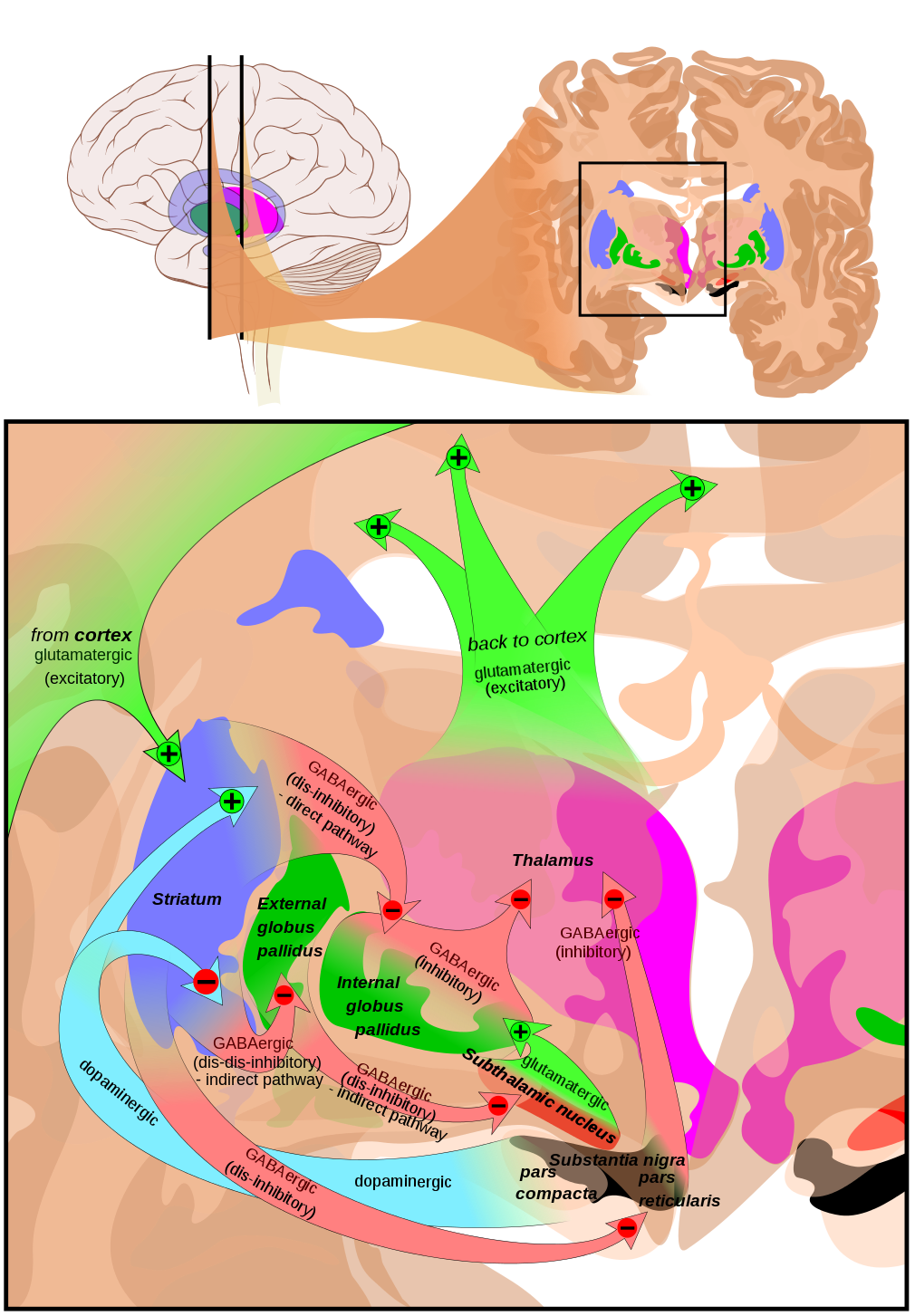
Dorsal striatum: the “northern” part of the striatum, activated when goal-directed behaviors shift from impulsive to compulsive; central to stimulus-response learning; triggers actions that are automatic and difficult to turn off; also fuelled by dopamine.

Lewis, Marc (2015-07-14). The Biology of Desire: Why Addiction Is Not a Disease (Kindle Locations 780-782). PublicAffairs. Kindle Edition.

The brain and areas around dorsal striatum.

The brain and areas around dorsal striatum.

Ladies and gentlemen, this is the part of your brain that controls things that you do without having to think about it. Your brain has evolved to reduce the high-reward behaviors to automatic actions that require little brain power to execute. Do you look at your cell phone habitually? Without hooking you up to a machine I can guarantee that your dorsal striatum is lit up. Ever owned an individual stock in the stock market? Your habitual intraday checking of that stock price is lighting up your dorsal striatum.

But the northern hemisphere of the striatum, the dorsal striatum, has a different mode of operation. It doesn’t care about the value of rewards, it isn’t attuned to likely pleasures, and it’s not about to send its owner on an impulsive hunt for goodies. Rather, the dorsal striatum records connections between stimuli and responses, so that well-learned actions will be linked with particular stimuli (i.e., cues) and get triggered by those stimuli whenever they are perceived.

Lewis, Marc (2015-07-14). The Biology of Desire: Why Addiction Is Not a Disease (Kindle Locations 1956-1960). PublicAffairs. Kindle Edition.

The activation of the dorsal striatum is a huge marker for addiction. The reason is that compulsive action like checking your cell phone are different than a normal reaction. These behaviors don’t require a stimulus, they come up on their own, compulsively. A trigger can start it, but most of the time these behaviors are automatic. You are driving along and you just have to check your phone. It’s almost in your face before you realize you have even reached for it.

These behaviors are all related, because they all go through the same brain. The overeater is not diseased, their brain is not different from yours, and they can’t control their weight because they are being treated for the wrong illness. A weekly trip to OA (Overeaters Anonymous) treats the fat man like the problem. He doesn’t have enough willpower, is weak, doesn’t try hard enough to eat less, different, healthy. In reality, the overweight are just suffering from habits all through their day that are likely to make them stuck in their behavior patters. Looking in the refrigerator is a classic example. Its truly compulsive. How about starting off for the Coke machine? They are halfway there before they realize where they are going. Shopping for groceries is full of habitual behaviors that must be thought about in order to change them.

The second biggest impediment to fighting compulsive behavior is that it must be replaced with another behavior. Heroin addicts in Vietnam came home to a different world, totally. They didn’t stay addicted because there was no way to continue the compulsive behavior. I quit smoking successfully when I changed jobs at the same time. None of my compulsive times and actions applied to this job.

The very biggest impediment to successfully changing a compulsion is acknowledging that there is nothing wrong with a person who acts compulsively. It is actually a feature of the human brain that allows us to be evolutionally successful creatures. It is not a bug in the software. The anorexic has a destructive habit. Antidepressant drugs will not help, because the problem is not one of self-image. The behavior is not a choice it is a compulsion. That behavior modification is different than what is currently being treated.

The heroin addict is no different mentally than the workaholic or the compulsive phone-checker. The addict should not be reviled, shunned, even looked down upon. Literally, they are no different than you or I, only their compulsion is different. What is needed for us to more better help them is extra compassion and empathy. They need help understanding that they are not damaged goods, unworthy of self-love. They are just suffering from a bad habit, one that they can battle using the well known tools of behavior modification. Having a habit does change the brain. The brain, however, is designed to change, and it will easily change back to something more useful to it’s owner, but that does not start with labeling the addict as “Addict” or “diseased”. Their self-hate and your hate and disgust are not helpful.

“It helps to explain why treatments we expect to work, like antidepressantsand cognitive therapy, don’t work very well,” Dr. Walsh said. “Habits have to be replaced with another behavior.”

For example, he said, one strategy might be to get the patient to look at entrees as well as at the salad bar, or to switch to eating with the left hand, as a reminder to think about eating different foods.

If you have a self-destructive addict in your midst, your attitude toward him or her is a habit. Your disgusted sneer, your averted gaze are compulsive behaviors. They automatically convey your thoughts, and you can’t seem to help it. Intentionally smile and give a kind word. Its the equivalent of our anorexic using the off hand to eat with. It will remind you to think different about the victims of compulsion that you know and love.

Posted in Health, Living | Tagged , , , , , | Leave a comment

Really Bad Advice

The world of health and nutrition information is really quite full of bad advice. Most of the places that you would think of first to get this kind of information will be the most frequent dispensers of this bad advice–eat less calories, exercise more. The worst thing about that advice is that for most of the people that need help the most, it is least likely to be successful.

Eating sugar and starches is addictive. When I personally am craving sugar it is behavior that I am willing to sneak to do. All of my friends know that I am anti-sugar, anti-carb, anti-processed food. When I really really crave sweets I have been known to hide the act, to do it in secret, to feel shame as I did it. These are hallmark behaviors of the addict. If you are eating all of your sweets in plain sight then that behavior is not unhealthy. The second you try to do it out of the sight of friends and family, you have made the jump into pathological behavior.

It is so easy to be addicted to food. Being addicted to food is so much worse than being addicted to some illegal drug or to alcohol. Food is required to live. Telling a food addict that they have to eat less of it is so unproductive. Especially since people who are overweight are not that way because of how many calories they eat in a day. People gain weight by eating carbohydrates. People who eat carbohydrates are going to gain weight because eating carbs makes you crave carbs. That cycle is not present with any other food type. Eating steak does not leave you hungry for steak in an hour or two. Eating meat leaves you satisfied for hours. Eat meat and potatoes and you will be hungry before your next meal. It’s not the steak.

What is needed for us sugar addicts is a group that is not going  to recommend counting calories. Counting calories is foolish, because all calories are not created the same. There are those who will tell you that if your ‘calories in are greater than your calories out’ you will gain weight. For them your body is a simple boiler, where every calorie you eat (input) must be balanced by every calorie out (work). Your body is not a simple machine, though. Some of the calories you eat will leave in your waste. One example of this is for the Type I diabetic–they cannot metabolize carbohydrates at all. They produce no insulin. The sugars that they eat end up in their urine. This is one example of calories in, calories out in waste. Some calories you eat will end up in your stool. If you eat lots of carbs, this is where the fats that you eat which are not being used end up. As a simple energy balance, calories in/out works, but you have to account for all of the ways you lose them. Exercise is but one way.

The really good advice for the overweight, obese, and over eaters that are looking for it is this–stop eating carbohydrates. That leaves the question, “How?” Well, my own personal journey took me to the 21 Day Sugar Detox route. The link to my experience is in my WordPress blog found at dcarmack.com.

If you need more personal assistance, if you need a group to be in, if you need the support of a community of like-minded and like purposed men and women, you might try a program called “Restart”. Here is some information on the program:

What is The RESTART® Program?
RESTART® is a 5-week program with a 3-week sugar detox built into it. Part nutritional class, part sugar detox, and part support group, it is a powerful and empowering combination for success!

Discover how good you can feel when you give your body a vacation from processing the toxin sugar! You will be fully supported as you go through a gentle, yet powerful sugar detox that will remove the negative effects of sugar from your body and your life.

You will also learn:

How to prepare mentally, physically, and emotionally to make successful changes to your diet.
How Digestion is supposed to work and simple ways to enhance yours.
What sugar really does in your body, the stages of dysglycemia (Hypoglycemia, Hyperglycemia, Insulin Resistance, Type 2 Diabetes), and effective ways to reduce your risk of these conditions.
The truth about FATS and why healthy fats are essential for healthy Blood Sugar Regulation, as well as your general good health. You will learn which fats to eat, which fats to avoid, and why!
How to move forward from the sugar detox and re-introduce foods in a healthful way back into your daily diet.

If that sounds familiar, Dear Reader, it is because you have been reading similar advice and facts on these pages for many months! I can wholeheartedly advise you to go to this location, read more about the program and then sign up, or ask my good friend Heather Page for more information. She is full of it.

I can advise you that you should quit eating sugar. You might be the kind of person that can take that advise and just do it. I could not. I needed a group of people around me on the same journey. When I did it, it was my wife, and our best friends. The four of us supported one another and compared notes. I began to blog about it–this blog. I hope my efforts have been a help to you and yours, but they have definitely been a help to me and mine. If you need a group then look to Heather and her group as one option. It really does help to have friends in need right along side you.

Unknown

Posted in Health, Living | Tagged , , , , | Leave a comment

Bad Impressions

Sometimes I Shake My Head in disbelief at the things that can creep, unquestioned, into a news article. Even in a paper as well-known for getting it right as the New York Times, sometimes inaccuracies get in there, and perpetuate myths.

In their Q&A Health article,  “Ask Well: Reversing Diabetes” the author says “Lifestyle changes like weight loss and exercise are most likely to have an effect early in the course of the disease, shortly after a patient moves from prediabetes to diabetes and is still producing some insulin.” The fact is that people with Adult Onset Diabetes do not quit producing insulin. The purpose of insulin is to keep the blood sugar levels inside a tight range. Diabetes where the body is still producing insulin occurs because the patient’s blood sugar levels are out of range high, but it cannot produce enough insulin to cope. Think of it as the body’s ability to deal with the onslaught of blood glucose is maxed out.

It might seem like a trivial distinction, and you might wonder why I get so worked up about it, but the public’s understanding of how blood sugar regulation is accomplished is just one indication of a vast problem in public dietary health education.

Another huge gap exists between the reality and the perception where dietary fats are concerned. People think that eating fats leads to body fat. That has never even been suggested by science. My thinking is that it’s an easy line to draw, mentally, so people make the leap on their own. The government was warning us to not eat foods high in cholesterol so as to keep our blood cholesterol levels down. People just figured then that eating fat makes you fat like eating cholesterol gives you high cholesterol in your blood. Except that that is not true, either.

Your body makes its own blood cholesterol, and if it is high, it’s because you eat carbohydrates, not eggs. Cholesterol is a form of fat, and fat is made out of carbohydrates. Fructose, for instance, can only be metabolized by the liver, and it is turned straight into fat. Eating fat does not make fat. Fatty acids can be used directly by most of the organs in the body and glucose must be converted into fatty acids in order to be useful for most of your internal organs. Eating cholesterol does not make cholesterol.

The news is getting really good as far as dietary fat advice goes. Today the Washington Post has a lengthy article on how the bad advice originated on saturated fats, how the science never really supported it, and how new science is pointing at the real culprit all along, carbohydrate. Here is the article:

For decades, the government steered millions away from whole milk. Was that wrong?

“If we are going to make recommendations to the public about what to eat, we should be pretty darn sure they’re right and won’t cause harm,” Mozaffarian said. “There’s no evidence that the reduction of saturated fats should be a priority.”

You have to get your energy for life from somewhere. There are three classes of food energy–fat, carbohydrate, and protein. Every day your food energy intake is split between these three types. If you lower one type, the other type must increase to make up the difference. If you lower one and do not increase another you will suffer an energy deficit, you will be starving. It is possible (I say desirable) to lower your carbohydrate intake to near zero eating real foods (not processed). It is possible to make up all of those calories by increasing your fat intake and you will suffer no ill effects. It will certainly not lead to more body fat for you to carry around. My own experience is that when I eat no carbs I slowly lose body fat. When I eat them I slowly gain body fat.

Here are the rules to live by, regarding food.

  1. Don’t eat any processed food. If it comes in a can, box, bag or bottle it is processed. If it has a health claim on the label then it is processed.
  2. Eat real, single ingredient foods as often as possible.
  3. Dont drink any sweetened beverage.
  4. Eat full fat versions of all dairy and meats. Most of your energy should be coming from dietary fats, and very little from carbohydrates.
  5. Make it at home, because any meal on the road will contain ingredients that violate one of the rules above.
Posted in Health, Living | Tagged , , | 2 Comments

Hubris of Man

product-2-680x453

Here we are, in the 21st century, and we are just these days coming to terms with the importance of the bacteria that have lived within us and on us for our entire evolutionary history. There are, on average, 100 Trillion bacteria living in an adult human being–even the really clean ones. That is 10 microbes for every human cell in your body.

Justin Sonnenburg, a microbiologist at Stanford, suggests that we would do well to begin regarding the human body as “an elaborate vessel optimized for the growth and spread of our microbial inhabitants.” This humbling new way of thinking about the self has large implications for human and microbial health, which turn out to be inextricably linked. Disorders in our internal ecosystem — a loss of diversity, say, or a proliferation of the “wrong” kind of microbes — may predispose us to obesity and a whole range of chronic diseases, as well as some infections.

New York Times, May 15, 2013

Some microbes are just along for the ride. Some have vital functions to perform and assist us in living a healthy life. Some are dangerous and damage us, but they are relatively few. The point here is that the cataloging of microbes is a study that is in the very beginning of it’s infancy. No one anywhere knows what they all are, or what they all do. They are notoriously hard to examine, because they exist within us, and if taken out of this environment they change, die, cannot function normally–because they are not in their normal environment.

Another place where there are more microbes than host cells is in the soil. Even the soil in your yard contains so many and so varied microbes that it is impossible to determine the roles that they play in plant life. There are more microbes in a teaspoon of soil than there are living people on the earth. Every single type of living creature in that teaspoon of soil has a vital role to play in it’s individual ecosystem. We have no idea what that role is. It would not be wrong to assume that the role of many of these microbes is the equivalent of the role that our own intestinal bacteria play, they metabolize and digest nutrients that the plant cannot. Their duties are performed at the outer surface of the plant roots, where our own microbes do theirs at the internal surface our intestines. We don’t know any more about the duties and responsibilities of soil microbes than we do those that reside within us.

That is why this story drives me nuts…

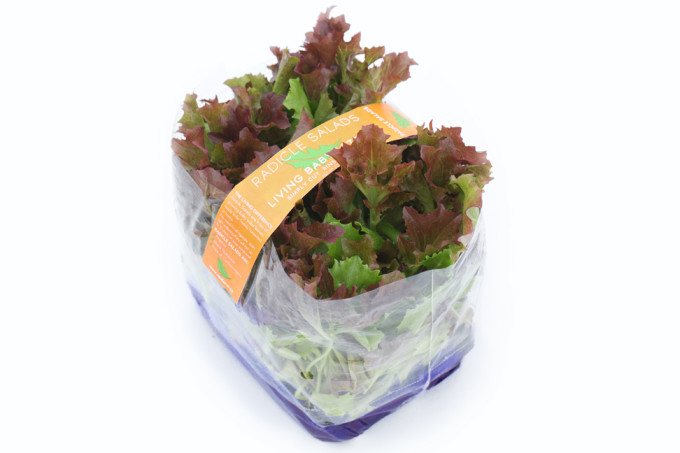
These Salad Greens Keep Growing on Your Kitchen Counter

Each package of greens is grown in a greenhouse in Utica, New York or Newark, New Jersey, in a compostable soil mix in a recyclable tray. Although the growing method and soil mixture are a trade secret, Washington describes their process as a mix between hydroponics and traditional agriculture. The plan is to become certified organic in the future. Growing indoors eliminates the need for any pesticides, and a targeted irrigation system relies on less water.

There may or may not be a benefit to growing salad greens hydroponically in a soil-like mix that is a trade secret. One thing that is certain, however, is that the soil and liquids that these plants are grown in is not what they have evolved to expect. We all know that we can keep plants in pots in our homes for years. We have no idea if the nutritional value of those plants is compromised by their living in potting soil in our homes.

We can eat just about anything living. We can live for quite a while eating food that resembles nothing that ever lived, and contains no living material at all. We are beginning to find out that when we live like the potted plant and only eat foods that are delivered to us processed and dead that we do not thrive. We live, but we get fatter and fatter, sicker and sicker–much like our transplanted house mates.

Nothing is free. Growing plants in hydroponic environments and in potting soil costs something to the plant, and up the food chain to us. Nothing would happen that would be drastic because of it, but over time–perhaps a lifetime, you could expect that your own internal microbe collection would suffer by being disconnected from the expected microbes that you should be eating in your natural foods. Eating even living plants that are far-removed from their natural environment is a change to your micro biome.

I am not saying that eating living plants is in any way bad. The article above though talks about traditional agriculture as though the dirt that is on real food is a bad thing. I don’t look at soil as filth, it is a necessary building block of life, and all good things start there. There is filth and pathogens in the world, and sometimes they end up on grocery store vegetables and fruit. They are the exceptions, far from the rule. The beneficial things found on real food grown on real farms in my neighborhood are far and away more beneficial than the noxious ones are dangerous.

I don’t fear the dirt and germs that are in real food from a real farm. The germs on the California vegetables, well, some of them are going to be bad. The trucked in foods are grown in close proximity to livestock that are themselves not living in the way that nature intended. The result is meat and plants that are each covered in things that are not according to nature’s plan. Fresh vegetables are better than dead processed foods, but are not as good as the foods grown in your local farms.

Eating the optimum food is harder to do. Currently our system is set up to deliver us crops and meats that are grown the cheapest, even though they are from a thousand miles away. Its really easy to go to the grocery store and pick through what is on display there. It’s a bit harder to get food from a farm that may be only a dozen miles away. That food will also only be available in one of nature’s seasons. These hydroponic foods will be available even in the dead of winter. Nature did not intend for you to have access to all foods all year long, so perhaps eating lettuce in the winter is not really a health concern for us. Eating these things can be seasonal.

Posted in Health, Living | Tagged , , | Leave a comment

Dead Food Kills

Can you imagine a future where you take a pill that gives you everything you need to survive? Perhaps you are a soldier in the field, all you have to carry to live for the week is seven tablets. You would think, if it were possible, that we would already be enjoying this product. The fact that we are not would seem to indicate that it takes more to live than vitamins and minerals. If if were so simple, we wouldn’t need to farm or cook to live, we could just count on the products of a pharmaceutical factory to input the stuff we need in its raw form, remove all of the things we don’t need that are in food, and put it back together as just the important parts.

When I was in elementary school we had two aquariums, each containing a white lab mouse. Every day during the experiment we gave one mouse a meal of real food and water. The other got processed foods. We thought it would like Fritos and potato chips. Instead of water, this mouse got Coke. After the experiment was over you could tell the difference just by looking. One mouse had a pretty coat of white fur, the other had a greasy, nasty looking appearance. We weighed them and monitored other things, but the difference was visible without even doing any of that.

Giving that mouse nothing but processed foods was the equivalent of giving the soldier nothing but a diet pill for nutrition. They fail for the same reason. Food cannot be reproduced in a lab. There are things that you need from your food that are put there by a billion years of evolution, and we can’t take a real food apart and reproduce it with just the necessary parts. Nobody knows what the necessary parts are.

There are symptoms that we experience when we are eating too much dead (processed) food. Like the lab rat’s appearance, our own appearance suffers. We gain weight. We get allergies. Our blood pressure goes up, our blood sugar goes up. We get acid reflux. We get gassy. Our joints and muscles ache. We get headaches.

Scientists in Australia have discovered that giving kids with a peanut allergy a bacteria from yogurt CURES 80% of them.

Researchers from Murdoch Childrens Research Institute have successfully trialled a treatment for peanut allergies that could potentially provide a long term cure for allergy sufferers.

Over 60 peanut allergic children in the study were either given a dose of a probiotic, Lactobacillus rhamnosus, together with peanut protein in increasing amounts, or a placebo over 18 months to assess whether children would become tolerant to peanut.

The implication here is that the children that have peanut allergies are suffering from a diet that has killed this bacteria in their bodies. Re-adding it to them allows them to tolerate whatever the irritant is in peanuts. This implies that even more of our common ailments might be because the dead food that we eat is not providing whatever the life-sustaining real foods that we should be eating do. There are things in wheat that are not in bread. There are things in cheese that are not in pasteurized processed cheese food product. The fact that processed foods will last forever and a day on the shelf is a problem for a living being to try and live off of them.

Life feeds on life. Eating nothing but re-constituted dead foods is turning out to be deadly. Eating raw vegetables will include something that eating even cooked vegetables do not, living bacteria on the plants. Eating raw vegetables that are grown without using herbicides, fungicides, fertilizers and pesticides will contain something that industrially produced vegetables will not–the plants own defenses from these attackers. Whatever the plant does to protect itself, when we eat it, we get it. Whatever beneficial bacteria on the surface of a natural plant are there are liable to be beneficial when we eat them. Our evolution might be expecting them, but we aren’t delivering it, because we are eating nothing but dead foods.

Posted in Health, Living | Tagged , , | Leave a comment

Running the Gauntlet

When I was a kid, back in the 60s, we ate breakfast before school every day. Mom would get up with us and make pancakes or oatmeal, sometimes bacon and eggs. By the 70s mom had quit getting up and breakfast had morphed into dry cereal and milk. I added my own teaspoon of sugar to corn flakes or cheerios to sweeten them up, most days. Usually I just added one teaspoon of sugar.

Times have changed.

CHICAGO - APRIL 20:  Students eat lunch at Jones College Prep High School April 20, 2004 in Chicago, Illinois. The Chicago Public School system will introduce next fall a new vending policy restricting junk food and a new beverage contract banning carbonated drinks.  (Photo by Tim Boyle/Getty Images)

CHICAGO – APRIL 20: Students eat lunch at Jones College Prep High School April 20, 2004 in Chicago, Illinois. The Chicago Public School system will introduce next fall a new vending policy restricting junk food and a new beverage contract banning carbonated drinks. (Photo by Tim Boyle/Getty Images)

In these busy times for the parents of school kids, they take advantage of the fact that schools now serve breakfast. It’s a great time saver for parents. It is good for the kids to eat a breakfast that is wholesome and healthful. Who could imagine that the schools would serve a breakfast that would be less healthy than what they would serve themselves at home, alone?

Today’s breakfast menu at a public school near you looks like this:

Blueberry Waffles:

1 serv Serving Size
190 Calories
7 g Fat
1.5 g Saturated Fat
0 g Trans Fat
15 mg Cholesterol
320 mg Sodium
30 g Total Carbs
2 g Fiber
3 g Protein
1000 IU Vitamin A
250 mg Calcium
0.0 mg Vitamin C
4.5 mg Iron

Cherry Craisins

1 serv Serving Size
110 Calories
0 g Fat
0 g Saturated Fat
0 g Trans Fat
0 mg Cholesterol
0 mg Sodium
28 g Total Carbs
3 g Fiber
0 g Protein

Apple Juice

1 ea Serving Size
50 Calories
0 g Fat
0 g Saturated Fat
0 g Trans Fat
0 mg Cholesterol
10 mg Sodium
13 g Total Carbs
0 g Fiber
0 g Protein
0.0 IU Vitamin A
0.0 mg Calcium
0.0 mg Vitamin C
0.0 mg Iron

Just 7 grams of fat in the whole meal–3 grams of protein. Every other energy-producing gram of this breakfast is carbohydrates.

That is a grand total of 71 grams of easily digestible, processed carbohydrates. They don’t list sugar in the ingredients for some reason. We can assume that all of the carbs in the juice and the craisins are in the form of sugar. Probably half of the waffle carbs are sugar. All of the carbs are highly processed and will have the same metabolic effect on the grade-schoolers as sugar in any case. If so, that would be the equivalent of about 18 teaspoons of sugar in that breakfast, not counting the lactose in the milk they get. Compare that to the 5 teaspoons of carbs in a serving of Cheerios that I ate, and add my teaspoon of sugar for a total of 6 teaspoons of carbs.

Today’s kids are being fed an insulin-spiking breakfast that is three times worse than mine in the 70s. This food is fattening and unhealthy. You are assuming that your babies are being fed a healthy breakfast, but instead they are being drugged and fattened. This food, combined with the lunch they get at school, is going to make them sick and overweight in the long run.

Fortunately, kids are only in school for 13 years. What can you do? Well, there is home-schooling. Alternatively, you could make them breakfast before they leave, so that only the school lunch will be fattening. Chances are though, if you are like most Americans, your breakfast will also be frozen waffles and syrup, maybe a super-sweetened ‘vitamin enhanced’ cereal, and a big glass or two of chocolate milk.

If anyone wonders why school aged children in the US are gaining weight and getting sick, the problem obviously starts at breakfast, continues at lunch, and ends up at the McDonalds between soccer games. Its not how much we eat, it’s what we eat. The problem isn’t too much fat in our foods, it’s too much sugar and starch in our food. Start making it yourself from real ingredients. Take the time, do it right.

Posted in Health | Tagged , , | 2 Comments

Upset Weekend

Unknown

This weekend I was a solo diner. Eating alone presents it’s own challenges. It’s tough to cook for one, and eating alone is not comforting it’s only filling. I finally invited my son over to share in the eating, so that it would be worth the cooking. Overall I ended up not doing too bad a job at eating good, but I didn’t try too hard in the end.

From this Thursday I was a bachelor. The first night I had dinner at the airport, bar food. The first night I boiled a beef tongue that I had cured, so that I would have prepared meat for later meals. That was the high point of my eating weekend, as the change in schedule of being alone to cook and eat was more than my meal planner could handle.

I made a corned beef hash with potatoes, beef tongue and eggs. It was a good start. I ate a hamburger salad one night, using home made ranch dressing. Then, when my son came to spend the rest of the weekend with me, I made reuben sandwiches with potato chips and the next night was processed battered shrimp and processed potato tater tots. Oh yeah, root beer. Oh yeah, ice cream.

I would love to blame my son for being a bad influence, but the reality is that I was having comfort food. I wanted to just eat without thinking and having something I could fry quickly, and eat quickly, well…it was comforting. I could have grilled steaks instead of buying the shrimp. I could have roasted a pork roast I had thawed. Instead I heated up some tallow, threw in a pound of artificially flavored battered shrimp, followed by some enhanced potato bites and called it dinner. Each bite was a guilty pleasure.

Back on the wagon.

Posted in Health, Living | Tagged , | Leave a comment