Price or Cost

cow-feed-lot[1]

Last week Mark Bittman tried to calculate the cost of our national love affair with the fast food hamburger. In the article he tried to differentiate the low price of the meal from the high cost of the meal. You see, the cost is much higher than the price. We pay the extra fees by living in a world that tries so hard to keep the price down.

Giving us low-price beef costs the world in many damaging ways. Here in the US, the beef that we get in those low price meals are forced to live the last six months of their lives in ‘feed lots’ where there can be ten thousand animals or more on a lot, where the recommendation is that they get 300 square feet of room per animal. That comes up to 145 cows on a plot of land the size of a football field. For six months they don’t eat grass, but a combination of roughage and grain. They stand in their and their neighbor’s wastes. The closeness and the change in diet forces them to consume antibiotics so that epidemic diseases do not flourish among the inmates. This is done so that it doesn’t take a year or two of eating grass on the range to achieve their final weight. It is done to save money, to keep the price low. One cost is in the product, which finishes it’s life in stress, meats and fats marbled with unnatural omega 6 oils, instead of nature’s intended omega 3 oils. To make matters worse, now the price isn’t even low. We are getting 100% of the bad effects and very little of the low costs. As of today’s post, ground beef in Kansas City is over three dollars per pound. Another cost is to the land, where the wastes are concentrated in such a small area that nearby streams are polluted with both the wastes and the chemicals used in these operations, like antibiotics, hormones and cleaning solutions, that are excess and eliminated by the animals.

aeriel-view-cornfield-uiuc[1]

Since the feeds for these animals are intended to quickly bring them to market weight, they must be high in energy, and they must themselves be low-priced. Corn and soy are used because these grains are subsidized by the federal government, so that the price paid by the feedlot consumer is less than the price paid for the grain to the farmer. We all share the cost of the grain, a little in our taxes, a little in the price of the meats. A small portion of your tax bill is paying for the profits on the beef in your fast food hamburger. If you don’t eat fast food hamburgers, you are still paying in to keep the price low to the consumer. To keep the cost of your feedlot corn down, the farmer is using corn that is genetically modified to not be susceptible to the Roundup herbicide. A side effect of this is that there is no longer enough milkweed in North America to sustain the monarch butterfly’s primary food source, milkweed. Milkweed is susceptible to the Roundup. Entire States that used to produce myriad food crops are now gigantic deserts of corn and soybeans. Honeybees cannot penetrate this landscape because it is devoid of food for them. The soil is damaged so must be amended with fertilizer to grow the crops in ever denser bushels per acre. All of this is to save pennies per bushel. The price must be kept low, and there is no concern about the cost. Excess fertilizers wash out of the fields, into streams and lakes, where the nitrogen causes algae to bloom and the mineral impurities which damage streams and soils alike. Densely grown crops are also irrigated to keep their prices low, and irrigation causes problems too. Salts are dissolved uphill and emerge downhill, where they solidify on the surface of the soils, rendering them dead to any food plant. Correcting this problem takes years of dedication by the farmer. This cost is not factored into the price of the grain.

67673719[1]

Fertilizer is not free, it also costs the world. The phosphorus in the fertilizer is from phosphoric acid and phosphate rock. Created at a chemical plant, the fertilizer is a mixture of nitrogen, ammonia and phosphoric acid. There is energy consumed at every phase from making or mining the raw ingredients and shipping them to the factory, to the energy needed to put the fertilizers on the fields. This expenditure of energy should be compared to the energy required to just allow the natural processes by which nitrogen gets into the soil from the plants themselves. Just allowing the plants to work together with the organisms in the soils to create natural foods would be pricier, but it would be less costly to the planet.

There are over three hundred million people in the US now. Feeding us all inexpensively requires more and more that we spend ever more energy, and cause ever more damage to the soil, the air and the water. Now we are finding out that keeping the price down is also causing us physical damage in the form of inflammatory fats and sugars in all of our manufactured foods.

cannedtomatoes[1]

Right now I can’t do anything about my portion of taxes that are being fed into this system. My part of changing the system though, is something that I am already doing. I won’t eat at a fast food place. I will get my meats from the farmer, have them processed myself. My foods are all whole and fresh, or canned by me in the summer when the real thing is available and plentiful. I can keep my personal costs low, and I will.

Posted in Health, Living | Tagged , , , , , | 2 Comments

Your Memory is at Stake

dementia-treatment1[1]

You are a very complex machine, crafted by millions of years of evolution. The interaction between you and the billions of other creatures around and inside of you is likewise complex. This complexity makes determining the cause or the effect of various problems that occur after decades of life very difficult.

Dementia is a blanket word for a symptom of a problem in your nervous system. It is a word like ‘fever’ which does not tell you why, but it tells you that there is a problem. Dementia’s main symptom is forgetfulness, to the point of being dangerous. Alzheimer’s is the most commonly known dementia. It is the most frightening, and the one that you know is a death sentence when you have it.

Now we all must die, as we all know, but nobody wants to die of a wasting disease like dementia. Science and big Pharma are busily looking for a way that we can live any way that we please and put off the negative effects of dementia with a pill. If they can pull this off, then it is a win-win situation for doctors, drug makers, and big-food. Why did I lump big food in with doctors and druggists, you ask?

Suzanne M. de la Monte, MD, MPH, a physician-scientist at Rhode Island Hospital and professor of neuropathology, neurosurgery, and neurology at The Warren Alpert Medical School of Brown University, found a critical link between our modern diet, characterized by processed “convenience” foods, and the disease. Though scientists had already determined that Alzheimer’s disease, a devastating form of dementia, was characterized by tangles and plaques in the brain, no one had determined the cause.

Long story, short, she discovered that insulin resistance is a cause of Alzheimer’s disease. Doctors have been calling dementia Type III Diabetes for a while now, and have been calling for changes in our foods to combat it. I wonder what could be in our foods that make us insulin resistant? I wonder if anyone is trying to figure out what ingredient out of the 10000 FDA approved artificial ingredients in our foods is causing us to become insulin resistant and prone to Type III Diabetes?

The answer is noone is testing food additives for this kind of problem or any other complication of their use. The system is not built that way. The fact that it does not sicken you right away is a feature of the system. This makes it possible for food makers to blame any of the other myriad factors that could cause dementia, weight gain, fatty liver disease, hypertension. These problems creep up gradually, over years of eating wrong. There will be no smoking gun found, and the fact that they can’t find a pill to cure Alzheimer’s (or make it bearable) is proof that there is probably more than one way to cause it.

There is, however, a way to defend yourself from all of the man-made diseases that we citizens of the richest nation on earth seem to catch.

Eat only real food.

Make your own dinners.

Don’t drink anything out of a can or bottle, unless you put it in the bottle yourself.

Don’t add sweeteners to your foods.

Buy no foods in boxes, bags or cans.

Stay out of the middle aisles of the grocery store. The products in the middle aisles are dangerous to your long-term health. The foods that don’t effect me I cannot say the same about for you. We are all complex machines, and our bodies react differently to every stimulus. It is known, though that if you eat the foods your great grandparents ate, if they are foods that existed one hundred years ago, they will be much less dangerous to the delicate, complex machinery that is you.

Posted in Uncategorized | 3 Comments

Our Bees, Our Selves

honey-bee[1]

So, reading the Times this morning, I find out that if the farmer left some of his acreage wild that the increase in honeybee numbers would actually increase his profit from farming, due to higher yields.

A variety of wild plants means a healthier, more diverse bee population, which will then move to the planted fields next door in larger and more active numbers. Indeed, farmers who planted their entire field would earn about $27,000 in profit per farm, whereas those who left a third unplanted for bees to nest and forage in would earn $65,000 on a farm of similar size.

This also applies to you, dear reader…don’t put all of your ‘health eggs’ in one basket by only consuming foods from one or two crops. Your beef, pork and chicken are raised on corn. Your vegetable oil is from corn. Your processed foods all contain a high percentage of corn and corn by-products. You are 90% corn if you don’t count the water. The genetic diversity that makes us up is shrinking lower and lower all the time.

Just like nobody has the job to consider bee health as a number one priority, so too there is nobody whose primary concern is your health.

Observing the tumultuous demise of honeybees should alert us that our own well-being might be similarly threatened. The honeybee is a remarkably resilient species that has thrived for 40 million years, and the widespread collapse of so many colonies presents a clear message: We must demand that our regulatory authorities require studies on how exposure to low dosages of combined chemicals may affect human health before approving compounds. [emphasis my own]

What is our food production system if nothing other than a way to dose us with untested combinations of chemicals? If you regularly eat foods that are highly processed and delivered to you in a box or a bag, ready to eat, just pop it in the microwave, then you regularly consume small doses of chemicals whose only testing is by the manufacturer. That manufacturer is not required to test the effect on you of that chemical when mixed with all of the other chemicals in your regular diet. NOBODY has that job. You, in fact, are the canary in the coalmine for this industry. The fact that two thirds of you are fat and getting fatter is proof that you are having a reaction to their products, but the advice from your government is to keep eating the same way, just less of it…yada yada.

You are just as vulnerable as the honeybee. Your diet is a similar desert compared to the rich and varied diet of even your parents. When I was a child you didn’t see entire states carpeted with corn and soybeans, to the virtual exclusion of all other foods. The problem is within our power to see, but we can only control the market in our one little way, which is to cut their processed foods out of our menu. We don’t have to drink corn syrup in our sodas, if we don’t buy them. We don’t need to eat tens of thousands of unverified chemicals if we buy our foods whole. No one is making us eat the easy meal, the cheap meal, the fast meal.

The evidence is piled high. The reasons to change mount ever higher. You don’t want to gain weight every year of your life. You don’t want to be a test bed for new and tasty chemicals, stabilizers and preservatives. Just change One Small Thing this week, stay on the outside edges of the grocery store.

Posted in Uncategorized | Leave a comment

It’s So Hard!

school%252C+sea+world%252C+gumball+board+118[1]

The easiest thing in the world to do, at least here in the USA is to eat carbs or other crap for your meal. On a day when you are busy from sunup to sundown, like we were this weekend, to just go out at the end of the day and grab pizza and a big coke is as American as apple pie. We didn’t get apple pie, but we could very easily have done it.

No amount of planning in the world can help when at the end of a very long day neither you nor your significant other can stand the thought of waiting to eat until after you cook. In that case it would be great if the majority of things you could eat out were healthy choices, made with real food, containing no sugar or artificial ingredients. Sadly, I do not live in that world.

Here is where the beauty of looking at the diet I am on as not a diet, but a lifestyle change. Eating my half of a large pizza this weekend, and my large Coke (with real sugar, no less) cost me nothing in the grand scheme. I have not created a new habit nor reinforced an old bad habit. Lucky for me, every weekend is not like this one was, and I normally have plenty of time to cook and eat properly. This weekend was different, and we consumed so much energy this weekend that we almost were required to make up the deficit in our energy by consuming carbs. I know that I felt no ill effects from it in the form of sweaty sheets or inflamed hands. I can only think that doing as much as we did our bodies did something else than what they normally would have done after a normal sedentary weekend.

I don’t have to reset my sugar free day counter to zero. I don’t have a day counter. I don’t have to ratchet down my calorie counter to compensate for the extra carbs I ate this weekend. I don’t have a calorie counter. I am not worried about the weekly weigh in or waist measurement. I don’t do that, because once I got back into my thirty waist jeans I didn’t see the use in keeping track of those things any more.

I am now going back to my regular routine of planning today’s meal using the real fruits and vegetables in my pantry. Today’s meats and fats will be my usual grass fed variety, so that my omega 6 to 3 ratio will be in proportion to the needs of my body. Today’s carbs will be the rolled oats that I had in my muesli and almond mild this morning. Eating like a typical American this weekend cost me nothing, because I am not on that journey, I am on this one.

Posted in Uncategorized | 1 Comment

Eat Your Meat!

paperbackcover_lg[1]

Eat wild. There is a certain logic to eating things that nature put in your environment. Your ancestors grew up in nature, where one hundred percent of the food they ate were connected to the ground on which they stood. Over millions of years, animals and plants that are always in close proximity to one another grow to depend on one another for different things. On first glance it seems incredibly fortunate that bees make honey from so many plants that depend upon the bee to create the next generation of plant. From the perspective of the participants, though, they are doing what has always worked. No thinking is involved, just the work of experience over a vast period of time.

Modern man is confronted with a very unique problem, in that more and more his food does not come from his environment. Man and the microbes that reside in him are fed things which are new to the universe. There are now compounds available to us that we nor our parasitic guests have ever encountered. Nature will not be denied, though so if we do not use the energy it contains, there will be a microbe that does. In addition to that modern problem, people these days are confronting natural things, like fruit juices, in unnatural concentrations. When Johnny Appleseed was getting his fruit on, it was a difficult thing to eat fruit just in juice form. Crushed and strained apple juice did not stay juice for more that a couple of days. Without refrigeration, that juice quickly became cider or ‘Apple Jack’, an apple based whiskey. The same is true of grape juice, which would quickly become wine or vinegar just a few generations ago. The only way to get fruit juice was to eat fruit.

The idea of eating whole foods is appealing because it takes us back closer to the times when we could not over eat fruit or grain. Our bodies would not have to worry about excessive energy from our foods, because it took so much energy to get those foods. With everything except plowing and hauling done by hand, with cooking involving hauling wood or shoveling coal, then later disposing of ashes, with the daily chores of living taking all day, with planning for the winter’s meals involving storing away the summer’s bounty, our forebears were not fat because they had to work every minute of the day to live.

Today’s society throws away forty percent of the food that comes off the field. How that compares to a time when there was no refrigeration or modern distribution of food, I don’t have an answer for. However, throwing away forty percent of the crop in a society that DOES have modern distribution and refrigeration says a great deal about the way we create food these days. If it took you all day today to get ready to eat tomorrow, you would not throw half of that food away. Think about it, if your food cost you something more than just money, if it were all of YOUR work you were throwing out, you would think twice. It is just easy to throw that money away instead. Toss half a frozen pizza? No problem, it sucked anyway!

Even as concerned about my health and my diet as I am, I am not proscribing that we start plowing our yards up by hand. I don’t think I will be selling my refrigerator, or raising my own dairy cow. I will continue to get food that is delivered to my grocer for me. As beneficial as it would be to me to chop my own wood or make my own charcoal, I will take advantage of the convenient electricity and natural gas in my home. However, I can look for natural beef (I have a friend that raises them in Kansas), natural eggs at the City Market, natural pork at Paradise Meats nearby, and whole fruits and vegetables at Price Chopper. I can cook just what I need, and I can store my leftover foods in mason jars. I can buy foods to can this summer while they are plentiful. There is no need for me to find foods that are shipped from the other half of the globe and harvested at less than peak flavor because it takes the food weeks to get to me from there.

If you want lots of information about eating wild, I have found a great site that collects lots of that information for us. Jo Robinson’s site “Eat Wild” is a great place to start your journey of looking for a way to give your body, your family and your microbiome the foods that they expect to find, just like they always did, throughout all of history. Pick a little thing that sounds easy to do, do that thing, make it a habit. Then change one more little thing. Evolve.

Posted in Health, Living | Tagged , , | 2 Comments

Sugar Alcohols

sugar-alcohols[1]

This is the question asked of the Washington Post food health advice column on July 8:

Question: I have Type 2 diabetes. I like to have low-sugar nutrition bars handy for snacks or missed meals, so I’ve begun buying bars that contain sugar alcohols. What do you think about these bars and sugar alcohol in general?

What do we know about the person asking this question, without knowing another single fact? We know that he or she is just like one third of all Americans, diabetic or pre-diabetic. The Centers for Disease Control and Prevention recently announced that 29 million people in the United States have diabetes and another 86 million people, one in three U.S. adults, are estimated to have prediabetes. Sixty percent of Americans are also overweight, and probably wanting to know the answer to this question, too. I would rephrase this question in this way: “I like to eat foods that contain less of this or that ingredient in them. Reading this label, it looks like there is a brand new ingredient that I haven’t heard of, that seem to have a health benefit associated with it. How can I be sure this ingredient is safe or does what I want it to do?”

The column begins it’s answer in the following way:

I’m glad you asked. You’re not alone. “Lots of my clients are confused by foods labeled ‘sugar-free’ and containing one or more of these foreign-sounding ingredients with an ‘ol’ ending,” says Lise Gloede, a registered dietitian, certified diabetes educator and owner of Nutrition Coaching, a private practice in Arlington.

Most people don’t even ask. Looking for a magic bullet, they believe the label, they eat the food despite not knowing anything about the new ingredient. The Bold Letter “SUGAR FREE” is all the information that they need. Too bad, because that low-sugar description is only half of the news. The Post goes on:

On to sugar alcohols, also called polyols. They’re neither sugar nor alcohol but are called sugar alcohols because their chemical structure resembles that of sugar and alcohol.

Common names of sugar alcohols are sorbitol, xylitol, mannitol and maltitol syrup. A common suffix is “ol.” However, other ingredients, like isomalt, also are in this category.

Polyols are a group of low-digestible ingredients made of carbohydrates that provide, on average, 2 calories per gram vs. the 4 calories per gram in most other carbohydrates. The lower calorie counts are due to their incomplete absorption in the GI tract. When eaten in large amounts, this could translate to gas, gurgling sounds and/or diarrhea.

A brand new, just been invented for food, ingredient. Deemed safe by the FDA, which means the ingredient manufacturer ‘tested’ the ingredient, determined that it does not kill or maim people immediately and informed the FDA of this fact. It contains half the calories! This, according to the fine print means that you do not digest all of the calories it contains. However, keep reading because that “gas, gurgling sounds and/or diarrhea” language means that these new ingredients are indeed being digested in your bowels, just not by you. You are feeding one or more of the millions of bacteria that make their homes in you. Are they the good ones, or are they the ones that cause food allergies or weight gain? Nobody knows the answer to that question, nor are they looking–the FDA approved. Is this new set of ingredients safe for you, specifically? Same answer, nobody cares but you. Is it safe to eat these breakfast bars for you? Well, in my case, the answer is that I won’t even try them. If I could cook them myself in the four minutes it takes me to cook my egg and Canadian bacon breakfast there might be reason to consider it. If I knew for a fact that this food, which comes in a bag within a box didn’t violate two of my food-selection criteria, maybe I would be worried. However, since I don’t eat foods out of boxes, bags, or bottles, then this concern is one that I have settled long before I get close enough to read the health claims on the brightly colored packaging.

The final answer to the question posed to the Post is surprisingly similar to my own answer:

So are there benefits of foods with polyols for people with diabetes? “I don’t generally recommend them, because the majority aren’t much lower in calories and total carbohydrate, so their advantages are limited,” Gloede says. But check them out for yourself. Read labels and taste-test products. If you find products that satisfy your taste buds, shave calories and unhealthful sugars, and lead to a lower glucose rise, then fit them into your eating plan. {emphasis my own}

You are going to do what you want to do. You are going to change when you are ready to change. My advice is something that I have no trouble following, but until you are truly unsatisfied with the results you are getting from your processed foods, you will continue looking for ways to go on living like you are living right now. Good luck to you, but you can change very easily if you do it gradually, changing this or that bad habit for the good ones, one small change at at time.

Posted in Health, Living | Tagged , , , , , | 2 Comments

Sugar, Heroin, Gambling

Every addiction is like every other. I read one time that all addictions capture about the same percentage of people who try the behaviors. The number is steady at around six percent. That means that ninety four percent of the people who try heroin are not going to be sleeping under a bridge because of it someday. That also means that the two out of three Americans that are overweight are not addicted to damaging foods. The fact that they are not addicted means that their problem is likely due to a screwed up food delivery system that actually makes it hard to make the right choices.

If you are an over eater, or if you can’t resist that third piece of birthday cake with ice cream, then you may be in the six percent of people that are actually addicted to eating. If you are, there are competing ways these days for how to deal with your addiction. The old standby way is using the Alcoholics Anonymous method of absolute abstinence, relying on the power of god to help you where your own human weakness cannot be relied upon to resist the temptations of life. This method count’s the days, and resets if you slide, giving you no credit for the days that came before your fall. We who have quit smoking all know this way…200 days and then I had to start over at 1.

The newer ways to deal with addiction don’t deal with it in the same way. Today in the New York Times there is a great article on addiction treatments (on alcohol, but they are all the same in your head).

 it uses a suite of techniques that provide a hands-on, practical approach to solving emotional and behavioral problems, rather than having abusers forever swear off the substance — a particularly difficult step for young people to take.

Photo

And unlike programs like Al-Anon, A.A.’s offshoot for family members, the C.M.C.’s approach does not advocate interventions or disengaging from someone who is drinking or using drugs. “The traditional language often sets parents up to feel they have to make extreme choices: Either force them into rehab or detach until they hit rock bottom,” said Carrie Wilkens, a psychologist who helped found the C.M.C. 10 years ago. “Science tells us those formulas don’t work very well.”

The new approaches allow for normal behavior, trying to temper the excessive habits with more productive habits. In the article they describe a woman that had trouble with drinking in Kansas, but when she moved to New York she was able to replace that kind of stimulation with the productive pursuits of an intellectual life in the big city. If you have ever lived in small town America this will ring true. All of the other personal addictions will be harder to overcome in small communities, because the choices for productive activities are limited. People don’t have to work so hard just living out there now, which leaves a lot of minutes to fill in a twenty four hour day. Some of us fill those minutes with food and drink. It’s a habit.

Trying to change my eating habits I have decided that I am not quitting. I am not dieting. I am changing. I still eat sugar. I still eat carbs and breads. I am picking whole foods and vegetables. I am eating what I want, as long as I cook it myself. We eat out mindfully, picking carefully as we can from the menu and not eating foods that might have hidden sugar. We eat real butter and lard, instead of processed oils and margarine. If I eat cake, I don’t reset any kind of counter, because there is nothing wrong with eating a sweet desert infrequently. Resetting a counter would imply that all the progress I have made at building up better habits is lost when I don’t follow my rules once. It is ridiculous to think that my changes are all lost at that moment. My changes are real, they are with me as my own personal history. I build on all progress and even setbacks are learning experiences that I may also build upon.

I am having a great time changing one small thing at at time. Next for me is my omega oils!

Posted in Health, Living | Tagged , , , , , , | Leave a comment

How Long Does it Take to Change Your Oil?

This is from a blog that I follow. I believe that when we began feeding our farm animals corn and grain at feed lots and enclosures in the case of chickens and hogs we started having issues related to high Omega 6 levels. Eating grass fed beef and natural chickens and their products will restore our oil balance. If only congress would mandate the diet for our food animals.

E. M. Lores, Ph.D.'s avatarOil-Change Diet

That is basically the question I asked Dr Bill Lands, the biochemist that published the relationship between omega-6 and heart disease in various cultures. I was curious sine the omega-6/3 blood test that I had indicated that my Arachidonic Acid (AA) was still as high as the typical American.  AA is the omega-6 fatty acid our body uses to make inflammatory prostaglandins.

The answer is it depends. It depends on how much you actually change your diet and what your initial conditions are. After about a year on my diet, my omega-6/3 ratio was down to 55:45, which is much better than the typical American ratio of 10:1. Clearly, I had raised my level of omega-3, and I am sure I had lowered the AA as well, but it must have been a lot higher than the average.  A high level of omega-6 was clearly behind my medical problems of…

View original post 174 more words

Posted in Uncategorized | 1 Comment

The Soil and You

Have you heard about Omega 3? It is the good cop to Omega 6’s bad cop. What about sugar, did you know that there are different chemical types of sugars? Do you know the different effect the different sugars have in your body when you eat them? We all know about vitamins, we can name a bunch of them and we might be able to even list foods that are great supplies, in case we don’t have access to the vitamin pills which will give us our daily dose without eating all that food. Finding and naming these things is a growing branch of science.

Back when science was really taking off, especially the life sciences, it was discovered that there is a ratio of nitrogen-potassium-phosphorus that when applied to plants, they really shot up. At first fertilizer was referred to as ‘artificial manure’, and it used to be controversial. Back in the forties a study was done to identify the effect that the soil had on the animal at the top of the food chain, the human. The researcher looked at World War I draft physical exam results for young men of draft age from Southeast and Northwest Missouri. Back then people ate all foods that were grown in their locality, fertilizer had not yet been invented. The soil in Northwest Missouri is rich river bottom soil, and in Southeast Missouri it is the thin mountainous soil of the Ozark Mountains. The percentage of young men unfit for the draft in the Ozarks was much higher than the river bottoms. What effect would it have on us if all of our food was grown hydroponically, what as yet uncatalogued nutrients would we be lacking?

The researcher I am talking about above is Sir Albert Howard.  He was the head of the British version of the USDA. He wrote a book about his observations called “The Soil and Health” which can be found here. It was his idea that there are many things going on in the soil that we don’t understand. He proved that the health of the soil has a direct bearing on the health of the animals further up the food chain. Our health is directly proportional to the health of the soil our foods come from. Plant health is improved when the fertilizers used for them are natural, containing natural bacteria and fungi.

Nutrient discovery has led to the notion that plants for food can be grown without soil at all. Modern hydroponic farming completely eliminates the soil and the things living within it from the production of foods. The plants evolved over hundreds of millions of years to live symbiotically with the bacteria and fungus at it’s roots, much like we have evolved with the bacteria in our digestive tracts passed to us by our families and environments. To raise plants this way would be similar to just raising your children on vitamins.

Research has discovered lots of nutrients that are, in fact, beneficial, and some of them vital for us. Perhaps you have heard the story of sailors on long voyages that became ill before it was known that going without vitamin C was bad for you–way before we knew what vitamin C was. Naming and isolating nutrients led to a field of experts on food components. Throughout recorded and pre-recorded history people have been eating without knowing what the pieces and parts were of the foods that made them good or ‘bad’ for them.

Naming nutrients and classifying them into good ones or bad ones has created a kind of religion, or ideology, if you will. The high priests of nutrition create pills for us to take that contain them. Today it is ‘probiotics’ and ‘omega 3’ capsules. Yesterday it was Flintstone chewable vitamins. Before that it was ‘eat your vegetables’. Classifying bad fats, butter, lard, tallow led to the promotion of ‘good’ fats, margarine, canola, vegetable. Now it turns out that the bad fats aren’t bad, and the good fats aren’t good. Omega 3 is ‘good’ but only if it is in the correct proportion to the Omega 6 ‘bad’ fat, much like the nitrogen in plant fertilizer is only good in the correct proportion to the other elements contained in it. Just nitrogen is bad for plants.

Research is finding that the  best things in our foods are those that are good for the microbes that live within us and help us digest our foods. New science is discovering that the recent proliferation of food allergies are probably related to the modern diet, and may be because the modern diet is not promoting the health of the right microbes in our guts. Doctors are now transplanting feces from a healthy person to a sick person to re-inoculate his bowels with beneficial bacteria that may be missing. Reintroducing the proper bacteria of course would be a temporary fix if the person continued to eat in a way that starved them the first time.

mag-19microbiome-t_CA0-articleLarge[1]

How much of the modern health and weight issues are related directly to the unhealthy soils that our corn is grown in? Raising corn in tighter and tighter quarters at higher and higher speeds is leading to having to amend the soil with fertilizer, having to spray for insects more because the plant does not have time to form its natural defenses to them (perhaps something healthy soil naturally does), and having to spray for diseases that the plants are more prone to (also may be related to compromised soils). Rapidly raised crops and animals are bound to have less beneficial biological material to pass up the food chain to us. This is especially true if they eat the same corn and soybeans that make up ninety percent of our foods. We are all eating the same crops off of the same soils, so the diversity of our diets is limited. Whatever nutrients our gut microbes have evolved to rely on are likewise limited by this. The variety of life within us becomes more narrow, the benefits of their byproducts becomes more limited. Our health changes to reflect the quality of the soil that our corn is grown on.

Just taking the next pill to come along is exactly the wrong approach to take to deal with our worsening health. Omega 3 fish oil is not going to fix the fact that the foods you eat are from exhausted, amended soils. Taking vitamins is not going to improve the diversity of the microbes that help you digest your meals into the actual nutrients required by you to keep you thin and healthy. When they discover Omega 9 oil it won’t be the silver bullet to ‘burn off fat’. Your fat is from your reliance on processed foods in bags, boxes and cans instead of whole foods that you cook or ferment yourself.

If you want to be as healthy as your great grandparents were, you are going to have to start eating like they did. Lard and butter for cooking, eggs and grass fed meats for your omega 3 to 6 ratio, whole foods for your sugars and starches. You can change this all at once, your you can change one small thing at a time.

Posted in Health, Living | Tagged , , , , , , , , , , , | Leave a comment

…Love Thyself

This weekend we had a chance to see the play “Hairspray” as performed by a local production company. I hadn’t ever heard any part of the story, my knowledge was limited to the fact that John Travolta played a role in drag in the recent film version. For those of you who do not know, the story revolves around race relations, and an overweight girl’s struggle to be seen for her talent, instead of for where she is from or what she looks like.

As I was driving home from the show, I worried aloud to my wife that the show made light of two of the characters being overweight, and I worried that people would get the message that it is OK to be overweight. She pointed out to me that the message was that you need not scorn yourself if you are overweight, that the point was that you can still be excellent and you can still love your present self despite whatever physical problem you are having. I came to agree with her that the message was one of overcoming society’s opinion and dominating it with your own.

Most people who come to realize that they are damaging their bodies by eating the food they see on TV end up trying to find ways to stop hurting themselves. The process of breaking bad habits and adopting new, healthier habits is one that is not helped in any way by being self-abusive. Loathing oneself for having a lack of will-power, or for losing ground incidentally is actually part of the process of your brain attempting to maintain your old habits. Repeatedly telling yourself that you can’t do it is something that you may be used to believing. Telling yourself to give up when you give in to temptation, or when you find yourself with no alternative through circumstance is giving yourself permission to not change. Smoking a cigarette does not make you a smoker in the same way that eating a donut does not make you an over-eater. You have not failed until you quit being mindful about what you are doing when you make your choices. You have not failed until you believe the little voice that tells you cannot do it.

This week, if you are faced with a world or a mirror that tries to label you don’t accept the tag. Give yourself more time. Give yourself some slack. Your struggle against a world hell-bent on making you eat sugar is not a simple one. Navigating the menu at a restaurant where you have no idea how most of the dishes are made using just the descriptions on the menu is a Russian Roulette. Taking what you get sometimes is no reason to go back to not caring about it. Reward yourself with praise when you get it right. Share your success with your peers that may need help with their own struggles, you never know when your positive message may be just what someone needs to get over their own momentary struggles.

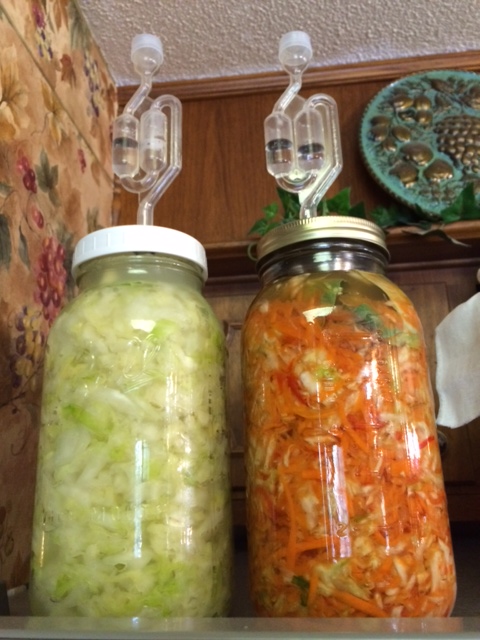
This weekend we went to the farmer’s market and got too much cabbage–on purpose. Cabbage is so easy to turn into great food. We turned ours into kimchi and sauerkraut. I have found a way to make individual jars of fermented foods using brewing airlocks and my regular mason jars. It’s is quite simple to do, I used rubber grommets from Lowe’s and put a 3/4 inch hole in the cap. These airlocks can be bought as an assembly but you will pay a serious premium for having someone else do it for you. It’s really easy to do it yourself.

Half Gallon Mason Jars

Half Gallon Mason Jars

Posted in Health, Living | Tagged , , , , , , | 3 Comments