Data Points

If you go to this website, http://beefretail.org/wholesalepriceupdate.aspx, you can see that one year ago beef was about 30 percent cheaper than it is this week. About a 25 to 30 percent increase in every cut of beef in one year. We can safely assume that this rapid spike in price is not due to the cost of raising those animals going up at a corresponding rate. There has been no increase in costly safety regulations, no huge die-offs due to disease, no huge spike in demand for beef. There is no good reason for this increase.

rising-beef-prices[1]

At the same time we read in today’s New York Times that according to a Federal Appeals court, even though the FDA has determined that using antibiotics on feedlot animals that are not sick is dangerous to human health, the FDA cannot be forced to prohibit the practice until it has been proven safe by producers. Here is news of the ruling.

According to the Times:

For years industrial meat and poultry producers have fed healthy animals antibiotics to fatten them up fast. The antibiotics also prevent disease in what are often overcrowded, unsanitary conditions. This practice breeds antibiotic-resistant bacteria that threaten us all.

Why would meat producers do this? To cut costs. If you are going to have 150 head of beef on an acre of ‘land’ (more than 150 if the ‘land’ is paved), then you have to medicate them to keep them from killing one another from disease. It also turns out that for some reason if you give them antibiotics they grow faster eating the grains and silage you are feeding them, even though this is not their natural diet. That means that instead of having them on the pasture for three or four years to get to market weight, an 18 month old will go to the feed lot for a maximum of six months. Longer than six months would kill the animal. While there, it will gain three or four pounds per day, eating a scientific diet of protein, grain, roughage and antibiotics. This is less ‘expensive’ than letting your herd eat the grass that nature provides.

And that lower cost is passed on to you. Right?

So, maybe beef is not cheap. You can still get steaks on sale for six or seven dollars per pound. Hamburger is sometimes down to three dollars per pound. So in exchange for not getting inexpensive beef, we are getting fed antibiotics in it. Plus, the huge concentrations of these animals are an environmental hazard due to the highly concentrated wastes. Also, their diet and living conditions are such that they are breeding dangerous new diseases that get into our food supply. Not only is there a beef or other meat recall every week, but sometimes their polluted poop finds its way into fresh vegetables and fruits, too. Remember the spinach recall? No spinach anywhere while the supply chain got the E-Coli cleaned up? Well it might not have been that particular pathogen, but it was a beef-feces related disease that caused that recall.

So the appeals court says that we can’t force the FDA to force the producers to even stop feeding antibiotics to animals that don’t need it. The Congress is busy removing all of the money from the FDA that it needs to enforce the laws that are already on the books. This Congress defunds the FDA, and the next Congress might pass laws that the one after that will then defund. Some Congressmen in office now believe that the government can’t do anything right, so they do everything in their power to cripple it and make sure that their opinion is proven by history. In the meantime, there are antibiotics and dangerous germs in our food supply.

Stop buying beef at the grocery store.

It’s really the only thing you can do. Keep eating it and they will keep finding ways to make it cheaper so that when they raise the price their profits go up. The states and the producers keep trying to make it harder and harder for us to find out what they are up to. They pass laws to make it a crime to photo or report on conditions in our food system.

What are they afraid of? They are afraid of your outrage. They are afraid that you care more about your kids’ health than you do about how cheap meat is. They rightly fear that you will quit eating their polluted products. GET OUTRAGED.

Posted in Health, Living | Tagged , , , | 2 Comments

Don’t Toucha De Mango!

CMART%20(1348x884)[1]

Or, do toucha-de-mango. I am a recent convert to mango-eater. We went to Hawaii and got a papaya and mangoes to bring to the room. Mangoes were much easier to eat without a full kitchen to prepare them in, if I recall correctly.

I read today all over the internets that eating mangoes: Prevents Cancer, Lowers Cholesterol, Cleans Your Complexion, Promotes Good Vision, Balances Body Alkalinity, helps diabetics Maintain Blood Sugar, Promotes Sexual Health, and your digestive system and Boosts the Immune System.

Do I believe all of that to be true? Well, fact is that I don’t care at all about health claims. As far as I am concerned, all I need to know is that it is a single-ingredient food. The only label on it tells people what it is, a small sticker says ‘mango’. The little number on the sticker is so the checkout girl will know what to put in the register. My mangoes have no ingredient label or nutrition information on them. They contain what mangoes contain, and eating them confers the same dietary blessings that mangoes have given us since they evolved into mangoes and we evolved into mango eaters. That was probably a very long time ago.

If you are the kind of person that would like to see a list of reasons you should eat a particular fruit, here is one of those.  15 reasons to eat mangoes. If you eat the mango flesh and all, then you get all of these benefits. If you just eat the juice of the mango, then you have defeated nature’s intention, and you will get more sugar and less nutrients than you need. The list of benefits then drop to just a couple, but I don’t know what ones make the cut. I haven’t read that list. I do know that if you drink fruit juice it is possible to get too much sugar, or at least much more sugar than if you were eating whole fruit. Myself, I peel the mango, losing something, I am sure, but what I eat is SO GOOD.

If you haven’t tried mango, here is how you eat it. It’s shaped like and egg, and you turn it pointy side away from you, but it’s also a little flattened, so you stand it on it’s ‘edge’. Cut down almost in the middle and cut off the right side, if you are right handed. If you hit the pit, move your knife a little more to the right. Flip the fruit around so the pointy side is toward you and cut off the opposite side. You can try to trim off the fruit that’s left around the pit, but the pit comes almost all the way to the skin…its easier to trim the skin off what’s left and then eat the flesh that is still stuck to the pit. There are millions of fibers that are tightly attached to the pit, and what you do is bite and suck the flesh off the pit. You won’t expose it, but you will get lots of great mango in each bite. The skin is bitter, so what I do with the pieces I cut away is cut it in ribbons, then run my knife blade near the skin to cut the flesh away. Eat it quickly or the kids or wife will steal it from you now that all the work is done.

Here is a video of how to do it.

Posted in Health, Living | Tagged , , , | 2 Comments

A Quiz!

A quiz for frequent readers of this blog.


What is this?

screen-shot-2012-04-16-at-7-18-02-pm[1]

A. An ad for a health food that has miraculous properties

B. An excerpt from an article in theonion.com magazine

C. A debunked health claim that one company agreed out of court to stop making.

The correct answer is “C”. However, if you go to the internet right now, and search for the health benefits of coconut water, you won’t get any of the truth on the subject, you will get the story that Dr Oz put out earlier, and all of it’s echoes on the internet. The internet is like a still pond, and when a nugget of ‘wisdom’ is tossed in, the ripples never subside. Any attempt to still the waters with truth cannot compete against all of the ripples and reflected ripples. The water is never again still.

Here is the news of the debunking of coconut water’s natural miracle qualities. New York Times.

Vita Coco, a leading brand, once boasted that it had 15 times the electrolytes — substances like sodium and potassium that are lost in sweat — in sports drinks. Then a 2011 class-action lawsuit contended that some of the mineral sums on its packages were exaggerated; as part of a settlement, Vita Coco agreed to stop saying that it rehydrated better than sports drinks. “We don’t try to compare ourselves to much of anything anymore,” said Arthur Gallego, the company’s publicist.

It is nice of them to quit making the claim. They don’t have to. We won’t find out that the claim is gone. Once it has been made, forever more the public will think of coconut water as a health food, better than water or sports drinks. No matter how loudly the truth is shouted now that it’s no better than water at rehydrating, there will be people who spend the extra for the miracle water found for thousands of years in the modest coconut.

Although I have never bought coconut water, if I ever did it would not be because it makes any claims to healthy properties or miraculous results on the label. Health claims on a label are reasons why I do NOT purchase a food. More generally, I don’t purchase foods in boxes, bags or bottles. I have, in the past purchased whole, real coconuts. I broke them open with a meat cleaver, harvested the meat and made coconut oil from it. Pain in the butt, can’t recommend it at all. It’s way easier to get virgin coconut oil already extracted for me. I guess that violates my self-imposed prohibition on buying in bottles, but there you go. Virgin coconut oil is a healthy oil, and I recommend it. If you make your own, you have my respect.

When I busted open my coconuts, I threw the water away.

Posted in Health, Living | Tagged , , , , , | Leave a comment

Still Here? Consider This.

nih-logo[1]

If you are still a reader of these pages, then you are likely a person who is trying to change, for the better. If you are looking for ways to eat healthier then you want useful information about doing so. If you are struggling against your bad habits, and striving to build new good habits then you want encouragement when you succeed and forgiveness when you do not. Lots of you, I think, are trying to decide which of the choices out there, considering things to eat, are worthy of the extra time and effort that you are expending to get them.

Is it worth it to make a special trip to the health foods store to get GMO free, organic, all-natural foods, or will the difference between them and the mostly natural foods in the local grocer’s vegetable section be enough to justify the effort?

Are the supplements that I am getting at the health food store really what I need? By that, I mean are they really what they say they are, and do they interact with one another in mysterious ways, perhaps cancelling one another out, or over-dosing me where they contribute to one another?

One place you can go for scientific advice on topics like these is your National Institute of Health website. They have a section dedicated to nutrition and dietary supplements. If you drill down into their site, they also have a browser-based app where you can trace your supplement usage.

The majority of adults in the United States take one or more dietary supplements either every day or occasionally. Today’s dietary supplements include vitamins, minerals, herbals and botanicals, amino acids, enzymes, and many other products. Dietary supplements come in a variety of forms: traditional tablets, capsules, and powders, as well as drinks and energy bars. Popular supplements include vitamins D and E; minerals like calcium and iron; herbs such as echinacea and garlic; and specialty products like glucosamine, probiotics, and fish oils.

If you count as ‘dietary supplement’ the added vitamins in milk, breakfast cereals, bread, and thousands of other processed foods in the grocery, you could safely say ‘the vast majority of adults’ are taking supplements. I read recently that most processed vitamins added into your foods are next to worthless at giving you the same effects as their true form as found in natural sources would give you, but all the same, we are most of us taking supplements.

If you only consider the more exotic things, like St John’s Wort, tropical plants, prebiotics and probiotics and oils of exotic plants and animals, then there are not as many people supplementing their diets with them, but the data on the quality, efficiency and interactions of these things with the other foods you eat is also not readily available. For that information, you must keep looking all of the time online. If you wait for ‘all the data’ to come in, you may never start taking supplements. Sometimes your faith in the practitioner who introduces you to a supplement is worth more to you than the supplement itself. Like I said earlier, the magic in the magic feather was inside Dumbo all along. My faith in science may be less powerful than your faith in prayer, so to speak.

However, it never hurts to watch the news, which is what makes the NIH site valuable to us. As a free resource the news there is not sensational, and they aren’t selling anything, which makes their advice right up there with Dr Oz’s advice, right?

Posted in Health, Living | 2 Comments

It’s Really Just That Easy

When I started looking around for how to make all of my foods myself, one of the earliest finds was mayonnaise. Mayonnaise looks like a really special kind of sauce. A little sour, completely opaque, I could not imagine the top secret process that must have been required to create it in the Hellman’s hidden laboratories. I think I accidentally came across a YouTube video of it when I found YouTube a few years ago. It’s crazy how easy it is to make mayo. It’s where the idea for my Facebook Group came from, actually.

Here is the actual video I found on YouTube.

Finding out how to make mayonnaise led me to other crazy-easy things. Ranch dressing is just mayo and buttermilk and spices. Makes me laugh every time I see ‘Buttermilk Ranch’ on a lable. There is no other kind. Russian dressing is just mayo and ketchup. Only. Matter of fact, one of the very best salad dressings is just a tablespoon of mayo all by itself, if the mayo is the one I made at home. There is no way to make mayo low-fat. If you see a low-fat mayo I will tell you what you are looking at. It is a product that uses an oil that is inedible. Watch the video and you will see why I say that. Mayo is an emulsion of oil and egg. Just two ingredients, and you can’t cut down on the oil and come up with the same amount of emulsion. Don’t by low-fat mayo, it really does come out of a secret lab somewhere.

Today in the New York Times Magazine, Mark Bittman has compiled seven easy to make sauces. Probably every one of these recipes also has a corresponding YouTube video of how to do it. They all are so easy to make. None of the ingredients will be robbed of their nutritional value by having been dissassembled where they are grown, broken into their component parts, dehydrated, shipped around the world, rehydrated and reassembled at a food factory where they are bottled and labled ‘natural ingredients’. You will use real food. You will use minimal processing. The nutrient loss will be minor. In exchange, your product will taste better and be better for you and your family. Unfortunately, (?) your product will not last for several years on the shelf, or six months in the fridge without spoiling. Come to think of it, is that a disadvantage?

Here is Bittman’s article.

A rare Sunday blog post, but so useful my normal Sunday routine had to suffer. Enjoy your day. Go Chiefs!

Posted in Health, Living | Tagged , , , , , , , , , , , , , , , , | Leave a comment

If It Works For You, It Works

I know several people who are beginning the quest for their natural health. Some of them are limiting their carbohydrates, some of them are trying to eat healthier oils. There are many paths to your future if you are just beginning to make small changes in your life. My path involved changing the way I shop and the things I drink at first. Your path may involve that and taking a fish oil pill every morning.

You may or may not have a companion on your journey. I did, but the journey that my companion took started years before mine did. She led me to this new leg of my journey by getting on the right track and I saw with my own eyes that change was possible, even if it was all alone. First she quit smoking. I tried that several years later and found out I could do it. Then she quit drinking. Without any help from me, she showed me that not drinking didn’t change anything that I loved about her, so after thinking about it for a very long time, I quit drinking too. She quit eating bread and flour products a couple of years ago, and I am not quite ready to do that yet, but I can see that in my future if the small changes I am making in my life right now don’t give me all that I am hoping they will.

The changes that I made were not me bravely doing what I needed to do. In my case, I was lucky that I had someone brave like that in my life. I could watch how it worked, see if it was easy or hard, learn how to break a habit by watching another person break a habit. Now, I know that I can break bad habits and make new ones.

If you don’t know that about yourself yet, there are lots of places out there offering you free advice. This is one of those places! My advice is truly free, since I am not selling you a pill that will magically help you, provided that you do all of the other things that I am advising you to do. Don’t get me wrong, there is nothing wrong with taking a pill. A fish oil pill every morning is not bad for you. If it doesn’t actually do the chemical thing you are buying it for, that is not relevant at all. If it allows you to think that changing your life is possible, then take that pill. There are people (me, for instance) that don’t believe in the power of prayer–for me. Prayer may have power for you, though. If prayer keeps you trying to make the small changes, then you need prayer.

dumbo-and-timothy-mouse-the-magic-feather-detail-_i-G-49-4943-CUHHG00Z[1]

Dumbo, the cartoon elephant, needed a magic feather that would allow him to fly. As adults watching the cartoon, we all knew, way before Dumbo realized it, that he didn’t really need the feather. The feather gave him confidence to keep jumping off the platform. All along he had what he needed to make those jumps. I think that you have that, too. I think that if you make enough small changes in your life that you will realize that you don’t really need to pray, or take a pill, or watch someone important in your life do it first. But, for now, maybe you do need one or more of those things.

My little part is to give you daily doses of free advice. I will keep going and finding little things for you to watch out for, things that don’t work for everybody, ways that companies are trying to sneak the things back into your life that you are trying to quit, places where you can be encouraged to not fall off of the track you are on, the right track. We can do it, some of us alone, some of us together, with or without our magic feathers. The placebo effect is a real effect. It turns on something inside of you that has powers that science hasn’t yet nailed down. The results don’t really come from the pill all of the time. Sometimes, the results come straight from you.

Posted in Health, Living | Tagged , , , , , , | 2 Comments

The Oil You Can’t Eat

almondtreeblooms-1024x768[1]

Beautiful Almond Flower

I love almonds, and I love almond milk. A three pound bag of raw almonds from Costco costs me about twelve dollars I think, maybe a little bit more. Out of a bag of almonds I will make gallons of home made almond milk, roast several batches of almonds in the oven for my own chopped nut mixes to put in my muesli that I eat for breakfast.

Ninety percent of all of the almonds grown for the whole world are grown in California. They will grow anywhere that has a mild spring, because a late cold snap will kill the blossoms and your chances of an almond harvest for the year. In fact, almonds are grown around the world, but most of the world’s almonds are produced here. You can’t beat the convenience of opening a bag of almonds that are already hulled, ready for you to blanch, roast or milk, not to mention inexpensive.

Here is the thing about the inexpensive part, though. Those almonds cost way more to the world and to the future than I pay for them. A couple of days ago I talked at length about the difference between price and cost. Almonds are a great example of the external costs that are not reflected at all in the price. Almond groves are a major factor in the death spiral of the European honeybee in the world. Watch this documentary today and you won’t wonder at all why the bees are dying.t Almond groves account for a major part of the irrigation demand, which is provided from depleted California rivers and reservoirs, and competes with people and real foods for that valuable water.

At least the almonds are grown in the US. I live in Missouri and the distance to the almond groves is only about 1700 miles. Getting them to me doesn’t expend all that much energy. However, of the approximately one billion pounds of almonds harvested annually in California, eighty percent of them are bound for the rest of the world. Japan is the largest consumer of California almonds. Japan is 5600 miles from the coast of California. Getting the almonds from here to there every year takes a great quantity of oil to power the freight ships that carry it. It is oil that powers those ships, and it powers the ships that bring salmon from South America to the US. Salmon also grow wild on our Northwest coast. Fishing for them produces salmon for the market, but it is high priced. Farmed salmon, from fish farms all over the world are much lower in price, but getting it here costs the world oil in the freighters used to move them. It is almost 6000 miles to San Francisco from Chile where about one third of all farmed salmon are from. The only reason they are grown so far away is based on money. Wages in Chile are low, regulations on agriculture are more lax. The savings on those things outweigh the price of the oil to get them to us. Farmed salmon prices are far lower than caught salmon prices.

Salmon_farms_in_Chile_node_full_image_2[1]

Farmed Salmon in Chile

The true cost of all of these foods that are produced at far away places on the planet and shipped huge distances by freighter ought to be measured in oil. By now we all should be aware that there is a finite supply of oil in the Earth. Someday, sooner rather than later, oil will be more scarce, priced to match it’s true value to the planet. When the oil is gone, we will wish we had eaten foods closer to home, instead of taking advantage of the current fact that oil is not priced according to it’s real value to human life. We are mining oil at such a rate that it’s price is very low compared to it’s true worth. We use it for everything–putting our crop on the field, taking our crop off the field, producing the fertilizers needed to boost ourcrop yield per acre, getting our crop to market, getting our crop home from market. We will need oil someday and all of the oil we wasted because there are low wages in China and no environmental regulations in Chile will come back to haunt us. The price of everything ought to be tied to the true value of the raw materials we use to get it to us. In a perfect world, we would only move things around the world on freight ships that are only found where they are, because that is where nature put them, like oil, for instance.

US almonds are the most popular to the world because the US subsidizes their marketing around the world. Our almonds are cheaper than home grown almonds because the US taxpayer makes them cheaper. Our milk products are cheaper than home-grown milk in Jamaica for instance, as you can see in this documentary. The dairy farms in Jamaica were forced out of business because they can’t compete with dairy from Wisconsin. Dried milk, freighted around the world is cheaper than local cows, milked by hand, and the milk carried on bicycles to the bottler. Here the cost versus price difference is starkly visible.

Low prices will be our undoing. The market is not pricing things according to their true value to the future of mankind. California almonds should reflect the cost in lost bees and water. Wisconsin milk should reflect the cost in absolutely essential oil, oil that once burned cannot ever be replaced.

I don’t have a prescription for change that avoids the fate awaiting us all. This system will continue until the obvious endpoint is upon us, at which time it will be too late to conserve. All I can do is my tiny little part. I will eat local foods, in season. I will store foods that are bountiful to carry me through the months when it is not in season. I will eat real food, not from a box, bag or bottle. I can’t stop salmon farming, but I can cease adding my approval through my purchases. Living right will cost me more, but it’s right. That’s worth something.

Posted in Health, Living | Tagged , , , , | Leave a comment

NOTHING ARTIFICIAL!

kashi[1]

I added the exclamation point. The words are on the box above, “Nothing Artificial.” Do you wonder if that is true? I’ll just point out that these are unnaturally doughnut shaped foods, found in a box, labelled with health-claims galore. Next I will point out that Kashi is now a small food group found under the umbrella corporation Kellogg. Ages ago, Kashi was an upstart company that produced natural foods. Kellogg bought the name and the idea that the food was all natural, no artificial ingredients.

A couple of months ago, Kellogg and Kashi were in the news:

The Kellogg Company, maker of some of the country’s most familiar breakfast cereals, said on Thursday that it had agreed to drop the terms “all natural” and “nothing artificial” from some products in its Kashi line as part of a settlement agreement ending a class-action lawsuit.

Also worth note in the article:

[Kellogg] has paid to have some Kashi products certified by the Non-G.M.O. ProjectLivia M. Kiser, a lawyer who is co-head of a task force on marketing compliance at the law firm Loeb & Loeb, said in an email that she expected lawsuits like the one Kellogg was settling to continue. “Historically, companies have primarily focused on making their labels compliant with applicable government regulations,” Ms. Kiser wrote. “Now, however, companies should expand their considerations to include risk and threat analysis around the descriptors and adjectives they are using to distinguish their products.” Among the Kashi products listed in the original lawsuit were some of its cereal and granola bars, waffles and shakes, and some GoLean items. Kellogg would not disclose which items would lose the “all natural” or “nothing artificial” terms.

I quickly point out, that this change in Kellogg labeling policy for their ‘all natural’ line of foods was not brought about by government regulators clamping down on fraudulent labeling, but by private watchdog groups in California. The government claims to be not particularly interested in what items of foods bear the words ‘no artificial ingredients’ if the ingredients concerned occur in nature (just not in the natural versions of the foods under consideration.) In this specific case, a few of the ‘natural ingredients’ were, pyridoxine hydrochloride, calcium pantothenate and soy oil processed using hexane, a component of gasoline. “Such ingredients occur naturally — wheat germ and flaxseed are sources of pyridoxine hydrochloride, for example — but food companies, as well as makers of vitamins, often use synthetic versions to control costs and ensure consistent supplies.” Kellogg paid the plaintiffs in this case 50 Million Dollars, and decided to change their labeling.

They changed the label. The ingredients remain in the food. Kashi is now in your brain as a health food, and Kellogg feels free to change what is in it, and how it is made as long as they don’t mislead you with a claim on the box that can be proven false. To be fair, they ought to label it “Contains Artificial Ingredients” in the same font and place as the old false claims. That’s not part of the settlement. They count on you buying this boxed, processed, health claim labelled food because you recall that it contained no artificial ingredients. It was all natural at one time. You know that a company would not take a health food, found in health food stores and modify it to be a less natural version without warning you. The government wouldn’t allow that kind of bait and switch, right?

Want to know why I don’t buy processed foods that come in boxes, bags or bottles, no matter what the label says?

Posted in Health, Living | Tagged , , , , , , | Leave a comment

It’s Alive!

10479905_875265639168418_5566389703439773910_o[1]

Did you ever wonder how people had food to eat before there was refrigeration and modern food preservation techniques? Once all the leaves are off of the trees and all of the food has been harvested in the garden, there are three or four months there that must have been pretty frightening. Families were pretty big and kids have got to eat.

One method that people have used successfully to prepare for the hungry months of winter has been to store away some of the bounty of summer in jars. Most people my age can remember grandmothers, or maybe mothers too that would spend a couple of weeks in the summer and fall loading up mason jars and pressure canning them or bath canning them. My own experience was that there were a few aunts that did this, and my grandmother. I remember grandma sealing her jars with wax, but modern jars have two part lids, and you reuse the lid rings and the sealing lid is disposable.

There is another way to store vegetables, though, if you have somewhere cool to store them, like a cool basement or root cellar. You can ferment your vegetables. Fermented vegetables use a culture of beneficial bacteria to consume the sugars in the foods that would promote rot and convert them into a weak acid that discourages dangerous pathogens from taking hold in the foods. We have all formed a healthy aversion to leaving food out, because it spoils. Leaving it out on purpose, to ferment, takes a little bit of faith in the experience of our forebears, but it really does work.

sauerkraut[1]

The easiest and best thing to start with is cabbage. Cabbage carries on it the very bacteria that you want to inoculate your ferment with. If you get a fresh head of green cabbage all you have to do is cut it to ribbons, massage some kosher salt into it, wait for the liquid to seep out of the cabbage into the salt, then bottle the finished product. If you keep the cabbage below the liquid level, and cover the jar so that no bugs can get into it, in a week you will have a quart of fresh sauerkraut for every head of cabbage.

You might think you don’t like sauerkraut, but I guarantee that if you use fresh cabbage, and follow this recipe to prepare it, you will be a kraut lover like I am. I always liked sauerkraut, but I never knew that you were supposed to drain it and rinse it before you cook it. Makes a big difference. Try cooking your kraut with this recipe. You can thank me later.

Pickled-beets[1]

Once you get kraut making down, you use exactly the same method to prepare fermented beets. You can’t believe how different beets are when they are fermented than they are when they are canned.

spicy-carrots-brine[1]

From there you know enough about fermenting that you can be confident as you ferment your peppers, beans, carrots, just about any food you can put in a jar, you can ferment. Just keep your finished products in a cool dark place. If you want to store them long term, you can always go ahead and can them in a hot canner, so that they will keep for years. Be aware, that the heat will kill the bacteria. Some people enjoy knowing that they are adding good guys to their bowels when they eat fermented foods. You might have to cook your ferments if you have a very large amount of vegetables to store, but if you are like me, you won’t have to worry about these foods lasting through even the winter.

Posted in Health, Living | Tagged , , , , , , | 1 Comment

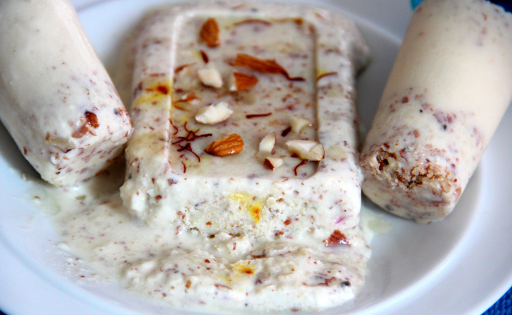
Kesar badam honey kulfi (Ice cream)

Here is something for me to try, instead of more ‘traditional’ american desserts.

Chitra Jagadish's avatarChitra's Healthy Kitchen

Almond Honey Kulfi

About:

It is a frozen Indian desert. It is often described as “traditional indian subcontinet ice cream”. Made from full cream milk thickened with Koya and badam (Almond).
As a healthy option have replaced full cream with low fat Milk and Milk powder. Honey is used in place of Sugar.

Yields: 4-6 kulfis
Preparation time: 10mins
Cooking time: 35-40mins

View original post 222 more words

Posted in Uncategorized | 1 Comment